1 listing
Filters
| Product | /oz | Premium | Price | |
|---|---|---|---|---|

 Metal Market Europe
|
$4,355.42 | +4.31% |
$350.06
€305
|
View Deal |
Prices are fetched automatically and may not reflect current merchant prices. Currency conversions and tax treatment are approximate. Rankings are based solely on price. We are not a dealer and accept no responsibility for transactions with listed merchants. Past performance is not indicative of future results. This site does not provide investment advice. Full disclaimer
About the 2.5g Heimerle + Meule Gold Bar
The 2.5g Heimerle + Meule Gold Bar
The 2.5g Heimerle + Meule gold bar contains 2.5 grams (0.0803 troy oz) of 999.9 fine gold. At roughly one-twelfth of a troy ounce, 2.5g is the most common fractional gold bar denomination, sitting at the intersection of small enough to be affordable and large enough to be worth trading. At 2026 gold prices a bar of this size is worth around $265, one of the most accessible entry points into physical gold bars.
The weight is a particularly natural fit in German-speaking Europe, where 2.5g is the dominant fractional gold bar denomination and metric weights are standard. It is also a common gifting size in the Middle East and India, and popular in metric-bar markets such as Singapore, Hong Kong, and Japan. In the US and Canada, buyers at this price point more often reach for 1/10 oz coins instead.
The honest economics: fractional bars carry a premium penalty, roughly 8 to 15 percent over spot at this size, around 10 percent more per gram than a 1 oz gold bar. Compared with going even smaller, though, 2.5g is markedly more efficient than 1g bars at 15 to 30 percent over spot. For gifting, gradual accumulation on a fixed budget, or holding gold in highly divisible units, the format earns its premium; for bulk accumulation it does not.
2.5g Gold Bar Specifications
The bar is struck to the standard retail purity of 999.9 fine gold (four nines).
| Attribute | Detail |
|---|---|
| Weight | 2.5 g (0.0803 troy oz) |
| Purity | 999.9 fine gold |
| Form | Minted bar |
| Face value | None (bars are not legal tender) |
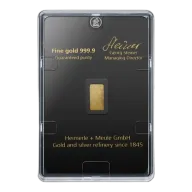
Bars at this weight are sold sealed in assay cards: credit-card sized tamper-evident packaging carrying the refiner's mark, a serial number, and the weight and purity certification. The card is integral to the product. Sealed assay-carded bars from major refiners are easily sold to bullion dealers worldwide and typically buy back at or slightly below spot, while a bar with a broken seal may need re-assaying and loses resale appeal. Storage is trivial; a dozen 2.5g bars in their cards take up less space than a deck of cards, which is why the format is popular as portable wealth. One practical caution comes from the low absolute value: shipping and insurance costs are proportionally high when selling a single bar, so small bars are best sold in quantity or in person.
Tax Treatment of 2.5g Gold Bars by Country
At 999.9 fineness this bar qualifies as investment gold in every major jurisdiction, which keeps purchase taxes at zero across most of the markets where the weight is popular.
- United Kingdom: VAT-exempt as investment gold (995+ purity). Bars carry CGT liability on disposal, unlike UK legal tender coins, though gains only become taxable above the £3,000 annual allowance, a threshold a single 2.5g bar is unlikely to trouble.
- European Union: 0 percent VAT on investment gold bars at 995+ purity in all member states. In Germany, the core market for this denomination, gains on bars held longer than twelve months are tax-free.
- United States: Most states exempt bullion from sales tax, though a few apply thresholds (California exempts only above $2,000, Florida above $500) that a single small bar will not meet. Long-term gains are taxed at the 28 percent collectibles rate. Gold from LBMA-accredited refiners at this purity can be IRA-eligible.
- Canada: GST/HST exempt at 99.5%+ purity.
- Australia and New Zealand: GST-free as investment-grade gold (99.5%+ purity).
- Singapore and Hong Kong: GST-exempt under Singapore's IPM scheme; Hong Kong has no sales tax, no import duty, and no CGT.
2.5g Bar vs 1/10 oz Coins and Swiss-Brand Bars
The nearest cross-format rival is the 1/10 oz gold coin. The two are not the same size: 2.5g equals 0.0803 oz while 1/10 oz is 3.11g, so the coin contains 24 percent more gold and costs correspondingly more. The 2.5g bar is the cheaper, more common choice in European metric markets; the 1/10 oz coin is the standard in troy-ounce markets like the US and UK.
Within the 2.5g bar market itself, the established names are the PAMP Suisse Fortuna, the single most recognisable small gold bar with the strongest fractional secondary market and the highest premiums to match; Valcambi, the lower-premium Swiss option; Argor-Heraeus, offered in classic and holographic Kinebar versions; Perth Mint in CertiCard packaging; and the Istanbul Gold Refinery bars popular in Turkish and Middle Eastern markets. Since every option delivers the same 2.5g of 999.9 gold, the choice is between paying for brand recognition that helps at resale and minimising the buy price.
One alternative worth knowing: the Valcambi CombiBar, a 50g or 100g bar perforated into 2.5g segments that snap off individually. It combines bulk-bar pricing with small-denomination divisibility, a better fit than individual 2.5g bars for anyone planning to accumulate many of them.
2.5g Heimerle + Meule Gold Bar: frequently asked questions
-
The cheapest listing we track is $350.06, sitting around 4.3% over the $4,176.20 gold spot price. Prices update throughout the day as dealers adjust their quotes, so check back if you are comparing across multiple sellers.
-
Yes. Small bars such as the 2.5g carry a higher premium per gram than larger formats like 1 oz or 100g bars. The minting, assay certification, and packaging costs are roughly fixed regardless of size, so those costs are spread across less metal. Buyers who prioritise value per gram typically look at larger bar sizes.
-
A 2.5g gold bar is very small, roughly the size of a thumbnail. The bar is suitable for gifting or for starting a collection rather than bulk accumulation, and it is usually packaged in a protective card or sleeve to aid handling and authentication.