1 listing
Filters

 APMEX
APMEX
Prices are fetched automatically and may not reflect current merchant prices. Currency conversions and tax treatment are approximate. Rankings are based solely on price. We are not a dealer and accept no responsibility for transactions with listed merchants. Past performance is not indicative of future results. This site does not provide investment advice. Full disclaimer
About the 500g Engelhard Gold Bar
A Half-Kilo Bar from a Historic American Refiner
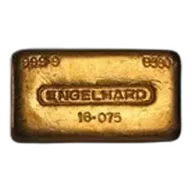
The 500g Engelhard gold bar is a product of one of the most significant precious metals refiners in American history. Charles W. Engelhard Sr. founded the company in 1902 in Newark, New Jersey, and by the 1950s it had become the world's largest precious metals smelter. The company's refining operations were acquired by BASF in 2006, and the Engelhard name was retired. No new Engelhard bars are being produced, which means every 500g Engelhard gold bar on the market is a secondary market piece with provenance dating to the company's operational years.
At 500 grams (16.075 troy ounces) of 999.9 fine gold, this is a substantial bar that sits at the half-kilo point where premiums over spot are significantly compressed compared to smaller sizes. The 500g weight is a metric standard more commonly encountered in European markets than in the US, where Engelhard primarily operated. The company did produce bars in both metric and troy-ounce denominations to serve global demand.
Engelhard gold bars were LBMA-accredited during the company's operational period. For resale purposes, this accreditation history means the bars are recognised and accepted by major dealers internationally, though buyers should expect that any secondary-market Engelhard bar may require verification or assay before a dealer offers full buyback value. Sealed, authenticated examples in good condition trade most readily.
The collector premium on Engelhard bars varies by size, era, and condition. The silver bars are the most actively collected Engelhard products, with detailed cataloguing of dozens of varieties. Engelhard gold bars also carry premiums above generic equivalents, though the collector market is less intensively documented than the silver side. For a buyer focused purely on gold content at the best price per gram, a current-production bar from an active LBMA refiner like Valcambi or Heraeus will typically cost less. The Engelhard bar appeals to buyers who value the historical provenance alongside the metal content.
500g Engelhard Gold Bar Specifications
| Property | Detail |
|---|---|
| Weight | 500 grams (16.075 troy oz) |
| Purity | 999.9 fine gold (24 carat) |
| Manufacturer | Engelhard Corporation |
| Country of origin | United States (Newark, New Jersey) |
| LBMA accredited | Yes (during operational period; company acquired by BASF in 2006) |
| Production status | Discontinued (secondary market only) |
| Serial number | Yes |
| Face value | None (not legal tender) |
Engelhard produced bars in cast and minted forms across its operational history. The 500g size was produced as a cast bar, consistent with industry practice for bars at this weight. Each bar carries the Engelhard hallmark, weight and purity markings, and a unique serial number. The serial number is the primary authentication marker for Engelhard products, as the company's bars went through multiple design periods with varying stamps and logos.
Because Engelhard ceased production, no standardised packaging equivalent to modern assay cards exists for most examples. Bars circulating on the secondary market may be loose or in third-party packaging. Authentication typically involves verifying the serial number format, font consistency, and weight against known Engelhard specifications for the production era.
Tax Treatment of the 500g Engelhard Gold Bar
The Engelhard bar's discontinued status does not affect its tax treatment. As a 999.9 fine gold bar, it qualifies for the same investment gold exemptions as any current-production bar.
United Kingdom
The bar is VAT-exempt as investment gold (995+ fineness). It is subject to CGT on disposal, as bars carry no legal tender status. Any collector premium above the gold value is included in the taxable gain. The bar qualifies for SIPP and SSAS pension eligibility at 999.9 purity.
United States
State sales tax treatment varies. Engelhard bars at 999.9 purity meet the IRS Section 408(m) requirement of 99.5% for IRA eligibility, though custodian acceptance of secondary-market bars may vary. Capital gains are taxed at the collectibles rate of up to 28% for long-term holdings. Any collector premium above bullion value is part of the taxable gain at disposal.
European Union
VAT-exempt across the EU under the Investment Gold Directive for bars at 995+ fineness. The discontinued status and potential collector premium do not affect the VAT exemption, which is based on metal content and purity.
Canada, Australia, and Asia-Pacific
GST/HST-exempt in Canada for gold at 99.5%+. GST-exempt in Australia and New Zealand as investment-grade gold. Exempt under Singapore's IPM scheme. Hong Kong applies no sales tax or CGT. In all these jurisdictions, the bar's discontinued status is irrelevant to its tax classification.
Engelhard vs Other 500g Gold Bars
The key distinction between the 500g Engelhard and competing bars is that Engelhard is a discontinued brand. Every other major 500g gold bar on the market, from Valcambi to Heraeus to PAMP Suisse, is in current production from an active LBMA refiner. This means those bars come with sealed assay card packaging, current certification, and straightforward authentication. The Engelhard bar, by contrast, is a secondary market product that may require verification before sale.
For buyers focused on maximising gold per dollar, current-production bars from Valcambi, Metalor, or Umicore will offer lower total cost because they trade at standard investment premiums without the collector markup that Engelhard bars sometimes carry. The wider dealer availability of these bars also means better price discovery.
The Engelhard bar's appeal is its provenance. This is a bar from one of the most important refineries in American precious metals history, a company that processed gold for the US Treasury and operated as the world's largest precious metals smelter. For buyers who appreciate that history alongside the metal content, the Engelhard 500g bar is a piece of industrial heritage that also happens to contain half a kilogram of fine gold.
The closest historical parallel is the 500g Johnson Matthey bar. Johnson Matthey, the British refiner, sold its bullion operations to Asahi in 2015. Both brands are discontinued, both were LBMA-accredited during their operational periods, and both carry secondary-market premiums for provenance. Johnson Matthey bars are somewhat more common in UK and European markets, while Engelhard bars have a stronger collector following in the United States.
500g Engelhard Gold Bar: frequently asked questions
-
Our sources do not contain a verified date for when Engelhard ceased gold bar production. What is documented is that Engelhard-branded bullion bars are no longer being manufactured, making any bar on the market today a secondary-market item rather than new stock from the producer.
-
Engelhard bars trade only on the secondary market. Bars in original packaging with readable serial numbers are generally accepted by dealers at or near spot, and some buyers pay a small additional amount for the Engelhard name. Condition and provenance matter; damaged or repackaged bars typically trade closer to melt value.