1 listing
Filters
| Product | /oz | Premium | Price | |
|---|---|---|---|---|

 Guardian Gold
Out of Stock
Guardian Gold
Out of Stock
|
$4,243.45 | +1.60% |
$68,217.23
A$97,257
|
View Deal |
Prices are fetched automatically and may not reflect current merchant prices. Currency conversions and tax treatment are approximate. Rankings are based solely on price. We are not a dealer and accept no responsibility for transactions with listed merchants. Past performance is not indicative of future results. This site does not provide investment advice. Full disclaimer
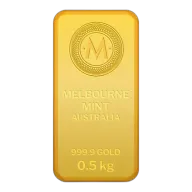
About the 500g Melbourne Mint Gold Bar
The 500g Melbourne Mint Gold Bar
A 500 gram gold bar holds half a kilogram of gold, equal to 16.075 troy ounces, which makes it one of the largest bars commonly traded at retail. At 2026 gold prices that is a position in the region of $53,000 or more in a single piece, so this weight sits firmly in the territory of serious investors, wealth managers, and buyers consolidating an existing holding into fewer, cheaper-per-gram units.
The case for the half-kilo format is premium compression. Gold bar premiums fall steeply as weight rises, and 500g bars typically trade around 1.5-3% over spot, below 1 oz and 100g bars and only slightly above full kilo bars. The step from 100g to 500g roughly halves the percentage premium. Against the 1 kilo gold bar, the 500g bar concedes a small premium penalty in exchange for better divisibility: holding two half-kilo bars instead of one kilo bar lets you sell half the position without breaking up a single large bar.
The format is most at home in metric markets. German-speaking Europe has a strong tradition of metric gold bar investment, and 500g bars are widely stocked by European dealers. In Australia the weight is produced locally, though kilo bars are more popular; in the US, troy-ounce sizes dominate and metric bars are less commonly traded.
Tax Treatment of a 500g Gold Bar
Gold bars of investment grade are tax-favoured at purchase in most of the markets this site covers, but the large transaction size of a half-kilo bar makes the disposal-side rules worth understanding.
- United Kingdom: Investment gold of at least 995 fineness is VAT-free, so there is no purchase tax. Bars are not legal tender, however, so gains are subject to CGT above the £3,000 annual allowance, at 18% or 24% depending on income. On a bar this size the potential gain is substantial, which is the main argument UK buyers weigh against CGT-exempt coins such as Britannias.
- United States: No federal sales tax, and most states exempt bullion; threshold states such as California ($2,000) are comfortably cleared by a purchase of this size. Long-term gains are taxed at the collectibles rate, capped at 28%.
- Australia: GST-free as investment-grade gold of at least 99.5% purity in tradeable form. CGT applies on disposal, with a 50% discount for individuals after a 12-month holding period.
- Canada and New Zealand: Exempt from GST/HST and GST respectively at 99.5%+ purity.
- EU: 0% VAT on investment gold bars of at least 995 fineness across all member states; CGT varies by country, with Germany taxing nothing after a one-year hold.
- Singapore and Hong Kong: No purchase tax on qualifying investment gold and no CGT.
500g Bars vs the Sizes Either Side
The natural comparisons are up and down the weight ladder. Against the kilo bar, the 500g format trades a slightly higher percentage premium for divisibility and a lower capital outlay per bar; the kilo carries the lowest retail premium of any common bar but must be sold whole. Against 100g gold bars, the half-kilo bar buys gold meaningfully cheaper per gram, at the cost of concentrating more value in one piece and narrowing the pool of potential resale buyers.
Form is the other axis. Bars at this size exist purely for premium efficiency; coins of equivalent total weight would cost more but spread the position across sixteen highly liquid 1 oz pieces that can be sold individually anywhere. For UK buyers the coin route also brings CGT exemption on legal tender issues, which a bar cannot match.
Buyers at this weight should also weigh authentication. Gold-plated tungsten is the classic counterfeiting threat for larger bars because tungsten's density (19.25 g/cm3) is close to gold's (19.32), and surface tests like XRF only read the outer microns. Ultrasonic testing is the reliable non-destructive check at this size, and buying from authorised dealers with serialised, certificated bars is the practical safeguard. Bars from LBMA-accredited refiners carry the strongest international recognition at resale; bars from outside that circle may need assay testing before a dealer will buy them.