 BGASC
BGASC
1 listing
Filters
| Product | /oz | Premium | Price | |
|---|---|---|---|---|
| $4,518.98 | +7.67% | $7,266.51 | View Deal |

Prices are fetched automatically and may not reflect current merchant prices. Currency conversions and tax treatment are approximate. Rankings are based solely on price. We are not a dealer and accept no responsibility for transactions with listed merchants. Past performance is not indicative of future results. This site does not provide investment advice. Full disclaimer
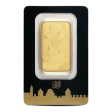
About the 50g Holy Land Mint Gold Bar
The 50g Holy Land Mint Gold Bar
The 50g Holy Land Mint gold bar sits at a notable point on the gold bar weight curve. At 50 grams (1.6075 troy oz) it is a mid-range metric bar, roughly one and a half ounces of gold in a single piece, and it occupies what multiple dealers describe as the sweet spot of the metric range: meaningfully lower per-gram premiums than 10g bars, but far more accessible than 100g or kilo formats.
The economics are the main reason to buy at this weight. Typical 50g bar premiums of 3-6% over spot represent a sharp drop from the 8-12% common on 10g bars, because this is the inflection point where fixed manufacturing costs become a small fraction of the metal value. Compared with a 1 oz bar at a similar 3-5% premium, the 50g bar delivers 1.6 times the gold at comparable efficiency, and the further saving from stepping up to 100g is only around 1-2 percentage points. At current gold prices the purchase runs roughly $5,000-$5,500, a substantial but not extreme outlay that several dealers consider suitable for first-time bar buyers seeking low premiums.
Physically the format is compact: a 50g gold bar measures approximately 44 x 24 x 3.5 mm, fitting easily in a small safe or deposit box, with any assay card packaging adding roughly credit-card dimensions. The weight is a natural metric denomination, widely stocked in Europe and a traditional savings size in Middle Eastern gold markets, though less standard in the US where troy-ounce gold bars dominate.
Tax Treatment of a 50g Gold Bar
Gold bars are not legal tender, so their tax treatment follows the investment gold rules rather than any coin-specific exemptions.
- United Kingdom: Investment gold bars of 995+ fineness are VAT-exempt on purchase, but bars carry no CGT exemption; only UK legal tender coins do. Gains above the £3,000 annual allowance are taxed at 18-24% depending on income.
- United States: No federal sales tax; around 35 states exempt bullion, some with thresholds (California over $2,000, Florida over $500, New York over $1,000), all cleared by a 50g gold bar's price. Long-term gains are taxed at the collectibles rate of up to 28%. IRA eligibility requires 99.5%+ purity from an accredited refiner with storage at an approved depository.
- European Union: Investment gold bars at 995+ purity are VAT-exempt across all member states under Directive 98/80/EC. In Germany, gains are tax-free after a 12-month holding period.
- Canada and Australia: GST/HST-free and GST-free respectively for gold of at least 99.5% purity in bar form.
- New Zealand: GST-exempt at 99.5%+ purity, with no capital gains tax.
- Singapore and Hong Kong: GST-exempt in Singapore for qualifying investment gold; no sales tax at all in Hong Kong. Neither taxes capital gains.
50g Bars vs 1 oz, 100g, and Branded Alternatives
Against the 1 oz gold bar, the 50g format is a question of outlay versus flexibility. The 50g bar costs roughly 60% more but carries a comparable or slightly lower premium per gram, so buyers who can afford the larger purchase get marginally better efficiency. The 1 oz size remains the sweet spot for resale liquidity and divisibility; a single 50g bar is an all-or-nothing sale.
Stepping up instead of down, the 100g gold bar trims the premium to roughly 2-4%, but the saving over 50g is small. Buyers who cannot stretch to 100g capture most of the premium benefit at 50g, which is precisely why dealers position this weight as a core accumulation size.
Brand matters at this weight because nearly every major LBMA-accredited refiner produces a 50g bar: PAMP Suisse (the Fortuna design), Valcambi, Argor-Heraeus, Heraeus, Perth Mint, and the Royal Mint all offer minted 50g bars in assay cards. Bars from LBMA-accredited refiners enjoy universal dealer recognition and the best buyback prices, while bars from outside that circle remain saleable but may face wider spreads or require assay testing before resale. Whatever the brand, keeping the bar sealed in its tamper-evident assay card preserves resale value, since a broken seal can mean re-assaying at the seller's expense.