1 listing
Filters
| Product | /oz | Premium | Price | |
|---|---|---|---|---|

 Metal Market Europe
|
$4,400.21 | +5.45% |
$707.37
€617
|
View Deal |
Prices are fetched automatically and may not reflect current merchant prices. Currency conversions and tax treatment are approximate. Rankings are based solely on price. We are not a dealer and accept no responsibility for transactions with listed merchants. Past performance is not indicative of future results. This site does not provide investment advice. Full disclaimer
About the 5g Austrian Mint Gold Bar
The 5g Austrian Mint Gold Bar
The 5g Austrian Mint Gold Bar is a sovereign mint product from Munze Osterreich, the official mint of Austria and a subsidiary of the Oesterreichische Nationalbank (Austrian National Bank). The Austrian Mint traces its origins to 1194, when Duke Leopold V used 12 tonnes of silver from the ransom of Richard the Lionheart to establish large-scale coin production in Vienna. That makes it one of the oldest minting institutions in the world, with over 800 years of continuous operation.
The Austrian Mint is best known for the Vienna Philharmonic coin programme, which launched in 1989 and was the world's best-selling gold coin in 1992, 1995, 1996, and 2000. From 1989 to 2012, the mint sold 14 million gold Philharmonic coins, equivalent to approximately 329 tonnes of pure gold. The Philharmonic coin comes in five gold sizes from 1 oz down to 1/25 oz. This 5g bar extends the Austrian Mint's product range into the bar format for buyers who prefer bars over coins.
At 5 grams and 999.9 fineness, the bar sits at a price point comparable to a 1/10 oz Gold Philharmonic coin. The sovereign mint backing provides a quality assurance that distinguishes this bar from products by private refiners in the 5g gold bar category. For European buyers in particular, an Austrian Mint bar carries strong regional recognition and straightforward dealer acceptance across the EU.
5g Austrian Mint Gold Bar Specifications
| Attribute | Value |
|---|---|
| Weight | 5 grams (0.1607 troy oz) |
| Purity | 999.9 fine (24 karat) |
| Metal | Gold |
| Manufacturer | Austrian Mint (Munze Osterreich) |
| Country of origin | Austria |
| Type | Sovereign mint |
| Legal tender | No (bar format) |
| Face value | None |
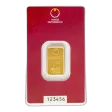
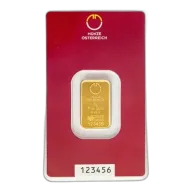
The Austrian Mint applies the same production standards to its bars as to its Philharmonic coin programme. The mint's coin-making heritage and government-backed quality control give its bar products implicit authentication advantages. Bars come in sealed, tamper-evident assay packaging with the Austrian Mint hallmark.
The Philharmonic coins, for context, feature the Great Organ of the Musikverein concert hall on the obverse and an arrangement of Vienna Philharmonic Orchestra instruments (cello, violins, bassoon, French horn, and harp) on the reverse. The bar design differs from the coin programme but carries the Austrian Mint's institutional branding. At .9999 fine, the bar matches the purity of the gold Philharmonic coins, which transitioned from .999 to .9999 fineness, as well as the PAMP and Valcambi bars that dominate this weight class.
Tax Treatment for the 5g Austrian Mint Gold Bar
As a 999.9 fine gold bar from a sovereign mint, this product qualifies for investment gold exemptions across all major markets. The bar format means it does not receive the legal tender benefits that apply to Austrian Mint coins like the Philharmonic.
European Union
Gold bars at 995 fineness or above are VAT-exempt across all EU member states under the EU Investment Gold Directive (Council Directive 98/80/EC). This bar qualifies at 999.9. Austrian buyers benefit from purchasing from their domestic mint with no cross-border complications. Capital gains treatment varies by member state. In Germany, gains on gold held for more than one year are tax-free. In Austria, gains from investment gold are also subject to favourable treatment when held beyond the relevant period.
United Kingdom
Investment gold at 995 fineness or above is VAT-exempt. This bar qualifies. Gold bars are subject to CGT in the UK, as the bar is not UK legal tender. The annual CGT allowance is 3,000 GBP. UK buyers seeking CGT exemption would need to choose a UK legal tender coin such as the 1/10 oz Gold Britannia.
United States
No federal sales tax. State exemptions apply in approximately 35 states. At 999.9 purity from a sovereign mint, the bar should satisfy IRA custodian requirements, though buyers should confirm acceptance since Austrian Mint bars are less commonly encountered in US IRA portfolios than American or Canadian products. Capital gains taxed at the collectibles rate of up to 28 percent.
Canada
GST/HST exempt at 99.5 percent purity. Capital gains at a 50 percent inclusion rate.
Australia, New Zealand, Singapore, and Hong Kong
GST-exempt in Australia and New Zealand at their respective purity thresholds. Exempt in Singapore as an Investment Precious Metal. No taxes in Hong Kong.
5g Austrian Mint Gold Bar vs Competing Products
The Austrian Mint bar benefits from sovereign mint provenance in a market dominated by private Swiss refiners. The key comparisons are with other sovereign mint bars and the leading LBMA-accredited refiner products.
The 1/10 oz Gold Philharmonic coin is the Austrian Mint's own nearest product by price point. The coin contains 3.11g of pure gold versus 5g in the bar, so the bar delivers more metal. However, the Philharmonic coin is legal tender in Austria with a 10 EUR face value, carries the globally recognised Philharmonic design, and has deeper secondary market liquidity due to decades of production history. In EU markets, the Philharmonic coin often trades at comparable or lower premiums than the 5g bar, making the coin the more liquid choice at a similar cost.
Against the 5g PAMP Suisse Fortuna bar, the Austrian Mint bar trades sovereign mint status for PAMP's brand dominance in the bar segment. PAMP Fortuna bars are the most widely recognised gold bars globally, with VeriScan verification adding a security layer. In European markets, both products enjoy strong dealer acceptance. The Austrian Mint's advantage is its governmental backing, which some buyers prefer on principle over private refiner products.
The 5g Heraeus gold bar is a German-produced, LBMA-accredited alternative that is particularly popular in the German, Swiss, and Austrian markets where the Austrian Mint bar also finds its strongest audience. Heraeus bars tend to price competitively and have excellent liquidity in Central European dealer networks. For buyers in the DACH region (Germany, Austria, Switzerland), both the Heraeus and Austrian Mint bars are natural choices, with the decision often coming down to brand preference and available premiums.
The 5g US Mint American Buffalo gold bar is another sovereign mint competitor at the same weight and purity. The Buffalo bar's strength is in North American markets, while the Austrian Mint bar performs best in European channels. Buyers should generally favour whichever sovereign mint has the strongest dealer network in their region.
5g Austrian Mint Gold Bar: frequently asked questions
-
The cheapest Austrian Mint 5g gold bar available right now is $707.37 from Metal Market Europe, sitting at 5.4% over spot. Prices update as dealers change their listings, so use this page to compare across all dealers in your currency.
-
The Austrian Mint 5g gold bar weighs 5g and is 999.9 fine gold (24 carat), produced by Austrian Mint. Many Austrian Mint bars also feature the Kinebar holographic design on the surface, which acts as a built-in authenticity feature. Check the specific product listing to confirm packaging details for your bar.
-
The Austrian Mint (Münze Österreich) is a state-owned institution based in Vienna. It holds LBMA Good Delivery accreditation, meaning its bars meet the strict standards required for international trading. Austrian Mint gold bars are accepted by dealers and vaults worldwide.
-
The premium on a 5g bar is currently 5.4% over $4,171.00 spot. Small bars cost more per gram because the fixed costs of fabrication, assay certification, and packaging are spread over far less gold. A 5g bar and a 1oz bar require similar production steps, so those costs make up a much larger share of a smaller bar's price.