
 APMEX
APMEX


Prices are fetched automatically and may not reflect current merchant prices. Currency conversions and tax treatment are approximate. Rankings are based solely on price. We are not a dealer and accept no responsibility for transactions with listed merchants. Past performance is not indicative of future results. This site does not provide investment advice. Full disclaimer
About the 5 oz APMEX Gold Bar
A Dealer-Branded Gold Bar from America's Largest Online Bullion Retailer
The 5 oz APMEX gold bar contains five troy ounces (155.52 grams) of 999.9 fine gold, produced under APMEX's own brand. APMEX (American Precious Metals Exchange) is one of the world's largest online precious metals retailers, headquartered in Oklahoma City, Oklahoma. The company sells products from dozens of mints and refiners but also offers bars under its own name, manufactured by contracted minting partners.
Dealer-branded bars like this one typically compete on price. Because APMEX controls both the manufacturing relationship and the retail channel, it can offer tighter margins than it would on third-party branded bars from Swiss or German refiners. For buyers purchasing and eventually reselling through APMEX, the savings on acquisition premium may be meaningful. The trade-off is brand recognition: an APMEX-branded bar does not carry the same international recognition as a bar from PAMP Suisse, Argor-Heraeus, or another LBMA-accredited refiner.
The 5 oz weight itself is an unusual denomination for gold. At roughly $15,000+ per bar at current prices, most gold buyers at this spending level prefer either multiple 1oz bars for maximum liquidity or a single 10oz bar for better premium efficiency. The 5 oz gold bar appeals to buyers who want a single substantial piece without committing to the higher outlay of 10 oz, and who value the APMEX brand relationship for future buyback.
APMEX's buyback programme is a relevant consideration. As one of the largest dealers in the US, APMEX maintains active two-way markets on its own branded products. Sellers returning APMEX bars to APMEX can expect competitive buyback offers, though the spread may be wider than for universally recognised LBMA bars that any dealer worldwide would purchase without hesitation.
5 oz APMEX Gold Bar Specifications
| Attribute | Detail |
|---|---|
| Weight | 5 troy ounces (155.52 grams) |
| Purity | 999.9 fine gold (24 karat) |
| Manufacturer | APMEX (dealer-branded) |
| Country of origin | United States |
| LBMA accredited | No (dealer brand, not a refinery) |
| Legal tender | No |
| Face value | None |
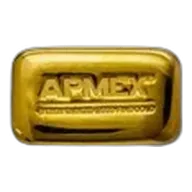
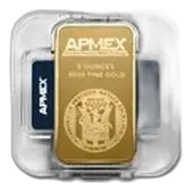
APMEX (American Precious Metals Exchange) is one of the largest online precious metals retailers in the world, headquartered in Oklahoma City, Oklahoma. The company operates both as a dealer for third-party products and as a brand owner for bars produced by contracted minting partners. APMEX-branded gold bars carry the company's logo, weight, and purity markings in clean institutional styling.
At 999.9 purity, the gold content is identical to bars from the major Swiss and German LBMA refiners. The difference is in the manufacturing chain: LBMA bars come from accredited refineries with their own hallmarks and assay processes, whereas APMEX bars are manufactured to APMEX specifications by partner facilities. The APMEX brand is well recognised within the US dealer network, where the company's buyback programme provides a ready secondary market for its own branded products. International recognition is more limited than for LBMA refiner brands like PAMP Suisse, Valcambi, or Heraeus.
Tax Treatment for the 5 oz APMEX Gold Bar
As a 999.9 fine gold bar, the APMEX 5 oz bar qualifies for investment gold exemptions in all major markets. Tax treatment is determined by purity and form, not by the manufacturer's brand or accreditation status.
Purchase Tax
- United States: No federal sales tax. Most states exempt bullion from sales tax. IRA eligibility is uncertain for APMEX-branded bars; the IRS requires gold bars to come from NYMEX/COMEX-approved refiners or national mints. APMEX is a dealer, not a refiner, and its contracted manufacturers may or may not hold the required approvals. Buyers should confirm with their IRA custodian before assuming eligibility.
- United Kingdom: VAT-exempt as investment gold at 995+ purity. Subject to CGT on disposal; gold bars are not CGT-exempt in the UK, regardless of manufacturer.
- Canada: GST/HST-exempt at 99.5%+ purity in bar form.
- European Union: VAT-exempt under the Investment Gold Directive for bars at 995+ purity.
- Australia: GST-free as investment-grade gold at 99.5%+ purity.
- Singapore: GST-exempt under the Investment Precious Metals scheme for gold at 99.5%+ purity.
- Hong Kong: No sales tax, no import duty, no capital gains tax.
Capital Gains
US long-term capital gains on bullion are taxed at the 28% collectibles rate, higher than the 15-20% rate applying to stocks and bonds. In the UK, gold bar gains above the annual exempt amount (currently £3,000) are subject to CGT at 18-24% depending on income. Germany exempts gold held for more than one year from CGT entirely, making it one of the most tax-efficient jurisdictions for bar investors willing to hold.
5 oz APMEX Gold Bar: frequently asked questions
-
The cheapest 5 oz APMEX gold bar tracked on this page is $21,446.45, currently 2.9% over the $4,171.00 spot price. The bar holds 5 oz of 999.9 fine gold, so its core value tracks the gold price directly. Comparing dealer offers before purchasing can save a meaningful amount on a bar of this size.
-
Bars sold under the APMEX brand are 999.9 fine (24-karat) gold. APMEX is a US-based bullion dealer; bars are hallmarked with their weight and purity, giving buyers a clear reference for the metal content.
-
A 5 oz gold bar is worth a significant sum, so a quality home safe bolted to the structure is the minimum practical option. It is worth checking your home contents insurance policy for any sublimits on precious metals and arranging additional cover if needed. Third-party allocated vaulting with an insured provider is a common alternative that removes both the security burden and the insurance gap.