5 listings
Filters
| Product | /oz | Premium | Price | |
|---|---|---|---|---|
|
5
 The Bullion Bank
Out of Stock
The Bullion Bank
Out of Stock
|
$4,214.90 | -4.38% | $21,074.50 | View Deal |
|
5O
Elite Rare Coins
Out of Stock
|
$4,215.00 | -4.38% | $21,075.00 | View Deal |
|
5O
AU Capital Management
Out of Stock
|
$4,226.10 | -4.13% | $21,130.50 | View Deal |
|
5O
A Coin Shop
Out of Stock
|
$4,226.40 | -4.12% | $21,132.00 | View Deal |
 IDC Coin and Bullion
Out of Stock
IDC Coin and Bullion
Out of Stock
|
$4,453.30 | +1.03% | $22,266.50 | View Deal |
Prices are fetched automatically and may not reflect current merchant prices. Currency conversions and tax treatment are approximate. Rankings are based solely on price. We are not a dealer and accept no responsibility for transactions with listed merchants. Past performance is not indicative of future results. This site does not provide investment advice. Full disclaimer
About the 5 oz Engelhard Gold Bar
The 5 oz Engelhard Gold Bar
Engelhard is one of the most historically significant names in American precious metals refining. Charles W. Engelhard Sr. founded the company in 1902 by purchasing the Charles F. Croselmire Company in Newark, New Jersey. His son, Charles Engelhard Jr., consolidated the family's holdings into Engelhard Industries, Inc. in 1958, listing it on the NYSE. By the 1950s, Engelhard was the world's largest precious metals smelter. Charles Engelhard Jr. is widely cited as the inspiration for Ian Fleming's James Bond villain Auric Goldfinger.
Engelhard exited the retail bullion market in the late 1980s to focus on industrial catalysts and materials. BASF acquired the company in 2006 for US$5 billion, renaming it BASF Catalysts LLC. No new Engelhard bars have been produced since the mid-1980s, making every surviving bar a secondary-market product with historical provenance.
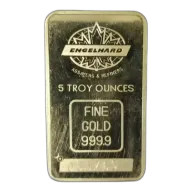
The 5 oz gold bar carries 999.9 fine gold (or 999 fine in some earlier production runs). Each bar is individually serial-numbered and stamped with the Engelhard hallmark, weight, and purity. The company produced bars in cast, pressed, and extruded formats, with surface finish and appearance varying across production eras.
Engelhard gold bars occupy a distinct market position: they function as investment bullion by weight and purity, but they also carry collector premiums driven by the brand's historical significance and the finite supply of surviving bars. The 5 oz size represents a significant gold holding, and the Engelhard name adds a layer of collectibility that most modern refiner bars lack.
5 oz Engelhard Gold Bar Specifications
| Property | Detail |
|---|---|
| Weight | 5 troy ounces (155.517 grams) |
| Purity | 999.9 fine gold (24 karat) |
| Manufacturer | Engelhard (Newark, New Jersey, USA; ceased retail production mid-1980s) |
| Format | Cast, pressed, or extruded (varies by production era) |
| Legal tender | No |
| Markings | Engelhard hallmark, serial number, weight, purity |
| Production status | Discontinued; secondary market only |
Engelhard bars were produced across multiple decades using different manufacturing methods. Cast bars were poured into moulds; pressed bars were stamped from sheet; extruded bars were formed through a die. The hallmarks evolved over the company's history, from early elongated octagon designs in the late 1960s to the distinctive "E" globe logo of the 1981-1986 era. Serial number formats also varied by era and size.
Precise dimensions for the 5 oz gold bar are not standardised across production runs, as the manufacturing method and era affect the bar's profile. The serial number is the primary identification and authentication marker for any Engelhard bar.
Tax Treatment of the 5 oz Engelhard Gold Bar
Engelhard gold bars receive the same tax treatment as any other investment gold product based on their purity. The discontinued status and potential collector premium do not change the fundamental tax classification in most jurisdictions, though gains based on collector value above melt price are still taxable.
United States
Sales tax: State-dependent. Most states exempt bullion from sales tax. The bar's discontinued status does not affect its classification as bullion for sales tax purposes.
Capital gains: Taxed at the collectibles rate of up to 28% for long-term holdings. This applies to any gain, including collector premium appreciation above melt value.
IRA: The 999.9 purity meets IRS requirements for a self-directed Precious Metals IRA. Eligibility depends on the specific custodian, and the bar's secondary-market status may require additional verification.
United Kingdom
VAT: Exempt. Investment gold at 995+ fineness is zero-rated for VAT, regardless of the manufacturer's current operating status.
CGT: Subject to capital gains tax at 18% or 24% on gains above £3,000. Not UK legal tender, so no CGT exemption.
Canada
GST/HST-exempt for gold at 99.5%+ purity. The bar's vintage status does not affect this exemption.
Australia
GST-free for investment-grade gold at 99.5%+ purity. Capital gains assessable with a 50% discount for holdings over 12 months.
European Union
VAT-exempt under the Investment Gold Directive for gold bars at 995+ fineness. The directive does not require the manufacturer to be currently operating.
Engelhard 5 oz Gold Bar vs Comparable Products
The Engelhard 5 oz gold bar competes in two overlapping markets: as a bullion product valued by weight and purity, and as a collector item valued for brand provenance and scarcity. This dual nature affects comparison with modern alternatives.
The 5 oz Johnson Matthey gold bar is the closest parallel. JM was the other major American refiner producing retail gold bars in the same era. Johnson Matthey sold its refining operations to Asahi Refining in 2015, making JM bars also secondary-market products with historical interest. Both brands carry collector premiums above modern generic bars, though Engelhard generally commands slightly higher premiums due to the Goldfinger connection and the greater variety of documented bar types.
The 5 oz PAMP Fortuna bar represents the modern premium bar market. PAMP bars are currently produced, widely available, and carry VeriScan digital authentication. They trade at known, predictable premiums above spot. Engelhard bars trade at less predictable premiums that reflect both metal content and collector demand, which can work in the seller's favour at resale but makes the initial purchase less transparent.
The 5 oz Sunshine Minting bar and 5 oz Republic Metals Corporation bar represent the modern US private-mint and refinery segment. Both offer current production, competitive premiums, and straightforward investment economics. They lack the historical cachet of Engelhard but provide predictable pricing and contemporary security features.
Buyers choosing an Engelhard bar should be comfortable with the collector-premium dynamic: the premium paid above spot may or may not be recoverable at resale, depending on market conditions and collector demand at the time of sale. For pure investment purposes, a modern LBMA-accredited bar at lower premiums delivers the same gold content with more transparent pricing.
5 oz Engelhard Gold Bar: frequently asked questions
-
Engelhard Corporation exited precious metals bar production years ago and was subsequently acquired by BASF, after which no new bars were produced under the Engelhard name. All Engelhard gold bars in circulation today are secondary-market pieces, which is a key part of their collector appeal.
-
All bullion bars trade above spot to some degree, but Engelhard bars often carry an additional premium because the brand is discontinued and no new supply enters the market. Buyers value the vintage assay marks, the historical reputation of the refinery, and the finite supply, creating collector demand that sits on top of the underlying gold value.
-
Counterfeits of vintage Engelhard bars do exist given their collector premium. Genuine bars feature a stamped or engraved assay mark, a serial number, and the stated fineness. Suspect bars should be checked for correct weight (155.52 g for 5 troy oz), thickness, and dimensions. An ultrasonic or XRF test from a reputable dealer provides definitive confirmation when provenance is uncertain.
-
A 5 troy oz gold bar weighs 155.5175 g. Troy ounces are the standard for precious metals: one troy ounce equals 31.1035 grams, which is heavier than a standard avoirdupois ounce (28.35 g). The full bar contains 5 troy oz of 999.9 fine gold.