1 listing
Filters

 APMEX
APMEX
Prices are fetched automatically and may not reflect current merchant prices. Currency conversions and tax treatment are approximate. Rankings are based solely on price. We are not a dealer and accept no responsibility for transactions with listed merchants. Past performance is not indicative of future results. This site does not provide investment advice. Full disclaimer
About the 5 oz Merrill Lynch Gold Bar
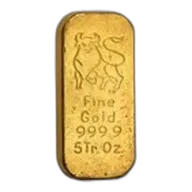
The 5 oz Merrill Lynch Gold Bar
This bar contains 5 troy ounces of 999.9 fine gold, equal to 155.52 grams. Five ounces is an unusual weight for gold: at well over $15,000 per bar at current prices, it represents a substantial single position, and the format is uncommon at retail compared with 1 oz bars below it and metric weights such as 100g above it.
The appeal of a bar at this size is the usual one for larger gold bars: premium efficiency. Gold bar premiums scale inversely with size, from 15-25% over spot on tiny 1g bars down to 1-2% on kilo bars, and a 5 oz bar buys gold considerably cheaper per ounce than the same weight in 1 oz gold bars. The trade-off is divisibility. A holding concentrated in one 5 oz piece must be sold whole, while five 1 oz bars can be liquidated in stages, and the buyer pool for a five-figure single bar is narrower than for ounce units. Buyers at this weight are typically consolidating a position rather than starting one.
Five ounces is also not a traditional bar weight outside North America. European and Asian markets favour metric sizes such as 100g, 250g, 500g, and 1kg, which limits how often this format appears on dealer shelves; the refiners that do strike 5 oz gold bars, PAMP Suisse, Valcambi, and the Perth Mint among them, treat it as a niche line because of the high unit cost. Condition matters at resale for a bar this valuable. Minted bars typically arrive sealed in tamper-evident assay cards recording the serial number, weight, purity, and refiner hallmark, and keeping that seal intact protects resale value, since a bar with a broken seal may need re-assaying before a dealer will buy it.
Tax Treatment of a 5 oz Gold Bar
At 999.9 fineness this bar clears the investment-gold purity thresholds in every major jurisdiction, so purchase taxes are rarely an issue; disposal taxes are where the rules differ.
- United States: No federal sales tax, and most states exempt bullion. In threshold states such as California ($2,000 exemption floor) a 5 oz gold purchase qualifies easily. Long-term capital gains are taxed at the collectibles rate, capped at 28%, with short-term gains taxed as ordinary income. IRA eligibility for bars requires 99.5%+ purity from an accredited refiner held at an approved depository.
- United Kingdom: VAT-free as investment gold (995+ fineness), but bars have no legal tender status, so gains above the £3,000 annual allowance are subject to CGT at 18% or 24%.
- Canada: GST/HST exempt at 99.5%+ purity. Capital gains taxed at a 50% inclusion rate.
- Australia: GST-free as investment-grade gold; CGT applies with a 50% discount after 12 months for individuals.
- EU: 0% VAT on investment gold across all member states under the Investment Gold Directive; CGT treatment varies by country.
- Singapore and Hong Kong: No purchase tax and no capital gains tax.
5 oz Gold vs Ounce Bars, Metric Bars, and Coins
Within bars, the 5 oz weight sits in an in-between position. It undercuts 1 oz bars on premium per ounce but is not a traditional weight in European or Asian markets, where metric sizes like 100g gold bars (3.215 oz) and 250g dominate the same price territory. That matters at resale: a 100g bar from an LBMA-accredited refiner is a standard unit dealers worldwide handle daily, while a 5 oz bar is a less familiar shape outside North America. Any large bar also raises the authentication stakes; gold-plated tungsten is the classic counterfeit risk for bigger bars because tungsten's density nearly matches gold's, so sealed, serialised bars from recognised refiners, or ultrasonic testing for loose pieces, are the practical safeguards.
Against coins, the comparison is the standard bars-versus-coins trade. Five 1 oz sovereign coins cost more in premium than one 5 oz bar but offer government-backed specifications, the tightest bid-ask spreads in the market, and staged liquidation. UK buyers get a further advantage from CGT-exempt legal tender coins that no bar can offer. A 5 oz bar makes sense for a buyer prioritising metal per dollar in a single large piece; buyers prioritising flexibility or tax treatment usually do better in ounce coins or standard metric bars.