1 product · 4 deals
Filters
| Product | /oz | Premium | Price | |
|---|---|---|---|---|

4 deals
|
$5,433.14 | +30.04% |
$87.34
£66
|
Compare |
Prices are fetched automatically and may not reflect current merchant prices. Currency conversions and tax treatment are approximate. Rankings are based solely on price. We are not a dealer and accept no responsibility for transactions with listed merchants. Past performance is not indicative of future results. This site does not provide investment advice. Full disclaimer
About 0.5g Gold Coins
Half-Gram Gold Coins: The Smallest Entry Point
A 0.5g gold coin contains just 0.0161 troy ounces of metal, making this the smallest standard denomination in the bullion market. At a spot price around $3,300 per ounce, the gold content of a half-gram piece is worth roughly $53, though retail prices sit well above that figure once minting and dealer costs are added. The coin itself is physically tiny, comparable to a postage stamp or micro SIM card, and is usually dwarfed by the card or capsule it ships in.
Buyers at this weight are rarely accumulating wealth in the conventional sense. The half-gram market is driven by gifting, collecting, and curiosity purchases: stocking stuffers, festival gifts, and first-time buyers who want to own physical gold without committing hundreds of dollars. In gram-denominated markets across the Middle East and Asia, small gold purchases are culturally routine, with pieces of this size sold as entry-level buys in gold souks and given as gifts at Chinese New Year and Diwali. In Western markets the half-gram coin occupies more of a novelty niche.
The economic trade-off against larger coins is stark. Manufacturing a coin costs broadly the same whether it holds half a gram or a full ounce, so the fixed costs land heavily on tiny pieces. A buyer who wants gold exposure per dollar spent gets substantially more metal by stepping up the scale; the research on small-denomination gold suggests the economics only begin to improve at 2.5g and above. Compared with a 1/10oz gold coin, which is itself an expensive way to buy gold relative to one-ounce pieces, the half-gram coin pushes the premium penalty further still.
That said, the format has genuine uses. It is the cheapest way to put a sovereign-minted gold coin in someone's hand, it introduces new buyers to the market at minimal cost, and some holders treat very small gold pieces as ultra-portable or barter-ready units. The key is buying with clear expectations: this is gold for giving and holding, not for trading.
Premiums at 0.5g: The Steepest on the Scale
Half-gram gold carries the highest premiums of any standard bullion denomination. Research on this weight class puts typical premiums at 30-50% or more over spot. In dollar terms, a piece holding about $53 of gold might retail for $75 to $110, meaning $22 to $57 of the purchase price goes to manufacturing, packaging, and dealer margin rather than metal.
The contrast with the rest of the weight ladder is severe. Fractional gold coins already carry elevated premiums relative to one-ounce pieces: roughly 5-8% at the half-ounce mark, 7-10% at a quarter ounce, and 8-15% at a tenth of an ounce. Small gold bars in the 1g to 5g range typically run 10-25% over spot. The half-gram coin sits above all of these. A 1oz gold coin from a sovereign mint, by comparison, typically trades at just 3-8% over spot in normal conditions.
The premium problem compounds at resale. Dealer buyback prices for half-gram pieces are typically at or near spot value, which means the premium paid at purchase is largely unrecoverable. The round-trip spread between buying price and selling price can exceed 40%. Gold would need to rise substantially before a half-gram buyer breaks even, whereas a one-ounce coin bought at a 5% premium might sell back at 2-4% over spot.
This is why comparison shopping matters more at this weight than almost anywhere else. With premiums spanning such a wide band, the difference between the cheapest and most expensive dealer for the same half-gram coin can amount to a large fraction of the gold value itself. Buyers who want the format anyway, for gifts or collecting, should treat the premium as the cost of the format and shop the percentage, not just the headline price.
What Sells at Half a Gram
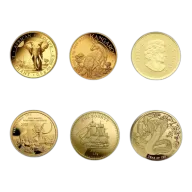
Sovereign mints produce a surprising variety of coins at this weight, mostly aimed at the gift and collector market. Listings tracked at this weight include the 0.5g Perth Mint Kangaroo gold coin, the 0.5g gold Maple Leaf, and the 0.5g Somalia Elephant gold coin, alongside themed issues such as the Pobjoy Mint Noble, Ocean Wonders, and Astrology series, plus generic half-gram gold coins from various mints.
The coin format competes directly with half-gram bars at this weight, and the bar side of the market is dominated by Swiss refiners. PAMP Suisse produces 0.5g bars in assay cards, including its Lady Fortuna design, and is the most recognised brand at this size. Valcambi sells 0.5g bars in assay cards and also produces CombiBar grids whose 0.5g segments can be snapped off individually. Argor-Heraeus offers half-gram bars in assay cards as well, and various private mints produce 0.5g pieces at lower premiums but with less resale recognition. Buyers open to either format can compare against 0.5g gold bars directly.
One related product worth knowing about: the Royal Canadian Mint's MapleGram packaging contains eight 1g coins in a sealed card. The individual gram is the smallest unit the RCM sells in that format, so buyers wanting divisible small gold from a major sovereign mint may find the gram-denominated route more practical than hunting for half-gram pieces.
Across all of these products, packaging is part of the product. Half-gram bars live in their assay cards, and removing one destroys most of its resale value. Coins at this weight are similarly best kept in their original capsules or cards, since the packaging carries much of the authentication burden for something too small to verify easily by hand.
Selling, Storing, and Handling Half-Gram Gold
Liquidity at this weight is limited. Major dealers will generally buy back half-gram pieces, but the wide gap between purchase price and buyback price makes frequent trading uneconomical. The format is better suited to long-term holding or gifting than to active position management. Anyone planning to sell small gold regularly should buy further up the weight scale, where spreads narrow sharply.
Brand recognition matters more at this size than at any other. For bars, PAMP and Valcambi pieces in sealed assay cards are the products with reliable dealer buyback at competitive rates; lesser-known private mint bars may be accepted but at weaker prices. For coins, sticking to recognisable sovereign mint issues gives the best chance of a smooth sale. The general rule for fractional gold applies with extra force here: the smaller and less famous the piece, the more the dealer discounts it.
There is also a practical friction unique to very small gold: the absolute value of each piece is so low that shipping and insurance costs for a resale can be disproportionate to the metal being sold. Posting a single $80 coin with tracked, insured delivery eats a meaningful slice of the proceeds. Sellers with several pieces should batch them into one shipment.
Storage, at least, is trivial. Dozens of half-gram pieces fit in a shirt pocket, and gold does not tarnish or corrode, so there are no environmental concerns. The one firm rule is to keep original packaging intact: for carded bars the assay card effectively is the product, and a bare half-gram piece without its card or capsule is hard to sell at any reasonable price. Beyond that, a small safe or even a well-hidden envelope comfortably houses a collection that would be worth storing in a vault at larger weights.
0.5g Gold Coins: frequently asked questions
-
The metal content of a 0.5g gold coin is about one sixty-second of a troy ounce, so its raw spot value is a small fraction of $4,176.20. Dealer prices are substantially above that because fabrication and packaging costs are spread over a tiny amount of metal. The 10 listings from 6 dealers on this page show actual current prices.
-
Minting, die work, assay certification, and packaging carry largely fixed costs per coin regardless of gold content. On a 0.5g coin, those fixed costs represent a far larger share of the coin's value than on a 1oz coin. The premium per gram at this weight is unavoidably high, which is the trade-off for owning the smallest standard bullion coin size.
-
6 dealers carry 0.5g gold coins in our listings, with 10 products tracked. Availability at this weight is more limited than at 1g or 1oz, so checking multiple suppliers here is worthwhile if you are looking for the best price.
-
Investment-grade gold coins are VAT-free in the UK, across the EU, in Canada, and in Australia. To qualify as investment gold, coins generally need to meet a minimum purity threshold (typically 99.5% in the UK and EU). Some very small coins may not meet local investment-gold criteria, so it is worth confirming the specific coin qualifies before purchase.
-
Yes. 0.5g is one of the smallest standard sizes produced by mainstream mints. Products at this weight include the Perth Mint Mini Roo and PAMP Suisse 0.5g pieces. The next common size up is 1g. While they make accessible gifts or introductory purchases, the premium at 0.5g is significantly higher per gram than at larger weights.