 BGASC
BGASC
1 listing
Filters
| Product | /oz | Premium | Price | |
|---|---|---|---|---|
| $9,859.70 | +136.62% | $158.53 | View Deal |

Prices are fetched automatically and may not reflect current merchant prices. Currency conversions and tax treatment are approximate. Rankings are based solely on price. We are not a dealer and accept no responsibility for transactions with listed merchants. Past performance is not indicative of future results. This site does not provide investment advice. Full disclaimer
About the 0.5g Bounty Gold Coin
The 0.5g Bounty Gold Coin
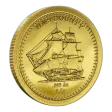
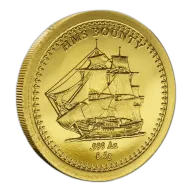
The Bounty series is legal tender of the Cook Islands, a 15-island self-governing nation in the South Pacific in free association with New Zealand. The coins depict the HMS Bounty, the Royal Navy vessel acquired in 1787 that became infamous for the 1789 mutiny led by Fletcher Christian against Captain William Bligh, one of the most famous events in naval history. This half-gram version delivers that design in the smallest practical gold format, struck in 999.9 fine gold; our catalogue records the manufacturer of this issue as B.H. Mayer.
Half a gram is 0.0161 troy oz, the smallest standard bullion denomination produced, and the economics at this size are blunt: production and packaging costs spread over almost no metal make 0.5g products the highest-premium items in bullion, and buyback prices typically sit at or near spot, so the premium paid at purchase is largely unrecoverable. That makes the 0.5g Bounty a gifting, collecting, and entry-level product rather than an accumulation vehicle. What it offers over a generic half-gram bar is a legal tender coin with a recognisable ship design and a genuine story attached.
The series sits in a budget sovereign niche overall: real government legal tender, unlike private mint rounds, but from a small nation with limited market recognition next to the major sovereign coins. Buyers who want the design with better premium efficiency should look at the larger gold Bounty sizes, or compare against mainstream 1/10 oz gold coins before committing to half-gram pieces.
Tax Treatment of the 0.5g Bounty Gold Coin
As a 999.9 fine legal tender gold coin, the Bounty qualifies for investment-gold purchase exemptions in the major jurisdictions, but its Cook Islands legal tender status earns it no capital gains privileges elsewhere, and the series carries one notable US quirk.
- UK: VAT-exempt as investment gold. Not UK legal tender, so no CGT exemption; gains above the annual allowance are taxable, unlike on Britannias or Sovereigns.
- EU: 0% VAT as investment gold under the EU directive (post-1800 legal tender coins of 900+ fineness qualify; this coin far exceeds the threshold).
- US: no federal sales tax and most states exempt bullion, though threshold states (such as Florida at $500 and New York at $1,000) will not exempt a half-gram coin bought alone. Note that the IRS treats Cook Islands coins as not IRA-eligible despite the purity, classifying them as overly collectible due to limited mintages and premium pricing. Long-term gains taxed at the collectibles rate of up to 28%.
- Canada: 0% GST/HST at 99.5%+ gold purity.
- Australia: GST-free at 99.5%+ purity when traded as investment bullion; numismatic-priced coins attract 10% GST.
- New Zealand: gold at 99.5%+ purity is GST-exempt; the Cook Islands Dollar is pegged to the NZD and the islands are in free association with New Zealand.
- Singapore and Hong Kong: no purchase tax and no capital gains tax.
A Mutiny on a Coin
The Bounty series first appeared in 2009 in gold and silver, with the original coins struck by Heimerle + Meule GmbH of Pforzheim, Germany; later production, at least from 2017 onward, was contracted to Sunshine Minting in Idaho. The Cook Islands has no minting facilities of its own, and like Niue, Tuvalu, and Tokelau it licenses its sovereign status to coin programmes, producing a numismatic output far beyond what a population of about 17,000 would suggest. The islands themselves were charted by Captain James Cook in 1773, which gives a nautical coin series from this issuer a certain logic.
The design shows the HMS Bounty under sail in fine detail, set against a distinctive stylised grid-and-wave background pattern not found on other bullion coins, with the Ian Rank-Broadley effigy of Queen Elizabeth II on the other side, common to Commonwealth coinage. The ship design has remained largely consistent across the annual issues, making the series instantly recognisable. The history behind it is genuine: after the 1789 mutiny, the Bounty was burned and scuttled at Pitcairn Island in 1790, where descendants of the mutineers still live today.
Mintages have been a defining feature. The 2017 silver issue was capped at just 5,000 pieces, exceptionally low for a bullion coin when American Silver Eagles run to tens of millions a year, and early-year Bounty coins consequently carry numismatic premiums. Later years increased production as the series settled into a bullion role rather than a purely collectible one.
Bounty vs Major Sovereign Coins and Half-Gram Bars
Against the major sovereign bullion coins, the Bounty trades recognition for price positioning. A gold Maple Leaf, Britannia, or Eagle enjoys universal dealer liquidity that a small-nation issue cannot match; the Bounty's counterweight is its budget-sovereign role, offering legal tender status that private mint products lack. Its .9999 purity matches the Maple Leaf and exceeds the Britannia's .999. The closest structural rivals are Niue's coin programmes, which use the same external-mint model through the New Zealand Mint and Perth Mint.
At this specific half-gram weight, the practical alternative is a 0.5g gold bar from PAMP Suisse, Valcambi, or Argor-Heraeus in a sealed assay card. Half-gram bars commonly price at 30-50% or more over spot, and the Swiss brands have the most reliable buyback at this size. The coin's advantage is purely aesthetic and historical; the bar's advantage is the assay card's verification convenience. Neither escapes the half-gram premium problem.
The weight question matters more than the brand question here. Premium economics improve sharply from 2.5g upward, and a 1/10 oz coin contains roughly six times the gold at a much lower premium percentage. The 0.5g Bounty makes sense as a gift with a story, a series collectible, or a first piece of gold; for building a position, step up the gram-bar ladder or into fractional sovereign coins instead.