52 listings
Filters
| Product | /oz | Premium | Price | |
|---|---|---|---|---|
| $4,807.26 | +14.53% | $1,201.82 | View Deal | |

 Knox Safe Custody
|
$4,795.54 | +14.63% |
$1,198.86
R19,750
|
View Deal |
| $4,818.24 | +14.88% |
$1,204.53
£910
|
View Deal | |
| $4,849.38 | +15.54% | $1,212.35 | View Deal | |
| $4,849.42 | +15.54% | $1,212.36 | View Deal | |
| $4,853.39 | +15.63% |
$1,213.38
S$1,566
|
View Deal | |

 Bullion Trading LLC
|
$4,881.46 | +16.30% | $1,220.37 | View Deal |
 Mac's Coins
|
$4,904.90 | +16.90% | $1,226.23 | View Deal |
 Golden Eagle Coins
|
$4,921.26 | +17.48% | $1,230.32 | View Deal |
| $4,933.74 | +17.55% | $1,233.44 | View Deal | |
| $4,951.06 | +17.81% |
$1,237.75
£935
|
View Deal | |
| $4,948.57 | +17.93% |
$1,237.18
£935
|
View Deal | |
| $4,948.57 | +17.93% |
$1,237.18
£935
|
View Deal | |
| $4,955.72 | +18.03% |
$1,238.91
£936
|
View Deal | |

 CanAm Bullion
|
$4,967.50 | +18.40% | $1,241.88 | View Deal |
| $4,975.94 | +18.55% | $1,243.99 | View Deal | |
| $5,018.10 | +19.56% | $1,254.53 | View Deal | |
| $5,034.10 | +19.96% |
$1,258.55
£951
|
View Deal | |
| $5,079.18 | +21.25% | $1,269.80 | View Deal | |
 Golden Eagle Coins
|
$5,126.94 | +22.40% | $1,281.74 | View Deal |
| $5,144.58 | +22.57% | $1,286.15 | View Deal | |
| $5,137.50 | +22.64% | $1,284.38 | View Deal |


 Chards


 BullionStar











Prices are fetched automatically and may not reflect current merchant prices. Currency conversions and tax treatment are approximate. Rankings are based solely on price. We are not a dealer and accept no responsibility for transactions with listed merchants. Past performance is not indicative of future results. This site does not provide investment advice. Full disclaimer
About the 1/4 oz South African Mint Krugerrand Gold Coin
The 1/4 oz Gold Krugerrand
The 1/4 oz Krugerrand contains 7.776 grams of fine gold in a 22-karat alloy (916.7 fineness), bringing the total coin weight to 8.482 grams. The copper alloy gives the Krugerrand its distinctive orange-gold colour and makes it harder and more scratch-resistant than 999.9 fine coins like the 1/4 oz Britannia or 1/4 oz Maple Leaf. This is the same alloy composition used in the 1/4 oz American Eagle, chosen for the same reason: durability for a coin meant to be handled.
Fractional Krugerrands were introduced in 1980, thirteen years after the original 1 oz Krugerrand created the modern gold bullion coin market in 1967. The 1/4 oz denomination sits at a practical price point for regular purchases, and the Krugerrand brand carries the deepest secondary market recognition of any gold bullion coin globally, with over 60 million coins produced across all sizes in more than five decades.
With 53 dealers listing this coin, the 1/4 oz Krugerrand has strong market presence. Premiums have historically been among the lowest for 1/4 oz gold coins, a benefit of the Krugerrand's enormous cumulative production volume. The trade-off is in two areas: the 22-karat alloy and the absence of modern anti-counterfeiting features.
1/4 oz Gold Krugerrand Dimensions and Details
| Attribute | Value |
|---|---|
| Fine gold content | 7.776 g (1/4 troy oz) |
| Total weight | 8.482 g |
| Purity | 916.7 (22 karat) |
| Alloy | 91.67% gold, 8.33% copper |
| Diameter | 22.06 mm |
| Thickness | 1.888 mm |
| Edge | Reeded (180 serrations, bullion) |
| Face value | None |
| First issued | 1980 |
| Mint | South African Mint (owned by SA Reserve Bank) |
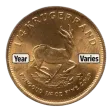
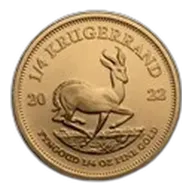
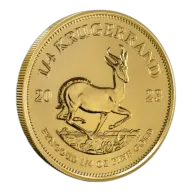
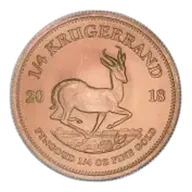
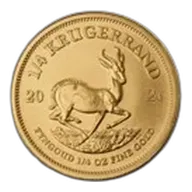
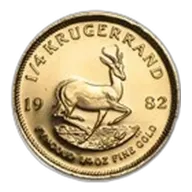
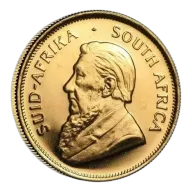
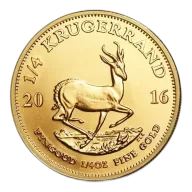
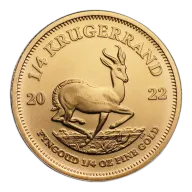
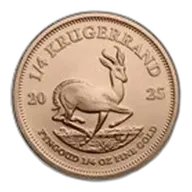
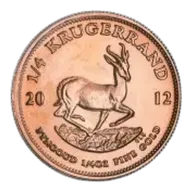
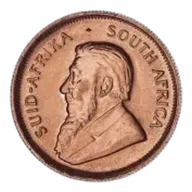
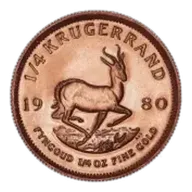
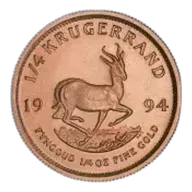
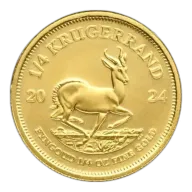
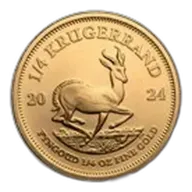
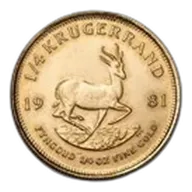
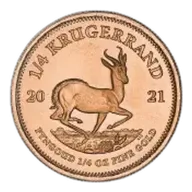
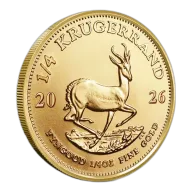
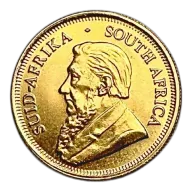
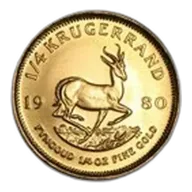
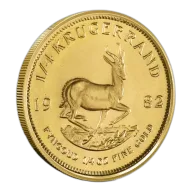
The obverse carries the portrait of Paul Kruger, President of the South African Republic, designed by Otto Schultz. The reverse shows a springbok antelope in mid-leap, designed by Coert Steynberg. Both designs have remained fundamentally unchanged since 1967, making the Krugerrand one of the most visually stable bullion coin programmes in existence.
The Krugerrand carries no face value on gold coins. Legal tender status in South Africa is based on gold content value, similar in concept to the British Sovereign. The silver Krugerrand (introduced 2017) and platinum Krugerrand do carry denominated face values (R1 and R10 respectively), making the gold Krugerrand unusual among major bullion coins in this regard.
The edge carries 180 serrations on bullion-grade coins and 220 on proof versions. This difference in serration count is one method for distinguishing the two grades. The coin carries no modern anti-counterfeiting features such as micro-engraving, latent images, or DNA marks. Authentication relies primarily on precise weight and dimension checks.
Krugerrand Tax Treatment by Country
The Krugerrand's 22-karat composition creates a specific tax nuance: it is 916.7 fine, below the 995 threshold that some jurisdictions use for investment gold. In practice, the Krugerrand qualifies for tax-exempt treatment in most markets because the test is applied to the fine gold content per coin (which is exactly 1/4 troy ounce of pure gold), not the overall alloy fineness.
United Kingdom
Gold Krugerrands are VAT-free as investment gold. They appear on the qualifying coin list. They are not CGT-exempt because they are South African, not UK legal tender. This is the single most important tax distinction between the Krugerrand and the 1/4 oz Britannia for UK investors. Gains on Krugerrands above the £3,000 annual CGT allowance are taxable at 18% (basic rate) or 24% (higher rate). The lower purchase premium on the Krugerrand can be offset by this CGT liability on disposal.
Other Markets
- US: IRA-eligible, specifically approved under IRS regulations. The American Eagle has a similar statutory exemption from the standard 99.5% purity requirement. Capital gains taxed as collectibles at up to 28%.
- South Africa: Legal tender. Gold Krugerrands are zero-rated for VAT under section 11(1)(k) of the Value-Added Tax Act. CGT applies at 40% inclusion rate.
- EU: Listed on the annual EU investment gold coin list. VAT-exempt in all member states.
- Canada: GST/HST-exempt. The fine gold content meets the 99.5% threshold even though the coin alloy is 22 karat.
- Australia: GST-free as investment-grade gold.
- New Zealand: The 22-karat alloy means the coin itself is below the 99.5% purity threshold. Depending on how the exemption is applied, 15% GST may apply. Buyers in New Zealand should verify with their dealer.
- Singapore: GST-exempt under the IPM scheme. The coin appears on the MAS-approved list.
- Hong Kong: No sales tax or import duty.
The Krugerrand's Role in Bullion History
The Krugerrand was first struck on 3 July 1967 with an initial run of 40,000 bullion coins plus 10,000 proof editions. It was the world's first modern gold bullion coin designed specifically for investment, and its success over the following two decades reshaped the global gold market. By 1980, the Krugerrand accounted for more than 90% of the global gold coin market. Every subsequent sovereign bullion coin programme, from the Canadian Maple Leaf (1979) to the Gold Britannia (1987), the American Eagle (1986), and the Gold Philharmonic (1989), was a direct competitive response to the Krugerrand's dominance.
The 1/4 oz denomination was introduced in 1980 alongside the 1/2 oz and 1/10 oz fractionals, broadening the Krugerrand's appeal to buyers who found the 1 oz coin too expensive for regular purchases. The 22-karat composition was chosen to match the historic British Sovereign, providing durability for a coin intended to circulate and be handled. The copper alloy produces the warm orange colour that distinguishes the Krugerrand visually from the yellow tone of 999.9 fine coins.
International sanctions during the apartheid era disrupted the Krugerrand's market position. The US enacted an import ban in 1985, and broader international restrictions followed. These sanctions directly created the market opening for competing coins: Canada launched the Maple Leaf in 1979 specifically to capture investors concerned about South African sanctions. When sanctions were lifted in 1991, the Krugerrand re-entered a market that now had multiple established competitors, and it never fully recaptured its earlier dominance. It remains, however, the most widely held gold bullion coin in the world by cumulative volume, with over 60 million coins sold across all sizes by 2017.
Krugerrand vs Britannia, Eagle, and Maple Leaf at 1/4 oz
The 1/4 oz Krugerrand competes most directly with the 1/4 oz American Eagle, as both are 22-karat coins containing exactly 1/4 troy ounce of fine gold with copper alloy for durability. The Eagle uses a gold-silver-copper alloy, giving it a slightly different tone from the Krugerrand's pure gold-copper alloy. Both lack modern anti-counterfeiting features. The Eagle commands higher premiums in the US market due to domestic demand, while the Krugerrand is more competitively priced internationally.
Against the 1/4 oz Britannia, the Krugerrand typically costs less at purchase. The Britannia counters with 999.9 purity, the Royal Mint's four-feature security suite, and CGT exemption in the UK. For UK investors who expect to sell at a gain above the annual CGT allowance, the Britannia's tax advantage can outweigh the Krugerrand's lower buy-in cost. For investors in jurisdictions without CGT distinctions between the two coins (most countries outside the UK), the Krugerrand's lower premium is a clean advantage.
The 1/4 oz Maple Leaf matches the Krugerrand on competitive pricing and adds 999.9 purity plus MintShield anti-counterfeiting technology. The Maple Leaf is the stronger choice for buyers who prioritise authentication assurance and purity. The Krugerrand is the stronger choice for buyers who value the coin's unmatched secondary market depth and the physical durability of the 22-karat alloy.
The Krugerrand's counterfeiting risk is a practical consideration. As the most widely held gold coin in the world, it is also one of the most counterfeited. The absence of modern security features means buyers should source from reputable dealers and verify weight and dimensions carefully. The 22-karat alloy does make density-based counterfeiting with tungsten cores more difficult to execute convincingly at coin thicknesses.
1/4 oz South African Mint Krugerrand Gold Coin: frequently asked questions
-
The lowest price we track for a 1/4 oz gold Krugerrand is $1,070.15 from Summit Bullion, currently at about 2.0% over the $4,195.70 gold spot price. The Krugerrand has accumulated over 60 million coins sold since 1967, giving it broad dealer availability and a competitive secondary market.
-
The 1/4 oz Krugerrand is struck in 916.7 gold (22 carat) with a total weight of 1/4 oz. At 91.67% purity that gives approximately 7.13 g of fine gold, exactly one quarter of a troy ounce. The remaining mass is copper, added deliberately to make the coin harder and more resistant to scratching than a 24-carat coin.
-
No. The Krugerrand is 916.7 fine gold (22 carat), not 24 carat. The 8.33% copper alloy makes it more durable than higher-purity coins and gives it a distinctive orange-gold colour. Despite the lower purity, the coin still contains exactly 1/4 troy ounce of fine gold; the total coin weight is higher to accommodate the alloy.
-
For standard bullion strikes, year of issue has little impact on value. The gold content is the same regardless of date, so dealers price them on spot plus a small handling premium. The 2017 50th-anniversary issues carry a privy mark and are a distinct commemorative edition. Proof versions of any year also trade above bullion price. For regular bullion coins, condition and dealer spread matter far more than date.
-
Tax treatment depends on your country. In the UK, Krugerrands are NOT CGT-exempt: only UK legal-tender coins such as Britannias and Sovereigns qualify for that exemption. UK gains above £3,000 are taxed at 18% or 24% depending on your income. US investors pay up to 28% on long-term gains. In Canada, 50% of any gain is included in taxable income at your marginal rate.