1 listing
Filters
| Product | /oz | Premium | Price | |
|---|---|---|---|---|

 Accurate Precious Metals
Out of Stock
Accurate Precious Metals
Out of Stock
|
$4,192.23 | +1.28% | $1,048.06 | View Deal |
Prices are fetched automatically and may not reflect current merchant prices. Currency conversions and tax treatment are approximate. Rankings are based solely on price. We are not a dealer and accept no responsibility for transactions with listed merchants. Past performance is not indicative of future results. This site does not provide investment advice. Full disclaimer
About the 1/4 oz Rose Crown Guinea Gold Coin
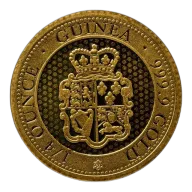
The 1/4 oz Rose Crown Guinea Gold Coin
The Rose Crown Guinea is a legal tender coin of Saint Helena, issued under licence by the modern East India Company and struck annually since 2018. The gold version contains a quarter troy ounce (7.78 g) of .9999 fine gold with a £25 face value, putting it in the middle fractional gold weight class alongside the quarter-ounce versions of the major sovereign series.
What this coin offers over those rivals is design and historical theming. The name comes from the original Rose Crown Guinea of King George II's reign (1727 to 1760), whose crowned shield of the Royal Arms was said to resemble an open rose. The modern coin keeps that shield motif on the reverse with a design that changes subtly each year, and the obverse carries the Raphael Maklouf effigy of Queen Elizabeth II within a decorative East India Company border, a portrait choice that gives the series a distinct visual identity compared with the more common Jody Clark or Arnold Machin effigies.
As an investment it is a niche product. It competes on design appeal and historical interest rather than liquidity, and the 1/4 oz weight class as a whole carries gold premiums of roughly 7 to 12 percent over spot, against 3 to 5 percent for 1 oz coins. The trade-off is a much lower price per coin, which suits regular smaller purchases. Buyers drawn to the East India Company's guinea theme often collect across the full range, which also includes the Spade Guinea and other Saint Helena issues.
Rose Crown Guinea 1/4 oz Gold Specifications
| Attribute | Detail |
|---|---|
| Weight | 1/4 troy oz (7.78 g) |
| Purity | .9999 fine gold |
| Diameter | ~22 mm |
| Edge | Reeded |
| Face value | £25 |
| Legal tender | Saint Helena |
| Finish | Brilliant Uncirculated |
| First issued | 2018 |
The obverse shows Raphael Maklouf's portrait of Queen Elizabeth II framed within a decorative East India Company border pattern; later issues may transition to Charles III. The reverse features the Rose Crown Guinea shield, a central stylised shield with a crowned rose emblem, surrounded by inscriptions noting weight and purity, plus the East India Company mint mark, which serves as the series' authentication mark. There is no proprietary anti-counterfeiting technology comparable to Royal Canadian Mint Bullion DNA or Royal Mint security features. The actual striking facility is not publicly confirmed; the East India Company contracts production to third-party mints, and Sunshine Mint in Idaho has been identified as the physical manufacturer for some EIC coin programmes. A 1.25 oz .999 silver companion coin with a £1.25 face value is struck in the same series.
Rose Crown Guinea Tax Position by Country
The key point for UK buyers is what this coin is not: despite the pound-denominated £25 face value, Saint Helena is a British Overseas Territory, not the UK, so the coin is not UK legal tender and does not qualify for CGT exemption. Gains are taxable, unlike with a Britannia or Sovereign. It does qualify for the UK's 0% VAT treatment as investment gold, since investment-grade gold coins are VAT-exempt regardless of issuer.
- UK: 0% VAT as investment gold; CGT payable on gains within the annual allowance.
- US: no federal sales tax, state rules vary, and most states exempt bullion. The coin is IRA eligible at .9999 fineness, above the 99.5% threshold for gold. Long-term gains are taxed at the collectibles rate of up to 28%.
- Canada: 0% GST/HST, as the .9999 purity clears the 99.5% federal exemption threshold for gold coins.
- EU: investment gold coins are zero-rated for VAT across member states.
- Australia: 0% GST for investment-grade gold of 99.5%+ purity.
For UK investors choosing between fractional gold coins at this price point, the missing CGT exemption is the main reason to prefer a 1/4 oz gold Britannia unless the Guinea's design is the draw.
From Charles II's Guinea to a Modern Bullion Series
The original guinea was first struck in 1663 for King Charles II, using gold from the Guinea region of West Africa. The Rose Crown Guinea type dates to the reign of George II, whose crowned shield design gave the coin its rose name; across his 33-year reign, eight different obverse and five different reverse varieties were struck. The guinea also carried a symbolic premium over the pound, valued at 21 shillings, or 1.05 pounds, a heritage of giving a little extra that the modern series references with its non-standard 1.25 oz silver weight.
The East India Company behind today's coin is not the original trading company, which was chartered in 1600, became one of the most powerful organisations in history, and was dissolved in 1874. The brand was reconstituted in 2005 by Indian businessman Sanjiv Mehta, who purchased the name and trademark; it now operates as a luxury goods brand with a retail presence in London, and issues coins under licence from Saint Helena.
Saint Helena itself is a remote volcanic South Atlantic island, best known as Napoleon's place of exile from 1815 to 1821. With a population of roughly 4,500, its role as a coin-issuing territory exists primarily to serve the international bullion market rather than local circulation. The Rose Crown Guinea series began in 2018 and has been struck annually since, with the reverse design changing each year while retaining the shield motif.
Rose Crown Guinea vs Maple Leaf, Eagle, and Britannia
At the quarter-ounce weight, the mainstream alternatives are the 1/4 oz Gold Maple Leaf, the 1/4 oz American Gold Eagle, and the 1/4 oz gold Britannia. All are more widely traded and recognised globally than the Rose Crown Guinea, which means tighter spreads and easier resale. The Guinea competes on design appeal and historical interest rather than liquidity.
For UK buyers the Britannia comparison is decisive on tax: the Britannia is UK legal tender and CGT-exempt, while the Guinea is not, despite its sterling face value. Both are VAT-free as investment gold. The Sovereign occupies a similar price point too, containing 0.2354 oz of gold in 22 carat form, and is likewise CGT-exempt for UK investors.
Within the East India Company's own catalogue, the Rose Crown Guinea is one of several guinea-themed Saint Helena issues alongside the Spade Guinea and other series such as the Standing Lion Guinea and Queen's Virtues. Collectors in this niche often buy across the full guinea range, and the annual reverse changes give each year's issue its own identity. As pure bullion, the open mintage and bullion-level premiums position the coin as a stacking product; as a collectible, the Maklouf portrait and yearly design rotation are the draw.