
84 listings
Filters
| Product | /oz | Premium | Price | |
|---|---|---|---|---|

 Celtic Gold
|
$4,387.46 | +4.98% |
$4,387.49
€3,826
|
View Deal |

 Gold Bank
|
$4,394.61 | +5.04% |
$4,394.72
£3,321
|
View Deal |
| $4,393.37 | +5.05% |
$4,393.37
£3,320
|
View Deal | |
| $4,395.55 | +5.10% |
$4,395.66
£3,322
|
View Deal | |
| $4,400.22 | +5.29% | $4,400.22 | View Deal | |

 Ainslie Bullion
|
$4,407.68 | +5.33% |
$4,407.70
A$6,284
|
View Deal |

 Indigo Precious Metals
|
$4,408.61 | +5.41% |
$4,408.51
£3,331
|
View Deal |

 GoldCore
|
$4,409.54 | +5.46% |
$4,409.51
€3,845
|
View Deal |
 Indigo Precious Metals
|
$4,417.32 | +5.53% |
$4,417.28
£3,338
|
View Deal |

 Texas Precious Metals
$4,401.53 for 20+
Texas Precious Metals
$4,401.53 for 20+
|
$4,416.09 | +5.83% | $4,416.09 | View Deal |

 Gold Stock Canada
|
$4,451.84 | +6.37% |
$4,451.82
CA$6,300
|
View Deal |
 As Good As Gold
|
$4,459.93 | +6.53% |
$4,459.89
A$6,358
|
View Deal |
 Liberty Coin
|
$4,477.37 | +7.30% | $4,477.37 | View Deal |
| $4,479.07 | +7.33% | $4,479.07 | View Deal | |
| $4,503.80 | +7.75% | $4,503.80 | View Deal | |
| $4,504.98 | +7.85% | $4,504.98 | View Deal | |
 First National Bullion
|
$4,510.00 | +7.90% | $4,510.00 | View Deal |
| $4,503.34 | +7.92% | $4,503.34 | View Deal | |
| $4,503.34 | +7.92% | $4,503.34 | View Deal | |
 Coins Online
|
$4,503.84 | +7.93% | $4,503.84 | View Deal |
 SilverAg
|
$4,516.23 | +8.06% |
$4,516.37
S$5,831
|
View Deal |
 Baird & Co.
|
$4,522.14 | +8.13% |
$4,522.10
£3,417
|
View Deal |
| $4,516.88 | +8.24% | $4,516.88 | View Deal | |
 U.S. Gold Bureau
$4,344.61 for 20+
U.S. Gold Bureau
$4,344.61 for 20+
|
$4,536.20 | +8.61% | $4,536.20 | View Deal |










Prices are fetched automatically and may not reflect current merchant prices. Currency conversions and tax treatment are approximate. Rankings are based solely on price. We are not a dealer and accept no responsibility for transactions with listed merchants. Past performance is not indicative of future results. This site does not provide investment advice. Full disclaimer
About the 1 oz Philharmonic Gold Coin
Europe's Best-Selling Gold Coin
The 1 oz Gold Philharmonic has been the best-selling gold coin in the world in four separate years (1992, 1995, 1996, and 2000) and remains the most popular gold bullion coin across continental Europe. Produced by the Austrian Mint (Münze Österreich), it contains 31.103 grams of .9999 fine gold and carries a face value of 100 euros as Austrian legal tender. The face value was denominated in Austrian schillings (2,000 ATS) until Austria adopted the euro in 2002.
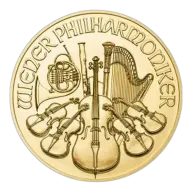
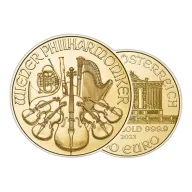
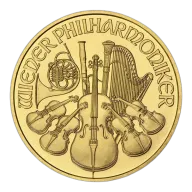
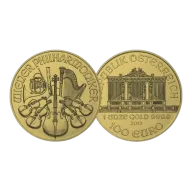
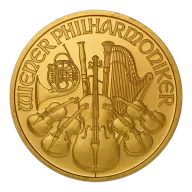
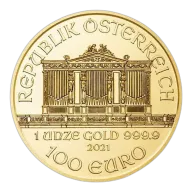
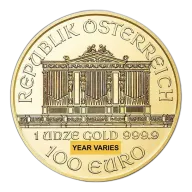
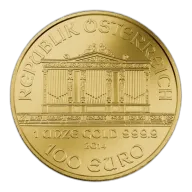
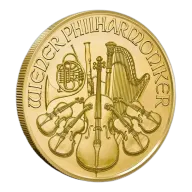
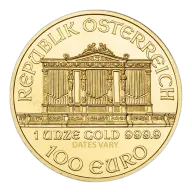
Named after the Vienna Philharmonic Orchestra, the coin depicts the pipe organ of the Musikverein's Golden Hall (Großer Musikvereinssaal) on the obverse and an ensemble of orchestral instruments on the reverse. Both designs were created by Austrian Mint engraver Thomas Pesendorfer for the 1989 launch and have remained unchanged since, with only the year-date and the schilling-to-euro denomination transition altering the coin's appearance over 35 years of continuous production.
The Philharmonic's consistent appeal rests on a combination of factors. Its .9999 purity matches the 1oz Gold Maple Leaf and 1oz Gold Britannia. Its premiums tend to sit at the lower end of the range for major sovereign gold coins, particularly in European markets where distribution is strongest. The euro denomination, though only valid as legal tender in Austria, gives it a familiar currency framework for buyers across the eurozone.
The trade-off is the absence of advanced anti-counterfeiting technology. The Philharmonic has no equivalent to the Maple Leaf's Bullion DNA, the Britannia's latent image and tincture lines, or the Perth Lunar's micro-laser engraving. The Austrian Mint relies on the intricate detail of the Pesendorfer design, precisely milled reeded edges, and the mint's institutional reputation. For most retail buyers purchasing from reputable dealers, this is sufficient. For secondary-market purchases of older coins, the lack of dedicated security features is a consideration.
1 oz Gold Philharmonic Technical Details
| Attribute | Detail |
|---|---|
| Metal content | 1 troy oz (31.103 g) fine gold |
| Purity | .9999 (99.99%, 24 carat) |
| Diameter | 37.0 mm |
| Face value | 100 EUR (pre-2002: 2,000 ATS) |
| Edge | Reeded |
| Issuer | Münze Österreich (Austrian Mint) |
| Designer | Thomas Pesendorfer |
| First issued | 1989 |
Philharmonic Gold Denominations
| Size | Face value | Weight | Diameter | First year |
|---|---|---|---|---|
| 1 oz | 100 EUR | 31.103 g | 37.0 mm | 1989 |
| 1/2 oz | 50 EUR | 15.552 g | 28.0 mm | 1991 |
| 1/4 oz | 25 EUR | 7.776 g | 22.0 mm | 1991 |
| 1/10 oz | 10 EUR | 3.110 g | 16.0 mm | 1991 |
| 1/25 oz | 4 EUR | 1.244 g | 13.0 mm | 2014 |
At 37.0 mm diameter, the 1 oz Philharmonic is the widest of the major gold coins at this weight. The Maple Leaf is 30.0 mm; the Britannia is 32.69 mm; the Krugerrand is 32.77 mm. The larger diameter produces a thinner profile, giving the coin a distinctive visual character that sets it apart from the more compact competitors.
The 1/25 oz denomination, introduced in 2014, was designed as an affordable entry point for new bullion investors in Europe, carrying a face value of just 4 euros. The Philharmonic relies on the intricate detail of its orchestral instrument design and precisely milled reeded edges for authentication rather than digital security technology. The silver Philharmonic is produced only in the 1 oz size, unlike competitors that offer multiple silver denominations.
Philharmonic Tax Treatment by Country
The Philharmonic's .9999 purity exceeds all investment gold thresholds, and its legal tender status (Austrian law) satisfies sovereign coin requirements. One important caveat: despite the euro denomination, the Philharmonic is legal tender only in Austria, not across the eurozone.
- United Kingdom: VAT-free as investment gold. Not CGT-exempt; only UK legal tender coins qualify. Capital gains are taxed at the individual's rate (18% basic, 24% higher), subject to the £3,000 annual allowance.
- Austria and EU: Gold Philharmonics appear on the EU's annual investment gold coin list and are VAT-exempt across all member states. Germany offers complete capital gains exemption on bullion held for more than one year, making the Philharmonic an especially attractive choice for German investors. Silver Philharmonics are subject to VAT at the local rate (20% in Austria), though German dealers commonly sell silver coins under the margin scheme (Differenzbesteuerung) at a reduced effective rate of approximately 7%.
- United States: IRA-eligible across gold (.9999 exceeds the 99.5% minimum), silver (.999 meets the minimum), and platinum (.9995 meets the minimum). Capital gains are taxed as collectibles at up to 28%. State sales tax varies.
- Canada: GST/HST exempt as investment gold at 99.5%+ purity. Not RRSP-eligible (not issued by a Canadian mint). Capital gains are taxed at a 50% inclusion rate.
- Australia: GST-free as investment-grade gold. CGT applies with a 50% discount for holdings over 12 months.
- Singapore: GST-exempt as an Investment Precious Metal. No capital gains tax.
- Hong Kong: No sales tax, no import duty, no capital gains tax.
- New Zealand: GST-exempt for fine gold at 99.5%+ purity.
Ransom Silver and a World-Class Orchestra
The Austrian Mint traces its origins to 1194, when Duke Leopold V of Austria used Richard the Lionheart's ransom to establish large-scale coin production in Vienna. Richard I of England had been captured during the Third Crusade, and Leopold extracted 12 tonnes of silver as payment for his release. That silver funded the Vienna Mint's expansion, giving the institution one of the most unusual founding stories in the minting world. Over eight centuries later, the same institution struck the first Gold Philharmonic on October 10, 1989.
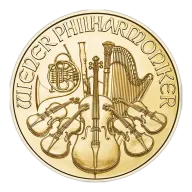
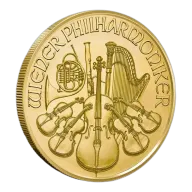
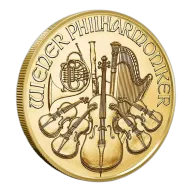
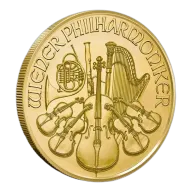
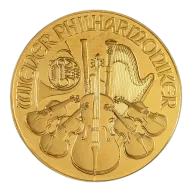
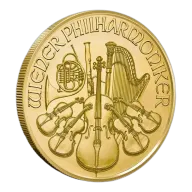
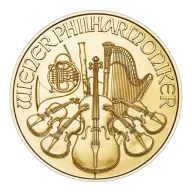
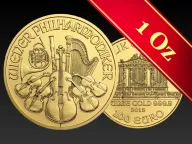
The coin was designed by Thomas Pesendorfer, an Austrian Mint engraver who created both the obverse and reverse for the launch. The obverse features the Rieger organ in the Musikverein's Golden Hall, built in 1870 and regarded as one of the finest concert venues in the world. The Vienna Philharmonic Orchestra's annual New Year's Concert from this hall is broadcast to over 90 countries. The reverse depicts a cello at centre, flanked by four violins, with a Wiener Horn, bassoon, and harp behind. The Wiener Horn (Vienna horn) is specifically depicted rather than a standard French horn, reflecting the orchestra's commitment to historically informed performance practice. The Vienna horn produces a warmer, rounder tone than its French counterpart.
The coin's early commercial success was striking. Within three years of its launch, the Philharmonic was the world's best-selling gold coin in 1992, a position it reclaimed in 1995, 1996, and 2000. From 1989 to 2012, the Austrian Mint sold 14 million gold Philharmonic coins, equivalent to approximately 329 tonnes of pure gold. Annual production fluctuated with global demand: the lowest year was 2001 at 54,700 coins (after the dot-com collapse), the highest was 2009 at 903,047 coins (financial crisis peak).
The silver Philharmonic launched on February 1, 2008, and the platinum version followed in 2016. Over 30 million silver Philharmonics were sold in the three-year period from 2021 to 2023 alone. The silver version is produced only in the 1 oz size, unlike competitors that offer multiple denominations.
In 2004, the Austrian Mint produced the "Big Phil", a 31 kg (1,000 troy ounce) gold coin with a face value of 100,000 euros. Only 15 were made. At the time of production, it was the largest gold coin ever minted.
Philharmonic vs Britannia, Maple Leaf, and Krugerrand
The 1 oz Gold Philharmonic competes directly with the Britannia, Maple Leaf, and 1oz Gold Krugerrand for the core bullion buyer. Its strongest position is in the European market; its weakest is in jurisdictions where competing coins carry specific tax advantages.
The 1oz Gold Britannia matches the Philharmonic at .9999 purity (since 2013) and adds a four-feature security suite: surface animation, latent image, tincture lines, and micro-text. For UK buyers, the Britannia is CGT-exempt; the Philharmonic is not. In European markets, however, the Philharmonic often trades at slightly lower premiums than the Britannia, and its euro denomination and strong continental distribution network give it the advantage.
The 1oz Gold Maple Leaf is the Philharmonic's closest match on purity and premium. Both are .9999 fine, both carry competitive premiums, both lack CGT exemption in the UK. The Maple Leaf's distinguishing advantage is the Bullion DNA verification system, which provides individual coin-level authentication. The Philharmonic has no equivalent technology. In terms of global distribution, the Maple Leaf has broader reach; the Philharmonic is strongest in Austria, Germany, and Japan, where the Austrian Mint has longstanding distribution relationships.
The 1oz Gold Krugerrand is 22-carat (.9167 fine), alloyed with copper for a distinctive reddish colour and greater scratch resistance. The Krugerrand has the deepest secondary market of any gold coin, built over nearly sixty years. The Philharmonic's advantages are purity (24-carat versus 22-carat), a euro-denominated face value, and its cultural distinction as the only major bullion coin celebrating a musical institution. For buyers who prioritise the purest possible gold in coin format, the Philharmonic and Maple Leaf are the natural choices over the Krugerrand.
The 1oz Gold American Eagle, like the Krugerrand, is 22-carat. The Eagle has greater liquidity in the North American market and a specific IRA exemption despite its sub-99.5% purity. The Philharmonic typically carries lower premiums than the Eagle and offers higher purity, making it a rational alternative for US buyers who want .9999 gold in an IRA.
1 oz Philharmonic Gold Coin: frequently asked questions
-
The cheapest 1oz Gold Philharmonic we track is $4,180.17 from Buy Gold and Silver Safely, currently 0.2% over spot. Prices update continuously as dealers adjust their listings, so comparing across dealers before buying can save a meaningful amount on a coin at this price point.
-
The 1oz Gold Philharmonic is .9999 fine gold (24 carat, four nines), the highest purity standard for mainstream bullion coins. It contains exactly one troy ounce of pure gold (31.1035g). The face value is 100 euros, though the gold content is worth substantially more.
-
The Gold Philharmonic is produced by Münze Österreich (the Austrian Mint) in Vienna and has been issued annually since 1989. It is legal tender in Austria. The obverse depicts the pipe organ of Vienna's Musikverein Golden Hall; the reverse shows a group of orchestral instruments from the Vienna Philharmonic. Investment-grade gold bullion coins are VAT-free across the EU and in the UK.
-
The 1oz Gold Philharmonic has a diameter of 37mm with reeded edges. The design by Thomas Pesendorfer has remained unchanged since the coin's 1989 launch, with only the year-date updated annually.