1 listing
Filters
| Product | /oz | Premium | Price | |
|---|---|---|---|---|

 Woodbury Gold Vault
|
$4,505.34 | +7.51% |
$4,505.30
£3,405
|
View Deal |
Prices are fetched automatically and may not reflect current merchant prices. Currency conversions and tax treatment are approximate. Rankings are based solely on price. We are not a dealer and accept no responsibility for transactions with listed merchants. Past performance is not indicative of future results. This site does not provide investment advice. Full disclaimer
About the 1 oz Pobjoy Mint Angel Gold Coin
The 1 oz Pobjoy Mint Gold Angel
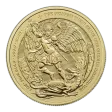
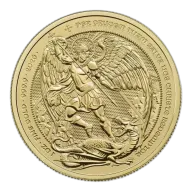
The Angel is the Isle of Man's flagship bullion coin, struck by the Pobjoy Mint from 1984 until 2016, after which the Tower Mint continued the series. The reverse depicts Archangel Michael slaying a dragon, a motif borrowed from the English gold Angel first struck under Edward IV in 1465, framed by a Viking knit border with the Manx triskele at the top. The design won a Coin of the Year award in its debut year.
Two things set the Angel apart from mainstream sovereign bullion. First, its issuer: the Isle of Man is a Crown dependency with its own coinage rights, not part of the United Kingdom, and it commissioned a private mint to strike its coins. The Pobjoy run from 1984 to 2016 was the longest-running sovereign bullion series produced by a single private mint. Second, its legal tender structure: like the Krugerrand, the Angel has no fixed face value, instead being legal tender at the value of its precious metal content.
Purity changed during the Pobjoy era. Coins struck before about 1992 were .917 fine (22 carat); from roughly 1992 the mint moved to 24 carat gold at .999 or .9999 fine. Both contain a full troy ounce of gold per 1 oz coin, with the earlier coins weighing more overall because of the copper alloy. The Pobjoy Mint itself closed in November 2023, ending any possibility of further coins from the original maker, which gives the Pobjoy-era Angels a closed-series character that standard 1oz gold coins from active mints lack.
Pobjoy Gold Angel Specifications by Era
The 1 oz coin's specifications depend on when it was struck. Post-1992 coins are 24 carat; pre-1992 coins are 22 carat with identical fine gold content but higher gross weight.
| Attribute | Post-1992 (.9999 fine) | Pre-1992 (.917 fine) |
|---|---|---|
| Gold content | 31.103 g (1 troy oz) | 1 troy oz |
| Gross weight | 31.2 g | 33.93 g |
| Diameter | 32.7 mm | 33 mm |
| Thickness | 2.8 mm | - |
| Edge | Reeded | - |
| Face value | None fixed; legal tender at metal value (Isle of Man) | |
The Pobjoy gold Angel was struck across a full denomination ladder: 1/20 oz, 1/10 oz, 1/4 oz, 1/2 oz, 1 oz, and 5 oz. The mint also produced unusual bimetallic variants, including a 1995 quarter-ounce with a gold centre and platinum ring, a 2007 one-ounce gold coin with a silver ring, and a 2011 one-ounce with a platinum centre and gold ring. The obverse carries Queen Elizabeth II's portrait, with four different effigies used across the series: the second portrait on the 1984 coin, the third from 1985 to 1997, the fourth from 1998 to 2014, and the fifth from 2015 onward. Those portrait changes give date runs a built-in collecting structure.
Gold Angel Tax Treatment
The Angel's unusual legal status matters most in the UK, where the distinction between Manx and UK legal tender has a direct tax consequence.
- UK: 0% VAT, since gold Angels qualify as investment gold regardless of issuer. However, the coin is NOT CGT-exempt: it is legal tender only in the Isle of Man, not the UK, and the Capital Gains Tax exemption is reserved for UK legal tender coins from the Royal Mint. Gains above the annual allowance are taxable.
- US: Post-1992 Angels at .9999 fine meet the IRS fineness requirement for precious metals IRAs (gold must be 0.995+ fine); pre-1992 coins at .917 fine do not qualify. Long-term gains are taxed as collectibles at up to 28% federally. Most states exempt bullion from sales tax.
- EU: 0% VAT as investment gold.
- Canada: Post-1992 coins at 99.5%+ purity are GST/HST exempt; pre-1992 22ct coins fall below the threshold.
- Australia and New Zealand: The 99.5% purity tests for GST exemption are met by post-1992 coins only. In New Zealand, 22ct coins attract 15% GST.
- Isle of Man: Legal tender at the value of the coin's metal content.
UK buyers for whom CGT matters should compare the Angel against the 1oz gold Britannia, which pairs the same VAT exemption with full CGT exemption. Buyers in 24ct-sensitive jurisdictions should confirm the year, and therefore the purity, of any secondary-market Angel.
From Edward IV to the Pobjoy Mint
The original English gold Angel was introduced by Edward IV in 1465 and carried the image of Archangel Michael for nearly two centuries, with the last hammered Angels struck in 1642 under Charles I. The coin acquired a folkloric role along the way: it was used in royal touching ceremonies, in which the monarch was said to cure scrofula, the "king's evil", through contact with the coin.
The Pobjoy Mint, founded in 1965 by Derek Pobjoy in Surrey, revived the motif for the Isle of Man in 1984, and the modern series ran continuously under Pobjoy until 2016. The design evolved in distinct phases: the Angel faced left from 1984 to 1993, right from 1994 to 2007, adopted a more upright right-facing stance from 2008, and reverted to the left-facing pose in 2016. The 2009 issue is an outlier with three distinct designs produced in that year only, and some left-facing coins also appeared in 2014.
Pobjoy's wider record explains the Angel's production quality. The mint struck the Isle of Man's platinum Noble (1983-1989), the world's first investment coin in 0.9995 fine platinum, and produced the world's first titanium coin in 1999. At its peak it struck coins for roughly 20% of the world's governments and central banks, plus circulating currency for British Overseas Territories. The Tower Mint took over the Angel after 2016, and Pobjoy closed entirely in November 2023 following Taya Pobjoy's retirement, fixing the Pobjoy-era Angels as a finite, completed series.