1 listing
Filters

 APMEX
APMEX
Prices are fetched automatically and may not reflect current merchant prices. Currency conversions and tax treatment are approximate. Rankings are based solely on price. We are not a dealer and accept no responsibility for transactions with listed merchants. Past performance is not indicative of future results. This site does not provide investment advice. Full disclaimer
About the 1 oz South Korean Tiger Gold Coin
KOMSCO's South Korean Tiger Gold Medal
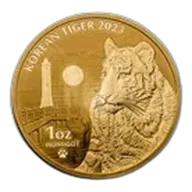
The 1 oz KOMSCO South Korean Tiger Gold Coin is an annual bullion medal produced by KOMSCO (Korea Minting, Security Printing and ID Card Operating Corporation), the state-owned mint of South Korea. Despite being struck by a sovereign government mint, the Tiger carries no legal tender face value and is classified as a medal rather than a coin, an unusual hybrid that provides sovereign mint credibility without formal currency status.
The Tiger series launched in gold in 2016 and has produced a new design each year, with the tiger (ho-rang-i) depicted in traditional Korean art style. The tiger is a major cultural symbol in Korea, believed to ward off evil spirits and representing courage and power. Each annual design presents the animal in a different pose or setting, from climbing Seoraksan mountain (2022) to tiger cub themes exploring Korean cities (2020 onward).
Gold versions are struck in .9999 fine gold across four weight classes: 1 oz, 1/2 oz, 1/4 oz, and 1/10 oz. Annual gold mintages are notably low, typically around 4,000 units for the larger sizes. This scarcity, combined with the changing annual designs, has created a strong secondary market following, particularly in East Asian bullion markets where earlier years can command significant premiums above metal value.
KOMSCO applies the same banknote-level anti-counterfeiting technology used for South Korean currency. The reverse features a proprietary holographic latent image that transitions between purity markers when tilted at different angles, a security feature derived from currency printing expertise that arguably represents the most sophisticated anti-counterfeiting technology on any bullion product.
South Korean Tiger 1 oz Gold Medal Specifications
| Attribute | Value |
|---|---|
| Weight | 1 troy oz (31.1035 g) |
| Purity | .9999 fine gold (24K) |
| Face Value | None (medal, not legal tender) |
| Typical Mintage | ~4,000 per year |
| Finish | BU, Proof, and Antiqued variants |
| Manufacturer | KOMSCO (Korea Minting, Security Printing & ID Card Operating Corp.) |
| Security | Holographic latent image technology |
| Series Start | 2016 (gold) |
The reverse design remains consistent across years: a stylised map of the Korean peninsula formed from Hangul script characters, with "REPUBLIC OF KOREA," the year, weight, and fineness inscriptions. The obverse changes annually, always featuring the tiger in a different composition. The Hangul script map is a distinctive artistic choice that connects the product to Korean cultural identity beyond the tiger motif itself.
Gold weight options span 1/10 oz, 1/4 oz, 1/2 oz, and the full 1 oz. The silver companion series (launched 2018) is available in 1 oz and 10 oz. A shaped silver variant was introduced in 2025, measuring 61 x 80 mm, breaking from the traditional round format entirely.
Tax Treatment for KOMSCO Tiger Gold Medals
The medal classification (no face value, not legal tender) affects tax treatment differently than sovereign bullion coins in most jurisdictions.
United Kingdom
Gold medals and rounds without legal tender status do not automatically qualify for the investment gold VAT exemption, which requires coins to be legal tender, post-1800, and .900+ purity. Gold bars of .995+ purity are separately VAT-exempt. Whether a gold medal is treated as a "bar" or as a manufactured gold article can depend on the specific dealer and HMRC interpretation. In practice, most UK bullion dealers sell gold medals VAT-free, treating them as investment gold, but the legal basis is less clear-cut than for legal tender coins like the 1 oz Britannia.
United States
No federal sales tax on gold. State-level treatment for medals varies. The .9999 purity meets the general precious metals threshold in states that exempt bullion. For IRA purposes, Section 408(m) requires gold to be at least .995 fine and either a legal tender coin or produced by a national government mint, or a bar meeting certain refinery standards. KOMSCO is a national government mint, but the medal format (not legal tender) creates ambiguity. Custodian acceptance should be verified.
Canada
The GST/HST exemption for precious metals requires bars, ingots, coins, or wafers of .995+ purity. Medals are not explicitly listed, though the purity threshold is met. Treatment may depend on the interpretation of "coin" versus "medal."
Australia
Investment-grade precious metals of .995+ purity in forms commonly traded on commodity markets are GST-exempt. Gold medals may or may not qualify depending on whether they are considered a form "commonly traded."
Singapore and Hong Kong
Singapore's IPM exemption covers qualifying coins on the MAS-approved list and gold of .995+ purity in bar, ingot, or wafer form. Medals are not explicitly included. Hong Kong imposes no sales tax, no import duty, and no capital gains tax on gold regardless of form.
KOMSCO Tiger vs Asian Government Mint Bullion
The Tiger occupies a distinctive position as a medal from a sovereign mint, sitting between the Chinese Gold Panda (legal tender, .999 purity, high mintage) and private mint rounds (no government backing, variable purity).
Against the Chinese Panda, the Tiger offers higher gold purity (.9999 vs .999), lower annual mintage (~4,000 vs hundreds of thousands), and arguably superior anti-counterfeiting technology via the holographic latent image system. The Panda, as legal tender of China, has cleaner tax treatment in most jurisdictions and far greater liquidity worldwide. Both feature annual design changes and appeal to East Asian collectors, but the Panda's established 40-year history dwarfs the Tiger's decade-long run.
Against the KOMSCO Chiwoo Cheonwang, the Tiger's sister series from the same mint, the comparison is primarily thematic. The Chiwoo features a legendary warrior figure; the Tiger features the national animal. Both share the same holographic security features, similar mintages, and identical production quality. Collectors often pursue both series in parallel.
For pure gold accumulation, the 1 oz Australian Kangaroo or 1 oz Canadian Maple Leaf deliver the same .9999 purity at lower premiums and with immediate global liquidity. The Tiger commands a collector premium that reflects its low mintage and artistic value, not its gold content. Buyers choosing the Tiger are accepting a higher entry cost in exchange for potential numismatic appreciation and the distinctive Korean cultural character of the product.