 Best Bullion


Prices are fetched automatically and may not reflect current merchant prices. Currency conversions and tax treatment are approximate. Rankings are based solely on price. We are not a dealer and accept no responsibility for transactions with listed merchants. Past performance is not indicative of future results. This site does not provide investment advice. Full disclaimer
About the 1g Germania Mint Gold Bar
A Polish-Made Bar with Germanic Branding
The 1g Germania Mint Gold Bar is a 999.9 fine gold bar from Germania Mint, a private mint headquartered in Jelenia Gora, Poland. Despite the Germanic name and branding, which references the Latin name Romans used for the lands north of the Rhine, the mint operates from Polish facilities. Founded by numismatist Apolinary Kurowski in 1986 as a coin shop, Germania Mint has grown to approximately 200 employees under the current ownership of his son Szymon Kurowski, making it one of the largest private bullion mints in the world.
At one gram, this bar occupies the same entry-level bracket as all 1g gold bars, priced around $100-120 with premiums in the 8-15% range over spot. Thirteen dealers currently carry the product, placing it in the upper tier for availability at this weight. The bar comes sealed in tamper-evident packaging with a certificate of authenticity and individual serialisation.
The 999.9 purity (four nines) is noteworthy for a private mint product. Most private mint rounds and bars are produced at 999 (three nines), so Germania Mint's four-nines standard matches the purity of LBMA-accredited Swiss refiners. The bar carries detailed engraving and the Germania Mint hallmark, though it lacks the proprietary anti-counterfeiting technologies found on products from PAMP (Veriscan) or Geiger Edelmetalle (UV coating).
An important distinction for tax-conscious buyers: Germania Mint is a private mint, not a sovereign mint or LBMA-accredited refinery. This affects tax treatment in certain jurisdictions. In the UK, gold bars from non-LBMA sources may face complications with the investment gold VAT exemption, though bars at 999+ fineness from recognisable manufacturers are generally accepted. The bar's main appeal is competitive pricing combined with four-nines purity and strong dealer availability.
1g Germania Mint Gold Bar Details
| Attribute | Detail |
|---|---|
| Weight | 1 gram (0.03215 troy oz) |
| Purity | 999.9 fine gold (24 karat) |
| Manufacturer | Germania Mint |
| Country of manufacture | Poland (Jelenia Gora) |
| Format | Minted bar in tamper-evident packaging |
| Serial number | Individually serialised with certificate of authenticity |
| LBMA status | Not LBMA-accredited |
| Legal tender | No |
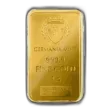
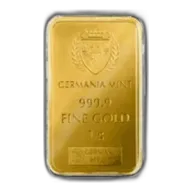
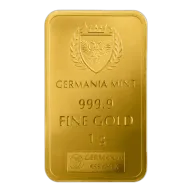
The bar features detailed engraving with the Germania Mint name and hallmark, alongside weight and purity markings. Germania Mint produces bars across multiple sizes as part of its gold product range, complementing its more widely known coin series. The mint also produces sovereign coins under agreement with foreign central banks, including issues for Malta and Niue, though those are separate products from the Germania bar range.
Tax Treatment of the 1g Germania Mint Gold Bar
As a private mint product without legal tender status or LBMA accreditation, the tax treatment of the Germania Mint gold bar requires more care than LBMA-accredited alternatives in some jurisdictions.
United Kingdom
Investment gold at 995+ fineness is VAT-exempt in the UK. The Germania Mint bar at 999.9 fineness meets this purity threshold. Bars are subject to Capital Gains Tax on disposal, with no CGT exemption (not UK legal tender). The lack of LBMA accreditation does not automatically disqualify the bar from the VAT exemption, but buyers should ensure their dealer confirms the investment gold classification.
Germany and the EU
Investment gold bars at 995+ fineness are VAT-exempt under EU Directive 98/80/EC. In Germany, capital gains on gold held for more than one year are tax-free. The bar qualifies for both provisions based on purity alone, regardless of LBMA membership status.
United States
The Germania Mint bar's IRA eligibility is uncertain. IRS Section 408(m) requires gold at 99.5%+ purity from refiners meeting certain criteria. Without LBMA accreditation, IRA custodians may not accept Germania Mint bars. Buyers planning IRA inclusion should verify with their custodian before purchasing. State sales tax varies; approximately 35 states exempt bullion. Capital gains taxed at up to 28% as collectibles.
Canada
GST/HST exemption applies to gold bars at 99.5%+ purity in bar, ingot, or coin form. The purity requirement is met. RRSP/TFSA eligibility may depend on custodian acceptance.
Australia, Singapore, Hong Kong
GST-free in Australia for investment-grade gold at 99.5%+ purity. GST-exempt in Singapore under the Investment Precious Metals scheme for gold at 99.5%+ purity from qualifying sources. Hong Kong has no sales tax or capital gains tax.
Germania Mint vs Other 1g Gold Bars
The Germania Mint 1g bar competes on price and purity against established LBMA-accredited refiners. Its position as a non-LBMA private mint product creates a distinct profile with both advantages and limitations.
The 1g Valcambi bar offers the same 999.9 purity with LBMA Good Delivery accreditation and over 70 dealers. Valcambi bars have the widest global liquidity and are accepted by virtually all IRA custodians and institutional buyers. The premium difference is typically modest, with Valcambi at slightly lower premiums due to economies of scale and distribution depth.
The 1g Geiger Edelmetalle Original bar is another non-Good-Delivery German-market product with 14 dealers (versus Germania's 13). Geiger holds LBMA Affiliate membership and differentiates with UV-reactive security coating, reeded edges, and the distinctive square format. Geiger bars carry a collector following and stronger security features. The two products target overlapping but distinct audiences: Geiger for security-conscious collector-investors, Germania for buyers attracted to the brand's design aesthetic and competitive pricing.
The 1g Heraeus bar and 1g C.Hafner bar represent the LBMA Good Delivery German alternatives. Both have institutional-grade credentials and clean, corporate designs. For buyers who need guaranteed LBMA acceptance, these are the German products to choose.
Germania Mint's strengths are competitive pricing, four-nines purity, and a growing brand presence through major US and European dealers (available on APMEX, JM Bullion, SD Bullion, and Hero Bullion). Its limitations are the absence of LBMA accreditation and proprietary security features. For buyers building IRA positions or seeking maximum institutional liquidity, LBMA-accredited alternatives are the safer path. For buyers who prioritise value per gram and are comfortable with a private mint product, Germania Mint delivers genuine four-nines gold at a straightforward price.
1g Germania Mint Gold Bar: frequently asked questions
-
The cheapest 1g Germania Mint gold bar tracked here is NZ$276.05, which is about 18.2% over the NZ$7,272.02 gold spot price. Small bars carry a higher percentage premium than larger ones because minting costs are spread across just 1 gram of .9999 fine gold.
-
Germania Mint is a private bullion mint based in Poland. Despite the name, it is not a German state mint: "Germania" is the historical Latin name for the Germanic lands. The mint produces both minted bullion bars and collector coins sold internationally.
-
An assay card is a tamper-evident sealed package that holds the bar alongside a certificate confirming its weight and purity, issued by the refiner. Keeping the seal intact preserves the authentication chain. Assay-carded bars are generally easier to resell and may command a small premium over loose bars of the same weight.
-
Minted bars are cut from rolled sheet metal and then stamped to precise dimensions, giving a sharp finish with clear hallmarks. Cast bars are poured into moulds and have a rougher, more varied appearance. Because minting involves extra processing steps, minted bars typically carry a slightly higher premium over spot than equivalent cast bars.
-
Start by checking that the assay card seal is intact and undamaged. Weigh the bar: it should be exactly 1.000g. Inspect the hallmarks for the 999.9 fineness stamp and the Germania Mint logo. For deeper assurance, an XRF (X-ray fluorescence) test or ultrasound density check at a specialist dealer can confirm metal composition without opening the card.