 APMEX
APMEX


Prices are fetched automatically and may not reflect current merchant prices. Currency conversions and tax treatment are approximate. Rankings are based solely on price. We are not a dealer and accept no responsibility for transactions with listed merchants. Past performance is not indicative of future results. This site does not provide investment advice. Full disclaimer
About the 100g Engelhard Silver Bar
A Vintage 100g Silver Bar from a Defunct American Refiner
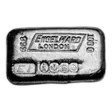
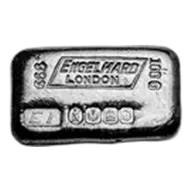
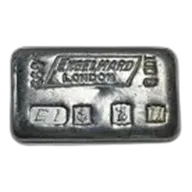
The 100g Engelhard silver bar is a product of a company that no longer exists, which is precisely why collectors and investors pay attention to it. Charles W. Engelhard Sr. founded the company in 1902 in Newark, New Jersey. By the 1950s, Engelhard was the world's largest precious metals smelter. Retail silver bar production ran from the late 1960s through approximately 1986, and BASF acquired the company in 2006 for $5 billion, ending the Engelhard name entirely.
Every Engelhard bar on the market today is secondary market stock. No new bars will ever be produced. This creates a collector dynamic absent from bars by active refiners like PAMP or Heraeus: the supply only shrinks over time as bars are lost, damaged, or permanently held. The 1979-1980 Hunt Brothers silver spike, when prices reached approximately $50/oz, led to mass meltdowns of Engelhard bars, further reducing surviving stock and paradoxically increasing the long-term collector value of remaining pieces.
At .999 fine silver, the metal content is identical to any modern 100g silver bar. The premium above spot reflects Engelhard's historical significance, scarcity, and the brand's cultural resonance. Charles Engelhard Jr. is widely cited as the inspiration for Ian Fleming's James Bond villain Auric Goldfinger, adding a pop culture dimension to what is otherwise a straightforward precious metals refining story.
Engelhard 100g Silver Bar Identification
| Property | Detail |
|---|---|
| Weight | 100 grams (3.215 troy oz) |
| Purity | .999 fine silver |
| Manufacturer | Engelhard (Newark, NJ; defunct since 2006) |
| Serial number | Yes (unique, various format types) |
| Production period | Late 1960s to approximately 1986 |
| Production method | Cast (poured), pressed, or extruded depending on era |
| Legal tender | No |
| Current production | None (brand extinct) |
Engelhard bars exist in numerous varieties, documented extensively by the AllEngelhard.com collector community, which serves as the definitive reference for identification and authentication. The site catalogues over 40 distinct varieties for the 1oz size alone, with additional variations at every other weight. Serial number formats vary between numerical-only (5-6 digits) and letter-prefix systems (e.g. PA, PB, FG series for smaller bars; P, S, W, C prefixes for larger bars). The "PB" prefix uses 6 digits while most other prefixes use 5.
Production methods evolved over Engelhard's two-decade retail bar run. Earliest bars (late 1960s) used elongated octagon hallmarks with an extruded finish. The 1970s introduced the bull-and-bear commercial logo. Portrait-orientation bars (1981-1986) featured the distinctive 'E' globe logo in multiple sizes. The final production run in 1986 used an Eagle logo design before Engelhard exited the retail market entirely.
Authentication relies on verifying serial number format, font consistency, edge finishing, and weight against the documented characteristics for the specific variety claimed. Counterfeits are common, particularly at the 100oz size. Genuine bars show consistent period-appropriate fonts and spacing that counterfeiters struggle to replicate with precision.
Tax Treatment of Vintage Engelhard Silver
Engelhard bars receive the same tax treatment as any .999 silver bar. Their vintage status and collector premium do not create special tax categories in any jurisdiction.
- United Kingdom: 20% VAT on purchase (applies to all silver bullion). CGT on disposal. No legal tender status, no CGT exemption. Margin scheme (VAT on dealer's profit margin only) commonly applies since these are by definition second-hand products
- United States: Capital gains taxed at the 28% collectibles rate. The .999 purity meets IRA fineness requirements. Some dealers and custodians list Engelhard bars as IRA-eligible due to the .999 purity and Engelhard's historical NYMEX/COMEX accreditation, though approval depends on the specific custodian. State sales tax varies by state
- Canada: GST/HST exempt at 99.9%+ purity
- Australia: GST-free for investment-grade silver at 99.9%+ purity
- EU: Standard VAT applies. German margin scheme (Differenzbesteuerung) commonly used for second-hand silver bars, which would naturally apply to Engelhard bars purchased through German dealers
One tax consideration specific to Engelhard bars: if the collector premium significantly exceeds the metal value, some jurisdictions may question whether the item qualifies as "investment bullion" or should be classified as a collectible or antique with different rules. In practice, most dealers and tax authorities treat them as bullion bars regardless of the premium paid. The margin scheme in the UK and EU is particularly relevant here, as all Engelhard bars are necessarily second-hand, so the reduced VAT treatment should apply automatically.
Engelhard vs Johnson Matthey and Modern Refiner Bars
Engelhard bars occupy a distinct category: vintage, collector-premium bullion from a defunct refiner. The relevant comparisons are against other discontinued-brand bars and against modern alternatives at the same weight.
Engelhard and Johnson Matthey (JM) bars are the two iconic vintage American silver bar brands. Both were major refiners, both are .999 fine, and both ceased retail bar production (JM's bullion arm was sold to Asahi in 2015). Engelhard bars generally command higher collector premiums than equivalent JM bars due to greater variety of types, the Goldfinger connection, and more aggressive meltdowns during the Hunt Brothers spike reducing survivor numbers.
Against modern bars from PAMP Suisse or Heraeus, Engelhard bars carry substantially higher premiums for the same silver content. A buyer choosing Engelhard is paying for provenance, scarcity, and collector demand rather than pure metal exposure. Modern LBMA bars are the rational choice for investors focused on accumulating silver weight at minimum cost. Engelhard bars suit those who value the historical connection and believe the collector premium will hold or grow as surviving stock diminishes further.
The authentication risk is also higher with Engelhard bars. Modern bars from active refiners can be verified against current security features and manufacturer databases. Engelhard bars require knowledge of period-specific characteristics and reference to collector documentation at AllEngelhard.com, making them a specialist purchase that rewards research and careful sourcing from reputable dealers.
100g Engelhard Silver Bar: frequently asked questions
-
The cheapest Engelhard 100g silver bar we track is $1,046.19, currently around 398.1% over the silver spot price. The bar contains 100 grams of .999 fine silver, so its melt value follows the spot price directly. Check the comparison table for the latest dealer prices.
-
Engelhard ceased precious metals production decades ago, making its bars secondary-market collectibles rather than newly minted bullion. Collector demand for the Engelhard name pushes prices above melt value, with the premium varying by bar type, condition, and market demand at the time of sale. Buyers are paying partly for silver content and partly for the Engelhard provenance.
-
Store silver bars in airtight capsules or zip-lock bags with the air removed to limit exposure to oxygen and humidity. Anti-tarnish strips in the storage container help absorb sulphur compounds that cause discolouration. Avoid PVC flips or holders, which can react with silver over time and cause spotting. Keep bars away from rubber, wool, and household chemicals.