 APMEX
APMEX
1 listing
Filters
| Product | /oz | Premium | Price | |
|---|---|---|---|---|
| $215.40 | +227.41% | $692.54 | View Deal |

Prices are fetched automatically and may not reflect current merchant prices. Currency conversions and tax treatment are approximate. Rankings are based solely on price. We are not a dealer and accept no responsibility for transactions with listed merchants. Past performance is not indicative of future results. This site does not provide investment advice. Full disclaimer
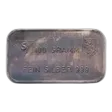
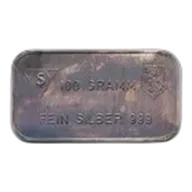
About the 100g Swiss Bank Corporation Silver Bar
The 100g Swiss Bank Corporation Gold Bar
The 100g Swiss Bank Corporation gold bar contains 100 grams (3.2151 troy ounces) of 999.9 fine gold, carrying the name of one of the great institutions of Swiss banking history. Swiss Bank Corporation ceased to exist as an independent bank following its merger with UBS in 1998, which places these bars firmly in secondary-market territory and gives them a historical character that current-production refinery bars lack.
SBC's connection to gold refining ran deep. The bank acquired the Le Locle refining business that became Metalor in 1918 and renamed it Métaux Précieux SA Metalor in 1936. That refinery became the first Swiss producer listed on the LBMA Good Delivery List in 1934 and remained an SBC subsidiary until the merger, after which UBS spun it off. SBC also held a stake in the refining world through Argor-Heraeus, an ownership position UBS exited in 1999 after the merger completed. A gold bar bearing the SBC name sits at the centre of that Swiss bank-and-refinery tradition.
The weight itself is one of the most cost-efficient ways to hold gold. At 100g, typical premiums of 2 to 4 percent over spot approach kilo-bar territory, and the drop from 50g premiums (3 to 6 percent) to 100g is one of the sharpest efficiency gains anywhere in the gram bar range. The format is a standard trading size in European bullion markets and is also common in Singapore and Hong Kong, though it is less dominant in the US, where troy-ounce denominations prevail. A 100g gold purchase is substantial: with gold around $10,000 to $10,500 for this weight, it is a significant single allocation.
The trade-off against a current-production bar from the 100g gold bar market is liquidity rather than gold content. Defunct-brand bars follow the same dynamic dealers describe with Credit Suisse bars: the brand can outlive the institution, and the value rests on the gold itself rather than the bank's financial standing. For buyers who want maximum metal per pound or dollar with a piece of Swiss banking history stamped on it, the SBC bar is a distinctive alternative to the interchangeable modern refinery products.
100g Swiss Bank Corporation Gold Bar Specifications
| Specification | Detail |
|---|---|
| Weight | 100 grams (3.2151 troy oz) |
| Purity | 999.9 fine gold |
| Form | Bar |
| Face value | None (bars are not legal tender) |
| Issuer | Swiss Bank Corporation (merged into UBS, 1998) |
A 100g gold bar is remarkably compact thanks to gold's density: the format typically measures roughly 47mm x 27mm x 5mm, though exact dimensions vary by manufacturer, and it fits in a shirt pocket. Like all gold bars, it carries no face value and is not legal tender; its worth is its fine gold content plus whatever premium the market assigns the brand.
Authentication deserves attention at this weight. Bars of 100g and above are the size range where tungsten-core counterfeits become a practical concern, because tungsten's density (19.25 g/cm3) sits close enough to gold's (19.32 g/cm3) to pass weight and dimension checks. XRF testing only reads the surface, so it cannot rule out a plated core. Ultrasonic testing is the most reliable non-destructive method, since gold and tungsten transmit sound at very different velocities, and electromagnetic verifiers such as the Sigma Metalytics unit remain effective up to about 100g. For a secondary-market bar from a defunct issuer, buying from a reputable dealer and keeping any intact packaging or paperwork with the bar matters more than it would for a sealed current-production product.
Tax Treatment of the 100g SBC Gold Bar by Country
At 999.9 fineness, this bar clears the investment-gold purity thresholds in every major jurisdiction, so it falls under the gold exemption regimes rather than the VAT treatment applied to silver and platinum.
- UK: Investment gold bars at 995+ purity are VAT-exempt. Bars are not CGT-exempt, however; that exemption is reserved for UK legal tender coins. Gains above the £3,000 annual allowance are taxed at 10 to 20 percent depending on income.
- EU: 0% VAT across all member states under the Investment Gold Directive, which covers gold bars and wafers of 995+ fineness.
- Switzerland: Investment gold carries no VAT in the bar's home market.
- US: Sales tax is state-dependent; most states exempt bullion bars. Long-term capital gains are taxed at the 28 percent collectibles rate. IRA eligibility requires bars from LBMA/COMEX/NYMEX-accredited refiners held at an approved depository.
- Canada: 0% GST/HST for gold refined to 99.5%+ purity in bar form.
- Australia: GST-free as investment-grade gold (99.5%+ purity threshold).
- New Zealand: GST-exempt for gold bars at 99.5%+ purity.
- Singapore: 0% GST under the Investment Precious Metals scheme for gold of 99.5%+ purity, with no capital gains tax.
- Hong Kong: No sales tax, no import duty, no capital gains tax.
The key lifecycle point for UK buyers is the CGT position: a gold bar is VAT-efficient on purchase but CGT-liable on sale, so for gains beyond the annual allowance, CGT-exempt legal tender coins can work out cheaper overall despite higher initial premiums.
SBC Bar vs Valcambi, PAMP, and Argor-Heraeus at 100g
The natural alternatives are the current-production Swiss 100g bars. The Valcambi 100g is described as one of the world's best-selling products in this format, made by the largest precious metals refinery in the world by capacity at 2,000 metric tonnes annually. It typically carries the lowest acquisition premiums of the major brands and is the cost-focused investor's default choice. The PAMP Suisse 100g bar carries the iconic Lady Fortuna design at a slightly higher premium, which it retains better at resale; PAMP and Valcambi bars are the most liquid in the format, recognised by dealers worldwide. The Argor-Heraeus 100g rounds out the Swiss trio, from a refinery LBMA-accredited since 1961 whose kinebar holographic security line added 50g and 100g weights in 2012.
Against all three, the SBC bar trades current-production advantages for history. Modern bars come sealed in tamper-evident assay cards with serial numbers, and PAMP and Valcambi add VeriScan verification technology; an SBC bar predates these conveniences, so resale may involve more scrutiny. Liquidity follows the pattern dealers report for other defunct Swiss bank brands: Credit Suisse bars remain among the most traded gold bullion products globally despite the bank no longer existing, proof that a strong brand on good gold keeps selling, but bars outside the major current LBMA names can face a narrower buyer pool and possible assay testing before a dealer pays full value.
The decision comes down to what the buyer values. All of these bars deliver the same 100 grams of 999.9 fine gold with the same tax treatment, and the 100g format's 2 to 4 percent premium efficiency applies across the board. A buyer prioritising the smoothest resale should take the Valcambi 100g gold bar or PAMP. A buyer who likes the idea of gold stamped by a bank that owned Switzerland's first LBMA-listed refinery, at a weight that keeps the premium low, has a reason to pick the SBC bar instead.