1 listing
Filters
| Product | /oz | Premium | Price | |
|---|---|---|---|---|

 Alex Lexington
|
$70.90 | +8.55% | $7,090.20 | View Deal |
Prices are fetched automatically and may not reflect current merchant prices. Currency conversions and tax treatment are approximate. Rankings are based solely on price. We are not a dealer and accept no responsibility for transactions with listed merchants. Past performance is not indicative of future results. This site does not provide investment advice. Full disclaimer
About the 100 oz CNT Silver Bar
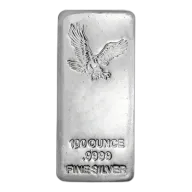
CNT Minting's .9999 Fine 100 oz Silver Bar
The 100 oz CNT Silver Bar delivers .9999 fine silver from one of the largest privately owned companies in the US precious metals industry. CNT, founded in 1973, operates a minting division that produces ultra-high purity silver bullion across weights from fractional ounces to this 100 oz format. The four-nines purity exceeds the .999 standard used by most LBMA-accredited refiners, placing CNT's metallurgical output alongside the Royal Canadian Mint and a small number of other producers who refine to this level at scale.
CNT's position in the industry is distinctive. The parent company describes itself as the largest privately owned entity in precious metals, with operations spanning refining, minting, and distribution. The minting division produces both CNT-branded bullion and contract-minted products for other brands. This industrial scale means the 100 oz bar benefits from production efficiencies that smaller private mints cannot match, which should translate into competitive premiums for buyers.
The .9999 purity is the bar's headline specification. At 100 troy ounces, the difference between .999 and .9999 amounts to approximately 0.31 grams of additional pure silver. The practical significance is not in metal content but in market positioning: the bar exceeds all tax-exemption thresholds worldwide, clears IRA purity requirements with margin, and signals production quality above the generic .999 baseline.
For US buyers, CNT's domestic production and long operating history provide straightforward access through American dealers. The company's 50+ year track record and scale lend credibility to the purity claim, though the absence of LBMA accreditation means international buyers cannot rely on the independent auditing standard that LBMA-accredited refiners undergo. Domestically, CNT's reputation and dealer relationships provide adequate assurance for the North American market.
100 oz CNT Silver Bar Technical Details
| Attribute | Detail |
|---|---|
| Weight | 100 troy oz (3,110.35 g) |
| Purity | .9999 fine silver (99.99%) |
| Manufacturer | CNT Minting (division of CNT) |
| Manufacturer type | Private mint |
| Country of origin | United States |
| Founded | 1973 |
| Markings | CNT branding, weight, purity |
CNT Minting operates as the production division within the broader CNT precious metals company. The minting operation produces a wide range of products spanning gold and silver in multiple forms (bars, rounds, coins) across weights from 1/10 oz fractional pieces to 100 oz large-format bars. The 100 oz silver bar sits at the top of their size range for silver products.
The .9999 purity requires refining beyond the standard .999 level that most commercial silver bar producers target. This additional refinement step removes the final traces of copper, lead, and other metallic impurities that remain after initial refining. For a company processing precious metals since 1973, the four-nines standard reflects decades of refining capability development.
Tax Treatment of the 100 oz CNT Silver Bar
The .9999 purity places this bar above all investment-grade thresholds globally, ensuring tax-exempt treatment wherever silver bullion qualifies for exemptions.
United States
The primary market. No federal sales tax. State-level treatment varies, with approximately 35 states fully exempting precious metals from sales tax. The .9999 purity exceeds the IRS Section 408(m) minimum for silver in precious metals IRAs (.999 required). IRA eligibility from private mints depends on the specific custodian; some require LBMA accreditation or equivalent certification, while others accept .999+ silver from established US producers. Capital gains at the 28% collectibles rate for assets held over one year; short-term gains taxed as ordinary income.
United Kingdom
Subject to 20% VAT on purchase. No exemption exists for silver bars regardless of purity, origin, or manufacturer reputation. CGT applies on disposal at the individual's marginal rate (18% basic, 24% higher). No legal-tender exemption available for any bar product.
Canada
GST/HST exempt at .999+ purity in bar form. The .9999 exceeds the 99.9% threshold required for the federal precious metals exemption.
Australia and New Zealand
GST-free in Australia for investment-grade silver at .999+ purity. GST-exempt in New Zealand at the same threshold. Both countries apply purity-based criteria rather than manufacturer-specific requirements.
Singapore and Hong Kong
Singapore's IPM scheme exempts silver at .999+ from qualifying sources. Hong Kong imposes no sales tax, import duty, or capital gains tax on precious metals.
CNT vs Other .9999 Fine 100 oz Silver Bars
The .9999 purity field at 100 oz includes the Royal Canadian Mint, Argentia, and Canadian PMX, alongside CNT. The RCM dominates this group with government-mint backing, LBMA accreditation, and global brand recognition. Argentia and Canadian PMX are Canadian private mints competing on the same purity specification. CNT brings US origin and a 50+ year operating history.
Against the RCM's 100 oz bar, CNT offers the same purity without the premium uplift that government-mint branding commands. The RCM bar is serialised, universally recognised, and carries implicit sovereign quality assurance. CNT competes on price, appealing to buyers who want .9999 purity at the lowest available premium without paying for brand prestige.
Compared to LBMA-accredited .999 bars from ABC Refinery, Argor-Heraeus, or Asahi (American Reserve), the trade-off is explicit: CNT offers higher purity without LBMA accreditation; the others offer internationally audited quality assurance at a slightly lower purity level. For domestic US buyers purchasing from established dealers, CNT's purity advantage is tangible. For international resale, the LBMA stamp on a .999 bar provides more predictable acceptance worldwide.
Against the 100 oz APMEX bar (.999 purity, dealer-branded), CNT offers a higher purity specification from a dedicated precious metals producer rather than a retailer-branded product. CNT's half-century manufacturing history and industrial scale distinguish it from dealer brands that contract-mint their products through third parties.
100 oz CNT Silver Bar: frequently asked questions
-
The cheapest 100oz CNT silver bar tracked here is $7,090.20, around 8.6% over the $65.33 silver spot price, available from Alex Lexington. At 100 troy ounces, the price moves directly with silver spot, making these bars popular with buyers who want large physical exposure at a lower premium per ounce than smaller sizes.
-
A 100 troy ounce silver bar weighs 100 oz (3,110.35 grams or approximately 3.11 kilograms). Troy ounces are used for precious metals and are heavier than standard avoirdupois ounces, so 100 troy oz converts to just under seven standard pounds.
-
CNT is a US-based precious metals wholesaler and refiner that produces silver bars traded within the industry. CNT bars are recognised as a standard commercial product and are accepted by major bullion dealers. They carry the CNT hallmark along with weight and purity markings.
-
A 100 troy ounce bar is a standard commercial size that typically carries a lower premium per ounce than 1oz or 10oz bars. The trade-off is divisibility: selling or gifting requires moving the whole bar at once. Liquidity is generally good because major dealers recognise the 100oz format, but buyers should consider storage, insurance, and the larger capital commitment per bar compared with smaller denominations.