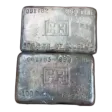
1 listing
Filters
| Product | /oz | Premium | Price | |
|---|---|---|---|---|

 Bullion Trading LLC
|
$75.14 | +15.02% | $7,513.93 | View Deal |
Prices are fetched automatically and may not reflect current merchant prices. Currency conversions and tax treatment are approximate. Rankings are based solely on price. We are not a dealer and accept no responsibility for transactions with listed merchants. Past performance is not indicative of future results. This site does not provide investment advice. Full disclaimer
About the 100 oz Handy and Harman Silver Bar
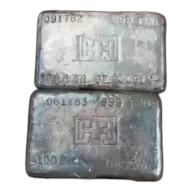
The 100 oz Handy and Harman Silver Bar
The 100 oz Handy and Harman silver bar contains 100 troy ounces (3,110.35 grams) of .999 fine silver, roughly 3.1 kg of metal in a single rectangular bar. The 100 oz format is the workhorse of the North American silver trade: it is a standard unit of trade in that market, and every major bullion dealer buys and sells bars at this weight.
The reason to buy at this size is premium compression. The fixed costs of manufacturing, assaying, and packaging spread across 100 ounces produce the lowest per-ounce premium of any standard retail silver bar size, typically 2 to 4 percent over spot, against roughly 3 to 5 percent for 10 oz bars and 5 to 10 percent for 1 oz bars. For accumulators building positions of 500 ounces and up, those savings compound quickly. Buyback spreads from major dealers typically run 1 to 3 percent below spot for recognised brands.
The trade-off is divisibility. A bar is indivisible, so selling means finding one buyer for the full amount, whereas a stack of 10 oz silver bars or 1 oz coins can be parcelled out. Occasional buyers and anyone who expects to liquidate incrementally usually prefer smaller denominations; dedicated stackers take the premium saving.
100 oz Silver Bar Specifications
| Attribute | Detail |
|---|---|
| Weight | 100 troy oz (3,110.35 g / 6.86 lbs) |
| Purity | .999 fine silver |
| Typical dimensions | Roughly 140 x 80 x 25 mm (varies by manufacturer) |
| Face value | None (bars are not legal tender) |
| Packaging | Sold individually; sometimes in protective sleeves (no tube convention) |
A 100 oz bar has the footprint of a large smartphone but weighs about 3.1 kg, and the format is stackable by design; most are poured or minted in rectangular form, though some cast bars have irregular surfaces. At this weight, expect verification at resale: most dealers will weigh, measure, or assay a secondary-market 100 oz bar before buying, an extra step compared with coins of fixed, universally known specifications. Counterfeit risk at this size is mostly plated base-metal cores rather than the tungsten problem that affects gold, because tungsten is nearly twice silver's density and would be obviously overweight. Weight and dimension checks, the magnet slide test, and specific gravity testing catch most fakes. Silver tarnishes when exposed to sulphur compounds, so store bars dry, wrapped or sleeved where practical.
Tax Treatment of 100 oz Silver Bars
Silver bars get no special treatment anywhere; what changes by country is how hard the standard rules bite, and at a roughly $3,300 bar (at 2026 prices) the percentages are material.
- United States: The home market for this format. Most states exempt bullion from sales tax; some tax it, and a few exempt only above thresholds that a 100 oz bar comfortably clears, such as New York and Louisiana ($1,000) and California ($2,000). Long-term gains are taxed at the 28 percent collectibles rate. Bars at .999 fineness from accredited refiners can be IRA-eligible.
- Canada: Zero-rated for GST/HST; .999 purity clears the federal 99.9 percent threshold for silver.
- United Kingdom: 20 percent VAT on purchase and CGT liability on sale, a double hit that makes large silver bars particularly tax-inefficient for UK delivery. The format is also simply less common there, where kilo bars dominate.
- European Union: Full local VAT on new bars (17 to 27 percent by member state).
- Australia and New Zealand: GST-free as investment-grade silver at 99.9 percent purity.
- Singapore and Hong Kong: No GST (Singapore IPM rules, 99.9 percent purity) and no taxes at all in Hong Kong; neither taxes capital gains.
Handy and Harman vs RCM, Johnson Matthey, and Asahi at 100 oz
The 100 oz silver bar market divides into bars in current production and discontinued brands trading on the secondary market. The Royal Canadian Mint bar is the premium in-production option: .9999 fine rather than the standard .999, serialised, and LBMA Good Delivery listed. Asahi Refining, which took over Johnson Matthey's precious metals business in 2015, is the other major current producer. On the discontinued side, Johnson Matthey bars from the 1980s trade at a slight collector premium, and Engelhard bars carry a brand premium driven by collector demand.
For a buyer choosing among them, the bar's job is identical in every case: 100 ounces of silver at the lowest available premium. Brand mainly affects the exit. Bars from LBMA-accredited refiners command tighter buyback spreads, while generic bars may face wider discounts and a higher chance of assay before purchase. Discontinued collector brands cost more going in without delivering more metal.
The other axis is size. Stepping down to a 10 oz bar costs slightly more per ounce but restores flexibility to sell in stages; stepping down to 1 oz coins costs the most per ounce but maximises liquidity. The 100 oz bar is the right tool when the goal is maximum metal per dollar and the position will be sold in bulk.
100 oz Handy and Harman Silver Bar: frequently asked questions
-
The best price we track is $7,513.93 from Bullion Trading LLC, around 15.0% over the silver spot price. A 100 oz bar holds 3,110.35 grams of 999 fine silver, making it a cost-efficient format for buying silver in quantity compared to smaller bar sizes.
-
100 oz of silver. A 100 troy ounce bar contains 3,110.35 grams, which is approximately 3.11 kilograms. Troy ounces are slightly heavier than avoirdupois ounces, so 100 troy oz works out to a little over three standard kilograms. Buyers comparing prices internationally often convert to kilograms to cross-reference kilo bar prices.
-
Handy and Harman is a US industrial metals company with a history in silver refining. Their 100 oz bars are produced to recognised industry specifications and are accepted by bullion dealers in North America. This broad dealer acceptance makes them a practical choice for buyers looking to trade or store large quantities of silver.
-
The 100 oz bar format is widely traded in North America and bars from established refiners such as Handy and Harman are accepted by most bullion dealers. Resale is straightforward at any dealer that handles silver. Storage is a practical consideration given the bar's weight of around 3.1 kg.