 BGASC
BGASC
1 listing
Filters
| Product | /oz | Premium | Price | |
|---|---|---|---|---|
| $75.87 | +19.05% | $758.75 | View Deal |

Prices are fetched automatically and may not reflect current merchant prices. Currency conversions and tax treatment are approximate. Rankings are based solely on price. We are not a dealer and accept no responsibility for transactions with listed merchants. Past performance is not indicative of future results. This site does not provide investment advice. Full disclaimer
About the 10 oz American Prospector Silver Bar
A Vintage Engelhard Silver Bar With Collector Appeal
The 10 oz Engelhard American Prospector silver bar combines the practical weight advantages of the 10 oz format with the collector cachet of the Engelhard brand. Engelhard Corporation, founded in 1902 in Newark, New Jersey, produced retail silver bars from the late 1960s through the mid-1980s before exiting the market. Every bar in this range is secondary market stock, and the Engelhard name consistently commands premiums above comparable generic silver bars.
For buyers focused purely on accumulating silver weight at the lowest cost, generic 10 oz bars from current producers will be cheaper. The Engelhard Prospector bar occupies a different niche: it carries a brand premium that has historically been recoverable on resale, and in many cases has appreciated relative to generic silver over time. The "Engelhard premium" on secondary market bars typically runs 20-50% above spot for common varieties, with rarer variants commanding significantly more.
The 10 oz size itself sits at the sweet spot for silver bar investors. Premiums at this weight typically run 3-6% over spot for generic bars, compared to 8-15% for 1 oz bars. With Engelhard bars, you pay more than a generic 10 oz bar, but the brand recognition and discontinued status provide a floor under the resale premium that generic bars lack. All Engelhard bars are .999 fine silver with unique serial numbers, the primary authentication marker for this brand.
Engelhard 10 oz Prospector Bar Specifications
| Specification | Detail |
|---|---|
| Weight | 10 troy ounces (311.03 g) |
| Purity | .999 fine silver |
| Manufacturer | Engelhard Corporation (Newark, NJ) |
| Production period | Late 1960s to mid-1980s |
| Serial number | Yes (unique to each bar) |
| Manufacturing methods | Cast, pressed, and extruded |
| Legal tender | No |
| Face value | None |
Engelhard produced bars using three distinct manufacturing methods: cast (poured into moulds, yielding a rougher surface texture), pressed (stamped from silver blanks, producing a smooth face), and extruded (forming silver through a die, creating a uniform cross-section). The finish and appearance vary considerably by production method and era, but the weight and purity specifications remain consistent across all varieties. The 10 oz size was produced in several distinct die varieties over the production run, identifiable by hallmark style, logo placement, and specific font characteristics used for the weight and purity stamps.
Authentication relies on weight verification (311.03 g), serial number format consistency for the claimed variety, and visual inspection of die details including font spacing, logo sharpness, and edge finishing quality. The AllEngelhard.com community maintains the definitive cataloguing of all known 10 oz varieties and their distinguishing characteristics, providing reference images and serial number range data. Sigma Metalytics testers verify silver content non-destructively through electromagnetic measurement. Counterfeit Engelhard bars exist, particularly targeting the 10 oz and 100 oz sizes, so purchasing from established dealers with return policies is advisable for secondary market acquisitions.
Tax Treatment of Engelhard Silver Bars
As a private mint silver bar with no legal tender status, the 10 oz Engelhard Prospector receives no special tax advantages in any jurisdiction. Silver bars are taxed less favourably than gold in most countries, and the lack of legal tender status removes the CGT exemptions available to some silver coins.
- United Kingdom: 20% VAT on purchase. Subject to Capital Gains Tax on disposal at the individual's rate (18-24%), with a £3,000 annual exemption. No CGT exemption exists for silver bars regardless of manufacturer. The combined VAT and CGT liability makes silver bars the least tax-efficient precious metal form for UK investors.
- United States: Sales tax varies by state; approximately 35 states exempt bullion purchases. Capital gains taxed at the collectibles rate (28% federal maximum for long-term holdings). Engelhard bars meet the .999 fineness requirement for IRA eligibility, though approval depends on the specific custodian since Engelhard is no longer an active LBMA/COMEX-listed refiner.
- Canada: GST/HST exempt for silver at 99.9%+ purity. Capital gains subject to 50% inclusion rate.
- Australia: GST-free for investment-grade silver at 99.9%+ purity from recognised refiners. Subject to CGT with 50% discount if held over 12 months.
- New Zealand: GST-exempt for fine silver at 99.9%+ purity. No formal capital gains tax.
- Singapore: GST-exempt under the Investment Precious Metals (IPM) scheme for silver bars at 99.9%+ purity from approved refiners. No capital gains tax.
- Hong Kong: No sales tax, no import duty, no capital gains tax.
- South Africa: 15% VAT on silver bullion (no exemption for silver, unlike gold Krugerrands). CGT applies at 40% inclusion rate for individuals.
Engelhard Corporation and the American Prospector
Charles W. Engelhard Sr. founded the company in 1902 by purchasing the Charles F. Croselmire Company in Newark, New Jersey. Over the following decade, he acquired Baker and Co. (a platinum smelter) and established Hanovia Chemical and Manufacturing Company. His son, Charles Engelhard Jr., consolidated the family holdings into Engelhard Industries, Inc. in 1958, listing it on the NYSE. By the 1950s, Engelhard was the world's largest precious metals smelter.
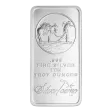
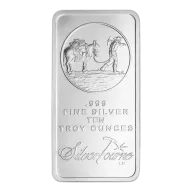
The American Prospector series was Engelhard's flagship retail silver product line, produced from 1982 to 1987. The design depicts Claude Chana (1811-1882), a French immigrant who was the first person to officially discover gold in Auburn, California, on 22 March 1848. Chana's find preceded James Marshall's more famous discovery at Sutter's Mill by just two months. The obverse shows Chana kneeling and panning for gold with a pick, set against a mountain landscape within a beaded border.
Engelhard ceased retail bullion production in the late 1980s, likely displaced by the American Silver Eagle launched in 1986 by the US Mint. Why purchase a private mint product when a government-backed legal tender coin became available at comparable premiums? BASF, the German chemical company, acquired Engelhard in 2006 for US$5 billion. In August 2025, BASF's Environmental Catalyst division and MKS PAMP Group announced the revival of the Engelhard brand, including new Prospector rounds produced at PAMP's facilities. The 10 oz bar format, however, has not been part of the revival announcement to date.
Charles Engelhard Jr. is widely believed to have inspired Ian Fleming's James Bond villain Auric Goldfinger. Fleming knew Engelhard socially, and the parallels are difficult to dismiss: the precious metals obsession, German surname, and vast wealth all align with the fictional character.
Engelhard 10 oz vs Other 10 oz Silver Bars
The 10 oz Engelhard occupies a distinct market position from most 10 oz silver bars currently in production. Current-production bars from PAMP Suisse, Valcambi, the Royal Canadian Mint 10 oz silver bar, or Asahi trade at modest premiums over spot (typically 3-6%) and are valued purely for their metal content. Engelhard bars trade at a persistent brand premium above generic silver because production ceased decades ago and surviving stock is finite.
Against other vintage/discontinued refiner bars, the closest comparison is Johnson Matthey (JM). Both Engelhard and JM were major LBMA-accredited refiners producing serial-numbered .999 silver bars through the same era. JM's bullion division was sold to Asahi in 2015. Engelhard bars generally command higher collector premiums than equivalent JM bars, driven by greater variety of die types, stronger brand recognition, and the Goldfinger cultural connection. Both carry significant counterfeiting risk at the 10 oz and 100 oz sizes.
For a buyer choosing between an Engelhard 10 oz bar and a current-production 10 oz PAMP Suisse silver bar, the decision turns on whether you view the Engelhard premium as recoverable. If you plan to sell through a bullion dealer specialising in vintage products or directly to collectors, the premium is likely recoverable and may appreciate. If you plan to sell to a generic bullion dealer at spot-based pricing, the extra outlay on an Engelhard bar offers no advantage over a cheaper current-production alternative.
10 oz American Prospector Silver Bar: frequently asked questions
-
The cheapest 10 oz Engelhard American Prospector bar tracked on this site is $758.75 from BGASC, around 19.1% over the $63.00 silver spot price. Vintage Engelhard bars often carry a collector premium above generic 10 oz bars because production ended in the late 1980s and the brand has strong secondary-market demand.
-
A 10 troy ounce silver bar weighs 10 oz (311.035 g). Troy ounces are used for precious metals and are slightly heavier than avoirdupois ounces. Knowing the gram weight is useful for customs declarations, storage planning, or comparing prices quoted per gram.
-
The American Prospector is a .999 fine silver bar produced by Engelhard Corporation between 1982 and 1987. Engelhard, founded in Newark, New Jersey in 1902, was a major precious metals refiner and fabricator. The Prospector range was designed to make silver accessible to individual investors. The obverse depicts Claude Chana, a French gold prospector credited as the first to officially find gold in Auburn, California, in 1848. Production ended in the late 1980s, with the brand later revived in 2025 under BASF and MKS PAMP.
-
Engelhard Prospector pieces are among the most commonly counterfeited silver products. For original rounds, check the weight (31.10 g per troy ounce), diameter (39 mm for the 1 oz round), and sharpness of the beaded border and logo. The 1984 "Large E" logo variant is the most frequently faked. Proof-like pieces in air-tite capsules warrant extra caution, as genuine Engelhard proofs are extremely rare. A Sigma Metalytics tester can verify silver content without surface damage.