 Bradford Coins
1 listing
Filters
| Product | /oz | Premium | Price | |
|---|---|---|---|---|
| $71.85 | +10.02% |
$2,307.64
A$3,290
|
View Deal |

Prices are fetched automatically and may not reflect current merchant prices. Currency conversions and tax treatment are approximate. Rankings are based solely on price. We are not a dealer and accept no responsibility for transactions with listed merchants. Past performance is not indicative of future results. This site does not provide investment advice. Full disclaimer
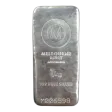
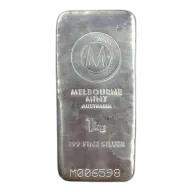
About the 1 Kilo Melbourne Mint Silver Bar
The 1 Kilo Melbourne Mint Silver Bar
A kilo bar holds 1,000 grams of silver, equal to 32.1507 troy ounces, and it is the international standard size for retail silver. The format dominates in Europe, Asia and Australia, where metric weights are the norm, while North American buyers more often reach for the 100 oz bar at the large end of the scale. For an Australian-branded bar, the kilo is the natural flagship weight.
The case for buying at this size is cost. Kilo bars carry premiums of roughly 3-6% over spot, among the lowest available for retail silver, against roughly 8-15% for 1 oz bars. Anyone accumulating silver by weight rather than by piece saves meaningfully by buying kilos, and the savings compound across a sustained stacking plan. The cost of that efficiency is granularity: a kilo bar is a single unit worth roughly $900-$1,000 at recent spot prices, and it cannot be partially liquidated. Selling means letting the whole bar go at once.
Physically, a silver kilo bar measures approximately 114mm x 57mm x 13mm depending on the maker and weighs 2.2 lbs. Bars come either cast, poured into a mould with a chunkier finish and usually a lower price, or minted, with a polished surface and often a serial number. Multiple bars stack neatly in a safe and store more efficiently per ounce than the same weight in 1 oz silver bars. Silver tarnishes in humid conditions, so dry storage below 50% relative humidity with desiccant packets is worth arranging.
Tax Treatment for 1 Kilo Silver Bars
Silver bar taxation turns almost entirely on purity thresholds, so check the stated fineness of the specific bar before assuming an exemption applies.
- Australia: Investment-grade silver, defined as 99.9% purity or higher in a commonly traded form, is GST-free. Capital gains tax applies on disposal, with a 50% discount for individuals after a 12-month holding period.
- UK: 20% VAT on new silver bars, and CGT applies on sale since bars have no legal tender status. This is the least tax-efficient combination for silver in any major market, though the kilo's low premium softens the entry cost.
- US: State-dependent sales tax; many states exempt bullion, others tax it or set purchase thresholds a kilo bar will typically clear. Long-term gains are taxed at the collectibles rate of up to 28%. IRA eligibility requires silver of 99.9% purity or higher from accredited refiners.
- Canada: 0% GST/HST for silver refined to 99.9% purity or higher in bar form.
- New Zealand: GST-exempt at 99.9% silver purity or higher; no formal capital gains tax.
- Singapore: 0% GST under the Investment Precious Metals scheme at 99.9% purity or higher; no capital gains tax.
- Hong Kong: No sales tax, no import duty, no capital gains tax.
- EU: Full national VAT on new silver, typically 17-27% depending on the member state.
Kilo Silver Bars vs the Alternatives
Within the bar family, the kilo competes against the 10 oz silver bar below it and the 100 oz bar above it. The 10 oz format is widely considered the most popular silver bar size because it balances low premiums with divisibility; moving up to a kilo squeezes out a further premium saving, but the marginal gain from 10 oz to kilo is small, often under 1% per ounce. The 100 oz bar sits at similar per-ounce premiums to the kilo, and the choice between them is largely regional: 100 oz is the North American tradition, the kilo the international standard. At 3.1 kg and several thousand dollars per unit, the 100 oz bar is also a heavier commitment in every sense.
Against coins, the comparison is starker. Government-minted 1 oz silver coins carry the highest per-ounce costs in silver because fixed minting costs loom large against a low metal value; a kilo bar avoids nearly all of that. What coins return is liquidity and recognition: sovereign coins sell anywhere instantly, while a kilo bar's resale depends on the producer being recognised by dealers. Bars from well-known refiners trade readily; bars from lesser-known producers can end up selling at melt value with no premium recovery, so brand recognition in your local market matters more at this size than at any smaller one.
Kilo silver coins do exist, from the Perth Mint's Lunar, Koala and Kookaburra ranges among others, but they price like collectables, above bar levels, and serve a different buyer.