 APMEX
APMEX
1 listing
Filters
| Product | /oz | Premium | Price | |
|---|---|---|---|---|
| $78.41 | +20.03% | $78.41 | View Deal |

Prices are fetched automatically and may not reflect current merchant prices. Currency conversions and tax treatment are approximate. Rankings are based solely on price. We are not a dealer and accept no responsibility for transactions with listed merchants. Past performance is not indicative of future results. This site does not provide investment advice. Full disclaimer
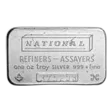
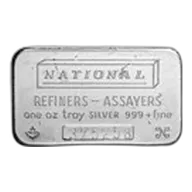
About the 1 oz National Refiners-Assayers Silver Bar
The 1 oz National Refiners-Assayers Silver Bar
The 1 oz National Refiners-Assayers Silver Bar holds one troy ounce (31.1035 grams) of .999 fine silver, the industry-standard purity for silver bars. As a privately produced bar it carries no face value and no government guarantee; what you are buying is silver content, priced at a markup over spot that is consistently lower than coin formats of the same weight.
That premium gap is the core of the buying decision at this size. In 2026 market conditions, 1 oz bars traded at 3-8% over spot while government-minted 1 oz silver coins ran 15-25% and privately minted rounds 5-10%. The reason silver coins cost so much over melt is that minting, quality control, and packaging costs are roughly fixed per piece, and on a low-value silver unit those costs are a large slice of the price. A bar strips most of that out.
The counterweight is liquidity. Sovereign coins such as the Eagle, Britannia, and Maple Leaf command the tightest bid-ask spreads at buyback, and bars from lesser-known producers typically sell back at melt value with no premium recovery. Bars also resell best with their original packaging intact, so keep any assay card or seal. A 1 oz bar like this one fits buyers who want silver in small, sellable increments at the lowest cost of entry for the weight, and who are content to treat it as pure metal value. Anyone planning larger single purchases will find better per-ounce economics further up the 10 oz silver bar scale.
Tax on 1 oz Silver Bars by Jurisdiction
Silver is taxed less kindly than gold in most of the world, and bars never qualify for the coin-specific exemptions some countries offer. For a .999 fine bar:
- US: No federal sales tax. Around 35 states exempt bullion entirely, a handful tax it, and several use thresholds; a single 1 oz silver bar falls below every threshold in the threshold states (California $2,000, Florida $500, Louisiana, Massachusetts and New York $1,000), so it would be taxed there unless bundled into a larger order. Long-term gains are taxed at the collectibles rate of up to 28%.
- UK: 20% VAT on new silver, plus CGT liability on disposal since bars have no legal tender status. This is the least tax-efficient market for the product.
- Canada: GST/HST-free, as the bar exceeds the 99.9% purity threshold for exempt silver.
- Australia: GST-free at 99.9%+ purity, which .999 meets.
- New Zealand: GST-exempt at 99.9%+ silver purity.
- Singapore: 0% GST under the Investment Precious Metals scheme (silver 99.9%+), and no capital gains tax.
- Hong Kong: No sales tax, duties, or capital gains tax.
- EU: Full standard VAT on new silver bars, between 17% and 27% by country. Margin-scheme relief in countries like Germany applies to pre-owned silver, not new bars.
In VAT markets the effective all-in cost on a 1 oz silver bar can reach 25-40% over spot once tax is added, which pushes many European buyers toward larger bars or pre-owned coins.
How a 1 oz Generic Bar Stacks Up Against Coins, Rounds, and Bigger Bars
Measured against a government 1 oz coin, the bar is the budget option. A 1 oz silver Britannia or American Silver Eagle brings a sovereign purity guarantee, universal dealer recognition, and in the Britannia's case CGT exemption for UK sellers, but at 15-25% over spot versus 3-8% for bars. Coins also hold more of their premium at resale. Over a long holding period the coin's resale advantage can offset some of its higher entry cost; for buyers who simply want ounces, it usually does not offset all of it.
Against silver rounds from private mints, the difference is smaller: rounds ran 5-10% over spot at this weight, marginally above bars, with neither carrying legal tender status. The practical choice between a generic bar and a generic round comes down to whichever is cheaper from your dealer on the day.
The most consequential comparison is vertical. The largest single premium drop in silver bars occurs between 1 oz and 10 oz, typically 4-5 percentage points, with 10 oz bars saving roughly $2 per ounce. Above 10 oz the savings flatten. The 1 oz bar earns its place when divisibility matters: ten separate 1 oz bars can be sold one at a time as cash needs arise, where a single larger bar is an all-or-nothing sale. For gradual accumulation or small-lot flexibility, the 1 oz bar is the right tool; for lump sums, size up.
1 oz National Refiners-Assayers Silver Bar: frequently asked questions
-
The live price for a National Refiners-Assayers 1 oz silver bar is $78.41, with silver spot at $65.33. The bar contains 1 oz of .999 fine silver, so its melt value tracks the silver price directly. Use the comparison table above to see the current spread across all dealers.
-
An assayer tests and certifies the purity and weight of precious metals. The name National Refiners-Assayers indicates a producer involved in both refining silver and assaying (verifying and stamping) the finished bars. The hallmark stamped on the bar is the assayer's guarantee of the stated purity and weight.
-
National Refiners-Assayers bars are stamped with purity and weight markings. If a serial number is present, contacting the refinery directly is the most reliable verification route. In the absence of a public online lookup, physical checks (weight, magnet test, XRF or acid test) remain the standard method for confirming a secondary-market bar's authenticity.
-
National Refiners-Assayers is a North American refiner and assaying operation producing .999 fine silver bars for the bullion market. Without a confirmed research source, specific founding dates or ownership details cannot be stated here. Its bars follow standard troy-ounce sizing and carry purity stamps consistent with investment-grade secondary-market silver.