1 listing
Filters
| Product | /oz | Premium | Price | |
|---|---|---|---|---|

 Global Bullion Suppliers
Out of Stock
Global Bullion Suppliers
Out of Stock
|
$79.62 | +21.77% |
$159.36
CA$226
|
View Deal |
Prices are fetched automatically and may not reflect current merchant prices. Currency conversions and tax treatment are approximate. Rankings are based solely on price. We are not a dealer and accept no responsibility for transactions with listed merchants. Past performance is not indicative of future results. This site does not provide investment advice. Full disclaimer
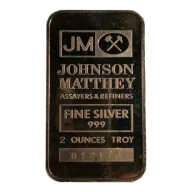
About the 2 oz Johnson Matthey Silver Bar
A Legacy Refiner's Silver Bar from a Bygone Era
The 2 oz Johnson Matthey silver bar carries the hallmark of one of the most respected names in precious metals history. Johnson Matthey (JM) was a British refiner with LBMA accreditation dating back to 1852, producing investment-grade gold, silver, and platinum bars for over 160 years. In 2015, JM sold its precious metals refining operations to Japan's Asahi Holdings, ending new production of JM-branded bars. Every Johnson Matthey silver bar on the market today is a vintage piece from pre-2015 production, trading on both silver content and the historical significance of the brand.
The JM name carries weight that extends beyond nostalgia. As an LBMA Good Delivery refiner for over a century, Johnson Matthey bars represent the gold standard (or rather, silver standard) of refiner credibility. The company's assaying and refining was trusted by central banks, institutional investors, and industrial users worldwide. This institutional heritage means JM bars are universally recognised by dealers and command consistent buyback prices, often with a small premium over generic bars of equivalent weight and purity.
The 2 oz size is an uncommon format from JM's production history. The refiner's primary silver bar production focused on 1 oz, 10 oz, 100 oz, and 1,000 oz formats. A 2 oz JM bar represents a less common piece from their range, which may carry additional collector interest for those building comprehensive JM collections.
2 oz Johnson Matthey Silver Bar Specifications
| Attribute | Value |
|---|---|
| Weight | 2 troy oz (62.207 g) |
| Purity | .999 fine silver |
| Manufacturer | Johnson Matthey |
| Country of origin | United Kingdom / Canada / United States |
| LBMA accredited | Yes (historically; accreditation since 1852) |
| Production status | Discontinued (2015) |
| Format | Minted bar |
| Legal tender | No |
Johnson Matthey operated refineries across multiple countries, including the UK, Canada (acquired by Asahi as the Brampton facility), and the United States (now Asahi's Salt Lake City operation). The specific origin of any given JM bar depends on its production era and hallmarks. Serial numbers and assay markings vary across production periods and facilities.
Tax Treatment for the 2 oz Johnson Matthey Silver Bar
As a .999 fine silver bar, the Johnson Matthey product follows standard silver bullion tax rules. The discontinued status and potential vintage premium do not alter the fundamental tax classification.
- United States: Sales tax follows standard state-by-state bullion exemptions. IRA-eligible: JM's LBMA accreditation and .999 purity meet IRS Section 408(m) requirements. The discontinued status does not affect IRA eligibility. Capital gains at 28% collectibles rate.
- United Kingdom: As a pre-owned silver bar, likely available under the margin scheme (VAT on dealer's margin only) rather than full 20% VAT. Not CGT-exempt. The UK origin adds no domestic tax benefit for silver bars.
- Canada: GST/HST exempt at .999 purity. Johnson Matthey had significant Canadian operations, so domestic availability through Canadian dealers is good.
- Australia: GST-free as investment-grade silver at 99.9% purity from an LBMA-accredited refiner (the accreditation remains valid for the bars despite the refining operation's sale).
- Singapore: GST-exempt under IPM rules. JM's LBMA status qualifies these bars for the Investment Precious Metals scheme.
- Hong Kong: No sales tax, no import duty, no capital gains tax.
- EU: Subject to local VAT rates. The margin scheme (Differenzbesteuerung in Germany, margeregeling in the Netherlands) may apply as these are pre-owned items.
Johnson Matthey: From 1817 to the Asahi Acquisition
Johnson Matthey's story in precious metals begins in 1817 when Percival Norton Johnson established an assaying practice in London. The company grew to become one of the world's five LBMA gold price-fixing members and one of the most trusted names in precious metals refining. LBMA Good Delivery accreditation, held since 1852, meant JM bars were accepted without question by central banks, bullion banks, and institutional dealers worldwide.
The company's refining operations expanded globally through the 20th century, with major facilities in the UK, Canada, and the United States. By the early 2000s, JM was one of the largest precious metals refiners in the world, alongside PAMP Suisse, Valcambi, and Heraeus. The decision to exit precious metals refining in 2015 and focus on catalytic converters, battery materials, and pharmaceutical ingredients surprised the bullion industry.
Asahi Holdings of Japan acquired the refining operations, inheriting the physical infrastructure, customer relationships, and workforce. The facilities in Brampton (Canada) and Salt Lake City (US) continue to produce bars under the Asahi brand, maintaining the same quality standards with different hallmarks. The JM brand name was retired from bullion production entirely.
The result is that every JM-hallmarked silver bar is a finite historical artefact. No more will be made. This scarcity supports a modest brand premium on the secondary market, particularly for less common weights and formats. The 2 oz size, which was not a core production weight for JM, represents a piece of collecting interest for those assembling comprehensive JM holdings across all available weights.
Johnson Matthey vs Other 2 oz Silver Bars
The Johnson Matthey bar occupies a unique position: it is simultaneously a standard bullion product (by composition and purity) and a historical collectible (by brand and discontinued status). This dual nature affects pricing and buyer motivation.
Against the 2 oz Asahi Diwali bar, the comparison is one of heritage versus modernity. Asahi directly inherited JM's infrastructure and institutional status. Both offer LBMA-accredited, serialised bars at .999+ purity. Asahi adds cultural theming and continues to produce new bars; JM offers the prestige of a discontinued heritage brand. Buyers choosing between them are deciding whether they value ongoing production and modern design (Asahi) or historical significance and finite supply (JM).
Against generic bars from active refiners like Sunshine Minting or SilverTowne, the JM bar benefits from stronger brand recognition and the finite supply dynamic. A sealed Sunshine bar is a current production item available in quantity; a JM bar at any weight is an increasingly scarce piece from a closed production line. The practical difference at resale is typically a small premium for JM bars over generic equivalents, reflecting brand recognition rather than any difference in silver content.
For UK buyers specifically, the Johnson Matthey name carries domestic significance as a British industrial heritage brand. Combined with the margin scheme availability (pre-owned bars attracting reduced effective VAT), a JM bar from a UK dealer can be a tax-efficient way to acquire branded silver with strong resale recognition.