1 listing
Filters
| Product | /oz | Premium | Price | |
|---|---|---|---|---|

 Global Bullion Suppliers
|
$95.18 | +45.01% |
$23.82
CA$34
|
View Deal |
Prices are fetched automatically and may not reflect current merchant prices. Currency conversions and tax treatment are approximate. Rankings are based solely on price. We are not a dealer and accept no responsibility for transactions with listed merchants. Past performance is not indicative of future results. This site does not provide investment advice. Full disclaimer
About the 1/4 oz $20 for $20 Silver Coin
The $20 for $20 Quarter-Ounce Silver Coin
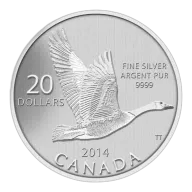
The $20 for $20 was a face-value silver coin programme from the Royal Canadian Mint that ran from 2011 to 2016. Each coin is Canadian legal tender with a $20 CAD face value, contains approximately 1/4 oz of .9999 fine silver in a Specimen finish, and was originally sold by the mint at exactly face value: $20 for a $20 coin, with zero premium.
That structure made it a genuinely unusual product. The RCM guaranteed face-value redemption with no expiration date, so buyers held a floor at $20 regardless of where silver went. If silver rose, the holder kept the gain; if it fell, the coin could go back to the mint for $20. Around 4.2 million coins were struck across the series.
Today these coins trade on the secondary market rather than from the mint, and the buying case is different. The silver content is modest, roughly $7-10 CAD of metal at typical silver prices, well under the $20 face value. The appeal is numismatic: a wide run of Canadian and pop-culture designs, RCM Specimen quality with certificate booklets, and a place in one of the stranger chapters of modern mint history. Stackers wanting quarter-ounce silver purely for metal content are buying face value and collector interest here, not efficient bullion; the 1 oz Silver Maple Leaf is the RCM's bullion workhorse.
$20 for $20 Coin Specifications
| Attribute | Detail |
|---|---|
| Weight | 7.96 g (approximately 1/4 troy oz) |
| Purity | .9999 fine silver |
| Face value | $20 CAD |
| Original sale price | $20 CAD (sold at face value) |
| Finish | Specimen |
| Packaging | Clear vinyl pouch with certificate booklet |
| Manufacturer | Royal Canadian Mint |
The coins carry the RCM's standard .9999 bullion purity and full legal tender status, with a certificate of authenticity included in the original packaging. The mint issued related face-value coins at other denominations under the same concept: $25 for $25, $50 for $50, $100 for $100 with a larger silver weight, and a $200 for $200 gold version.
$20 for $20 Tax Treatment
The coin's legal tender status drives its tax position, particularly in its home market.
- Canada: As .9999 fine silver legal tender, the coin clears the 99.9% purity threshold for GST/HST exemption. Redeeming at face value generates no capital gain, since purchase price and redemption value are both $20 CAD. Canada's Listed Personal Property rule also means a coin bought and sold for under $1,000 CAD produces no reportable gain or loss.
- United States: These are foreign silver coins with no US legal tender status. Most states exempt bullion from sales tax, though several apply thresholds or tax it; collector pieces with value above metal content can be treated differently from bullion in some states. Gains are taxed at the collectibles rate of up to 28%.
- United Kingdom: Silver coins carry 20% VAT, and Canadian coins are not UK legal tender, so there is no CGT exemption. UK market presence is minimal in any case; this was a distinctly Canadian product.
- EU: Standard silver coin treatment, meaning full national VAT rates on new purchases, with margin scheme relief available on pre-owned coins in countries such as Germany. European distribution was limited.
From Novel Concept to $17 Million Write-Off
The programme launched in 2011 with Canadian themes such as the Canoe and Maple Leaf, marketed as a low-risk way to buy silver collector coins. Designs across the run included Farewell to the Penny and the Polar Bear in 2012, Iceberg and Whales and Hockey in 2013, and the Canada Goose and Summertime in 2014. In 2015-2016 the RCM pivoted to licensed pop culture: Bugs Bunny, Superman, a T-Rex, and the Starship Enterprise, an attempt to broaden appeal that also added licensing costs.
The structural flaw caught up with the mint as silver fell roughly 67% from its 2011 levels, leaving each coin's metal content worth under $6 CAD against a guaranteed $20 redemption. Holders had no reason to keep them, and Canadians returned coins by the truckload. In financial terms each coin was a free put option: a guaranteed $20 floor with unlimited upside. With 4.2 million coins minted, the potential redemption liability reached $84 million CAD.
In its 2016 financial report the RCM reversed all past revenues from the programme, cutting reported profits from $41.3M to $24.5M CAD, a $17 million loss, and 1,200 mint employees lost their annual bonuses. The programme was discontinued in early 2017. Banks were initially reluctant to accept returns, so the RCM coordinated with financial institutions and offered prepaid Canada Post shipping labels. No other major mint has replicated the face-value-equals-sale-price model, and the episode is now studied as a cautionary tale in sovereign mint risk management.
$20 for $20 vs Conventional Silver Coins
Against the RCM's own bullion line, the contrast is stark. The Silver Maple Leaf is a full 1 oz .9999 coin that trades above spot and exists to deliver metal efficiently. The $20 for $20 holds only about a quarter ounce of silver and was positioned as a face-value collector product; its worth today rests on the $20 CAD redemption floor and numismatic interest in specific designs, especially the early issues and pop-culture pieces, rather than melt value.
Against other mints' collector coins, the difference is the pricing model. US Mint commemoratives, Perth Mint collector coins, and Royal Mint commemoratives are all sold at premiums above face value, which means the issuing mint carries no redemption risk. Selling at face value appears unique to this RCM programme, and its outcome explains why.
For a buyer today, the choice is straightforward. Quarter-ounce silver is not a standard bullion weight, so anyone wanting small silver for stacking purposes is better served by conventional 1 oz silver coins, where premiums and resale are well established. The $20 for $20 makes sense as a collectable with a built-in floor: at worst it is worth $20 CAD at the mint, at best a sought-after design carries a premium above that on the secondary market.
1/4 oz $20 for $20 Silver Coin: frequently asked questions
-
The cheapest $20 for $20 coin we track is $23.82, at around 45.0% over the $65.79 silver spot price. The coin contains only 1/4 oz of silver, so its metal content value is roughly a quarter of the silver spot price per troy ounce.
-
Each $20 for $20 coin weighs 1/4 oz and is struck in 999.9 fine silver, giving approximately 7.78 grams of silver content. The coin was produced by the Royal Canadian Mint as part of a face-value collector programme that ran from 2011 to 2016, with a Canadian legal-tender face value of $20 CAD.
-
Yes, the $20 for $20 coin is Canadian legal tender with a $20 CAD face value. In Canada, legal tender status means creditors are obligated to accept it for debt settlement, but retailers have no obligation to accept it for purchases. Because its silver content is worth significantly less than $20 CAD at typical silver prices, it functions as a collector coin rather than a circulating coin.