1 listing
Filters

 APMEX
APMEX
Prices are fetched automatically and may not reflect current merchant prices. Currency conversions and tax treatment are approximate. Rankings are based solely on price. We are not a dealer and accept no responsibility for transactions with listed merchants. Past performance is not indicative of future results. This site does not provide investment advice. Full disclaimer
About the 1 oz Great Wave Silver Coin
The 1 oz Fiji Great Wave Silver Coin
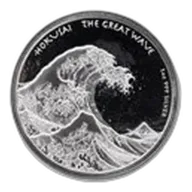
The Great Wave coin puts one of the most reproduced artworks in history onto a legal tender silver coin. The reverse carries a high-relief rendition of Katsushika Hokusai's woodblock print The Great Wave off Kanagawa, with the curling crest and churning foam set against a frosted sea-foam background. The coin was issued in 2017 by the government of Fiji with a $1 FJD face value, contract-minted by Scottsdale Mint in Arizona as part of that mint's broader programme of striking legal tender for Pacific island nations.
This was a single-year issue with no continuation, which shapes the buying decision. The standard brilliant uncirculated version was limited to 50,000 pieces, a mintage that sits between mass-market bullion (struck in the millions) and pure numismatic releases; a colorized proof version was capped at just 2,500. With no annual restrikes, supply is fixed, and the coin trades as a self-contained collectible in the art bullion niche rather than as stacking silver.
That makes the comparison point clear. A buyer who simply wants an ounce of .999 silver will get more metal for the money from a mainstream coin like the 1 oz Silver Philharmonic or from silver rounds. The Great Wave is for buyers who want the design, the limited mintage, and the sovereign backing in one package, and who accept the collector premium that comes with all three.
Fiji Great Wave Specifications
| Attribute | Value |
|---|---|
| Metal | Silver, .999 fine |
| Weight | 1 troy oz (31.1 g) |
| Diameter | 38.6-38.8 mm |
| Thickness | 3.1-3.2 mm |
| Edge | Reeded |
| Face value | $1 FJD |
| Country of issue | Fiji |
| Mint | Scottsdale Mint |
| Year | 2017 (single-year issue) |
Two versions exist: the proof-like brilliant uncirculated coin at 50,000 mintage, and a colorized proof at 2,500 with blue and white colour applied to the wave artwork. The obverse carries the Fiji Coat of Arms, a national shield featuring a British lion, coconut palm, sugar cane, banana tree, and a dove of peace, with the year and denomination inscribed.
Coins were sealed in individual acrylic capsules, and the presentation box carries traditional Japanese woodblock-style artwork. Beyond the reeded edge there are no documented anti-counterfeiting features, so authentication rests on weight, dimensions, and strike quality rather than the security technologies found on major sovereign bullion coins.
Great Wave Tax Treatment by Country
Silver receives less favourable tax treatment than gold in most jurisdictions, and the Great Wave's collector character adds a wrinkle in the US.
- US: Not IRA-eligible despite meeting the .999 fineness threshold; the limited mintage and premium over spot disqualify it. No federal sales tax applies, most states exempt bullion, and long-term gains are taxed at the collectibles rate of up to 28%.
- UK: 20% VAT on new silver coins. Not UK legal tender, so no CGT exemption, unlike a 1oz silver Britannia. Pre-owned examples sold under the margin scheme can largely avoid the VAT.
- EU: Silver attracts full local VAT in most member states (17-27%); second-hand coins can qualify for margin scheme taxation in countries such as Germany.
- Canada: The federal GST/HST exemption covers silver refined to at least 99.9% purity in coin form, though coins with numismatic value above their metal content may not qualify.
- Australia: Investment-grade silver at 99.9%+ purity is GST-free, but numismatic and collector coins attract 10% GST, a relevant distinction for a limited-mintage issue.
- New Zealand and Singapore: GST exemptions apply to qualifying 99.9% silver; Singapore additionally has no capital gains tax.
From Edo-Period Woodblock to Pacific Silver
The original Great Wave off Kanagawa was created by Katsushika Hokusai between 1830 and 1833, during Japan's Edo period, as part of his Thirty-six Views of Mount Fuji series. Hokusai was around 70 years old when he produced it. The print shows an enormous wave threatening boats off Kanagawa Prefecture with Mount Fuji small in the background, and it went on to become one of the most reproduced artworks in history. Western scholars initially misidentified the wave as a tsunami, though the Japanese title describes a wind-driven wave.
The coin itself belongs to a modern phenomenon: small Pacific nations licensing their legal tender rights to private mints. Scottsdale Mint struck the Great Wave for Fiji in 2017, alongside its other Fijian programmes such as the Fiji Iguana series and its legal tender work for other island states. The arrangement gives the issuing nation royalties while the private mint handles production and distribution.
As a one-time issue, the coin has no design history of annual changes to track. The 2017 date, the fixed 50,000 mintage for the standard version, and the immediately recognisable artwork together define its identity on the secondary market, where it competes with other art-themed bullion rather than with annually-issued stacking coins.
Great Wave vs Other Art Bullion
The Great Wave competes in the art bullion niche alongside coins like the Tuvalu Gustav Klimt series, the Niue Starry Night, and the Cook Islands Hokusai Panda, all of which follow the same formula of famous artwork, sovereign face value, and limited mintage. Within that field the Great Wave has the advantage of arguably the most recognisable source image, and its 50,000 standard mintage keeps it closer to bullion pricing than the deep-collector end of the niche.
Against mainstream sovereign silver, the trade-offs run the other way. An American Silver Eagle or Canadian Maple Leaf offers vastly superior liquidity, annual availability, modern security features, and US IRA eligibility, none of which the Great Wave can match. Major government coins already run premiums of 15-25% over spot at 1 oz; a fixed-mintage art coin sits above that, and wide buy-sell spreads mean less of the premium comes back at resale unless collector demand has appreciated.
The closest structural relatives are Scottsdale Mint's other Pacific issues, such as the Fiji Iguana, which share the contract-minted sovereign model but run as continuing series. The Great Wave's single-year status cuts both ways: no dilution from later dates, but also no ongoing programme keeping the design in front of buyers.
1 oz Great Wave Silver Coin: frequently asked questions
-
The reverse reproduces Katsushika Hokusai's woodblock print "The Great Wave off Kanagawa" (created 1830-1833) in high relief on .999 fine silver. Scottsdale Mint struck the coin in 2017 under contract from the government of Fiji; it carries a $1 FJD face value. Two versions were produced: a proof-like edition (50,000 pieces) and a colorized proof (2,500 pieces).
-
The Fiji Great Wave was a single-year programme with no continuation after 2017. Two distinct versions were struck: a Brilliant Uncirculated proof-like edition with a mintage of 50,000, and a colorized proof with a mintage of 2,500. There are no subsequent annual dates in the series.
-
No error varieties of the Fiji Great Wave silver coin are documented in the sources covering this series. The coin was produced by Scottsdale Mint under controlled conditions to the specifications of the Fiji government. If you encounter a listing claiming an error coin, treat it with caution in the absence of independent authentication.