1 listing
Filters

 APMEX
APMEX
Prices are fetched automatically and may not reflect current merchant prices. Currency conversions and tax treatment are approximate. Rankings are based solely on price. We are not a dealer and accept no responsibility for transactions with listed merchants. Past performance is not indicative of future results. This site does not provide investment advice. Full disclaimer
About the 1/2 oz Taku Silver Coin
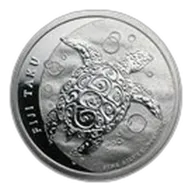
The 1/2 oz Fiji Taku Silver Coin
The Fiji Taku is a discontinued legal tender bullion series featuring the hawksbill turtle, known as taku in Fijian. It was contract-minted by the New Zealand Mint on behalf of the Reserve Bank of Fiji and issued from 2010 to 2013 only, which makes every Taku, including this 1/2 oz silver version, part of a finite, closed series. That is the core of the buying case: unlike perpetual sovereign series, the supply of Fiji-branded Taku coins can never grow, and the earlier years are becoming increasingly scarce on the secondary market.
The half-ounce format itself is unusual for silver. The 1 oz coin dominates silver bullion, and 1/2 oz silver pieces are rare in mainstream bullion programmes, appearing more often as commemoratives. The 1/2 oz Taku contains 15.5518 grams of .999 fine silver, half the metal of the standard 1 oz Fiji Taku, and the series also produced a 5 oz silver size alongside gold versions. Buyers drawn to this coin are usually combining a collector angle (a closed Pacific series with a conservation theme; the hawksbill turtle is listed as critically endangered by the IUCN) with bullion content.
The honest trade-off is liquidity. The Taku's appeal is more niche than the big sovereign coins; Perth Mint and Royal Canadian Mint products benefit from wider dealer networks and faster resale. As a discontinued contract issue, the Taku trades partly on scarcity rather than pure metal content, so comparing live dealer prices matters more here than for a commodity coin where every dealer stocks identical current-year supply.
Tax Treatment of the Silver Taku by Country
As a silver coin, the Taku does not benefit from the investment-gold exemptions that cover gold bullion in most jurisdictions.
- UK: New silver coins from non-UK territories attract 20% VAT. The Taku has no UK legal tender status, so it is also liable for capital gains tax on disposal, unlike a Silver Britannia. Some UK dealers trade pre-owned Taku coins on the secondary market under arrangements that avoid the full VAT charge.
- US: No federal sales tax, and most states exempt bullion coins from sales tax. Capital gains are taxed at the collectibles rate of up to 28% for holdings over a year. The coin's .999 purity and legal tender status meet general IRA criteria, though acceptance depends on the specific custodian.
- Canada: Silver coins refined to 99.9% purity or better are zero-rated for GST/HST, which the .999 Taku meets, though coins valued mainly for numismatic appeal above their metal content may not qualify.
- Australia: Investment-grade silver requires 99.9% purity for GST-free treatment, which this coin meets; numismatic and collector coins attract 10% GST.
- EU: Silver coins attract the standard national VAT rate, or margin scheme treatment on second-hand pieces in countries such as Germany.
- Singapore and Hong Kong: No capital gains tax in either. Hong Kong has no sales tax at all.
Since the Taku trades partly above melt value on scarcity, buyers in jurisdictions that distinguish investment bullion from collector coins should check how their dealer classifies it.
Four Years of the Fiji Taku, 2010 to 2013
The series launched in 2010 with an obverse showing a stylised hawksbill turtle swimming along the ocean floor amid bubbles, paired with the Ian Rank-Broadley portrait of Queen Elizabeth II on the reverse. The 2011 and 2012 issues continued the same general format with updated dates. The coins were official Fiji coinage authorised by the Reserve Bank of Fiji, struck under contract by the New Zealand Mint, which has a pattern of issuing bullion coins for Pacific Island nations including Fiji, Niue, and Tokelau.
The 2013 issue brought the series' most significant change: the reverse was redesigned to carry the Coat of Arms of Fiji in place of the Queen's portrait. The change reflected Fiji's political trajectory after the 2006 military coup and subsequent constitutional reforms, which moved the country away from overt British monarchy symbols. Fiji formally became a republic in 2013 under a new constitution, and the coin redesign was one of the earliest public signals of that shift. The 2013 1 oz silver issue had a confirmed mintage cap of 350,000 coins; mintage figures for the series were not published to the granularity of major sovereign mints.
After the Fiji government ended the licensing arrangement with the New Zealand Mint, the design continued from 2014 onward as the Niue Hawksbill Turtle, issued for Niue, a self-governing New Zealand-associated territory. The reverse reverted to a portrait of Queen Elizabeth II and the engraving changed from "Fiji Taku" to simply "Turtle." The Fiji-branded coins of 2010 to 2013 are the original series, and the 2010 first-year issue in particular carries a scarcity premium.
Taku vs Niue Hawksbill, Perth Mint Series, and the Maple Leaf
The most direct comparison is the Niue Hawksbill Turtle, the post-2014 continuation of the same design from the same mint. The differences are the issuing authority and denomination currency: Fiji versions are denominated in Fiji dollars, Niue versions in New Zealand dollars. Niue coins remain in production and are more readily available; the Fiji originals are finite and carry a scarcity premium, especially earlier years. Buyers wanting the design at the lowest cost should price the Niue version; buyers wanting the closed original series pay extra for the Fiji branding.
Against the Perth Mint's annual-design series, the closest Southern Hemisphere competitors, the Taku gives ground on liquidity. Perth coins benefit from greater liquidity, wider dealer networks, and Australian legal tender status, while the Taku's appeal is more collectible. The same applies even more strongly to the 1 oz silver Maple Leaf, the global benchmark for .9999 silver purity. The Taku's .999 fineness is slightly lower, though this makes no practical difference for investment purposes; the Maple Leaf's far greater liquidity is the practical difference.
Within the New Zealand Mint's own Pacific output, the Fiji Great Wave series shows the mint's ongoing relationship with Fiji as an issuer, with a different theme. For a buyer choosing at the 1/2 oz weight specifically, the field is thin: half-ounce silver is not a standard bullion weight, so the realistic alternatives are stepping up to a 1 oz coin from any major mint or accepting the fractional format's narrower market.
1/2 oz Taku Silver Coin: frequently asked questions
-
The Fiji Taku is a 999 fine silver coin featuring the hawksbill turtle, minted by New Zealand Mint as legal-tender coinage for the Reserve Bank of Fiji. 'Taku' is the Fijian name for the hawksbill turtle. The series ran from 2010 to 2013; from 2014 onward, a continuation series was issued for Niue under the name Niue Hawksbill Turtle.
-
Tax treatment varies by country. In the UK, silver coins attract 20% VAT on purchase, and gains above the £3,000 annual allowance are subject to CGT at 18% or 24%. In Canada, investment-grade silver bullion is GST/HST-exempt at 0%, and 50% of any capital gain is included in taxable income. In the US, silver coins are taxed as collectibles at up to 28% on long-term gains.