 APMEX
APMEX
1 listing
Filters
| Product | /oz | Premium | Price | |
|---|---|---|---|---|
| $91.42 | +38.96% | $91.42 | View Deal |

Prices are fetched automatically and may not reflect current merchant prices. Currency conversions and tax treatment are approximate. Rankings are based solely on price. We are not a dealer and accept no responsibility for transactions with listed merchants. Past performance is not indicative of future results. This site does not provide investment advice. Full disclaimer
About the 1 oz Lion Dollar Silver Coin
A 17th-Century Trade Coin Reimagined in .9999 Silver
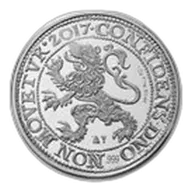
The 1 oz Restrike Lion Dollar is an official reproduction by the Royal Dutch Mint (Koninklijke Nederlandse Munt) of the historic Leeuwendaalder, one of the most important international trade coins of the 16th and 17th centuries. The modern restrike programme launched in 2017 with annual releases continuing through at least 2024, each year featuring a different historic Dutch provincial lion on the obverse while maintaining the 16th-century knight reverse design.
The original Lion Dollar was first struck in 1575 during the Dutch Revolt against Spain. It circulated across Europe, the Middle East, Africa, and into the Americas, becoming so widely recognised that it influenced the naming of the US "dollar" itself (from daalder/thaler). Lion Dollars have been found in archaeological excavations across the eastern United States, remnants of the coin's use when New York was the Dutch colony of New Amsterdam. The modern restrike captures this historical significance in investment-grade .9999 fine silver.
Each year's obverse features the heraldic lion from a different one of the seven historic provinces of the Dutch Republic that originally struck Lion Dollars: Holland, Zeeland, Utrecht, Gelderland, Overijssel, Friesland, and Groningen. The 2017 debut used the Holland provincial lion (matching the original 1575–76 design), with subsequent years rotating through the remaining provinces. This gives the series a natural collecting framework with a defined endpoint.
Lion Dollar Restrike Technical Specifications
| Attribute | Silver BU | Silver Proof | Silver Piedfort |
|---|---|---|---|
| Weight | 1 troy oz (31.1 g) | 1 troy oz (31.1 g) | 2 troy oz (62.2 g) |
| Purity | .999 fine silver | .9999 fine silver | .9999 fine silver |
| Diameter | 37 mm | 37 mm | 37 mm |
| Thickness | Standard | 3.9 mm | Double thickness |
| Edge | Reeded | Reeded | Reeded |
| Finish | Brilliant Uncirculated | Mirror/Frosted Proof | Proof |
Mintage by Year (Silver BU)
- 2017: 5,000 (debut year, relatively scarce)
- 2019: 15,000
- 2020: 5,000 (proof)
- 2021: 1,000 (proof, Overijssel lion, last struck 1701)
These are collector-grade mintages, far below mainstream bullion programmes where coins like the Britannia or Maple Leaf have effectively unlimited production. The proof versions at .9999 purity carry a higher fineness than the BU at .999. A 1 oz gold proof (.9999 fine) is also produced in extremely limited quantities. The 2 oz piedfort references the weight of the original historic Lion Dollar, providing a connection to the denomination's physical history.
Tax Status: Official Restrike, Not Legal Tender
The Restrike Lion Dollar is explicitly an official medal/restrike rather than legal tender. The Royal Dutch Mint labels these "official restrikes" without a face value denomination. This classification affects tax treatment in important ways.
In the Netherlands and EU, silver restrikes without legal tender status are subject to standard VAT (21% in the Netherlands). Gold versions may qualify as investment gold under the EU directive if they meet the broad criteria for gold accepted by bullion markets (99.5%+ purity), though the absence of legal tender status could complicate qualification in some member states.
In the United Kingdom, the silver version carries 20% VAT as standard for silver bullion. Gold versions may qualify as VAT-exempt investment gold (the directive covers gold bars of 99.5%+ purity accepted by bullion markets, which a sovereign mint product at .9999 would typically meet). The coin is not CGT-exempt in the UK since it is neither UK legal tender nor a coin in the strict sense (being labelled a restrike/medal).
For US buyers, the absence of legal tender status may affect IRA eligibility. Section 408(m) requires coins to be issued by a government entity as legal tender, or bars/rounds to meet fineness standards from NYMEX/COMEX-approved refiners. The Lion Dollar's classification as a medal rather than a coin could exclude it from IRA accounts depending on custodian interpretation, despite its sovereign mint origin and .9999 purity.
From Dutch Revolt to Global Trade Currency
The original Leeuwendaalder emerged from economic necessity during the Dutch Revolt (1568–1648). The seven provinces of the nascent Dutch Republic each struck their own version bearing their provincial heraldic lion, creating the visual variety that the modern restrike series now recreates. The coin was deliberately struck lighter than the standard Spanish dollar, a form of competitive devaluation that made Dutch trade coins cheaper to produce and more profitable for Dutch merchants operating across global trade networks.
The Lion Dollar's reach was extraordinary. It became a standard medium of exchange in the Levant trade (eastern Mediterranean), circulated throughout the Ottoman Empire, crossed into the Americas with Dutch colonial expansion, and served as currency in New Amsterdam (now New York). The coin's widespread circulation in colonial America directly contributed to the English word "dollar" entering American usage, derived from the Dutch/German daalder/thaler.
The Royal Dutch Mint, operating since 1567 (making it one of the oldest continuously operating mints in the world), launched the modern restrike programme in 2017 to celebrate this numismatic heritage. The seven-province rotation provides a natural framework: each year features a different provincial lion that appeared on historical Lion Dollars from that province. The 2021 Overijssel release was particularly notable because Overijssel was one of the rarest historical Lion Dollar designs, with the last original struck in 1701. The 2 oz piedfort option references the physical weight characteristics of original-era Dutch coinage.
1 oz Lion Dollar Silver Coin: frequently asked questions
-
The cheapest 1oz Restrike Lion Dollar on this page is $91.42 from APMEX, around 39.0% over the silver spot price. As a low-mintage collector-grade series, the Lion Dollar typically carries higher premiums than mass-market silver bullion.
-
The Lion Dollar (Leeuwendaalder) was a Dutch silver trade coin struck from 1575, one of the most important international trade coins of the 16th and 17th centuries, circulating across Europe, the Middle East, Africa, and the Americas. The Royal Dutch Mint launched a modern restrike programme in 2017, recreating the coin in .999 fine silver. Each year's edition features the heraldic lion of a different historic Dutch province.
-
The Brilliant Uncirculated 1oz Restrike Lion Dollar weighs one troy oz (31.1 grams) and is struck in .999 fine silver by the Royal Dutch Mint in Utrecht. The coin has a reeded edge and a 37mm diameter. Proof versions of the same series use .9999 fine silver and come boxed with a certificate of authenticity.
-
Cleaning silver coins is generally not recommended. Even gentle polishing can remove original mint luster and leave hairline scratches invisible to the naked eye, reducing the coin's surface quality and resale value. Toning that develops naturally over time is considered acceptable by the market. Coins are best stored in their original capsules and left as-issued.
-
The Dutch lion (Hollandse Leeuw) is the heraldic lion from the Dutch coat of arms, a symbol used by the provinces of the Dutch Republic since the 16th century. It appeared on the original Leeuwendaalder (meaning "lion dollar") and is carried forward in the modern restrike. Each annual edition features the lion from a different historic province, working through the seven provinces that originally struck Lion Dollars.