4 listings
Filters

 IDC Coin and Bullion


Prices are fetched automatically and may not reflect current merchant prices. Currency conversions and tax treatment are approximate. Rankings are based solely on price. We are not a dealer and accept no responsibility for transactions with listed merchants. Past performance is not indicative of future results. This site does not provide investment advice. Full disclaimer
About the 1 oz South Korean Tiger Silver Coin
KOMSCO's Korean Tiger Silver Medal
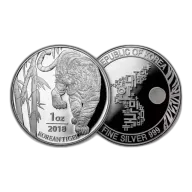
The 1 oz South Korean Tiger is an annual silver medal produced by KOMSCO (Korea Minting, Security Printing & ID Card Operating Corporation), the state-owned mint of South Korea. Launched as a gold medal in 2016 with silver editions added in 2018, each year features a new tiger design in the traditional Korean artistic style: stern and watchful rather than roaring. The tiger (ho-rang-i) is a central symbol in Korean culture, believed to ward off evil spirits and represent courage and power.
A critical distinction: the Korean Tiger is classified as a medal, not a coin. It carries no legal tender face value and is not official South Korean currency. This is an unusual position for a product from a sovereign government mint. KOMSCO produces South Korea's banknotes and applies the same anti-counterfeiting technology to these medals, giving them arguably the highest security features of any bullion product, but without the legal tender status that coins from the Perth Mint or Royal Mint carry.
For buyers browsing 1 oz silver coins, the Korean Tiger sits in a category somewhere between a sovereign mint coin and a private mint round. It has the credibility of a government mint but the legal classification of a round. Annual silver mintages typically range from 20,000 to 30,000 pieces, substantially below mainstream sovereign bullion but higher than Scottsdale Mint's most limited programmes. Premiums reflect the collector positioning: above generic rounds and most sovereign bullion, driven by the annual design changes and the growing secondary market for earlier years.
The 2024 release was marketed as the "Final Release" of the standard round silver medal format. From 2025, KOMSCO introduced a shaped medal variant (61 x 80 mm), breaking from the traditional round form entirely. This makes the 2024 and earlier round-format medals a closed series, which could influence secondary market pricing as collectors seek complete sets.
Korean Tiger Specifications and Security Features
| Attribute | Value |
|---|---|
| Weight | 1 troy oz (31.1 g) |
| Purity | .999 fine silver |
| Diameter | 40 mm |
| Edge | Smooth (no reeding) |
| Face value | None (medal, not legal tender) |
| Finishes | BU, Proof, and Antiqued variants |
| Striking mint | KOMSCO, South Korea |
The series is also available in 10 oz silver (80 mm diameter, 311 g), 1/10 oz gold, 1/4 oz gold, 1/2 oz gold, and 1 oz gold (.9999 fine). Gold mintages are very limited, typically around 4,000 units per year across all sizes.
Security Technology
KOMSCO applies banknote-level anti-counterfeiting technology that sets the Korean Tiger apart from most bullion products. The reverse features a holographic latent image: a circular element that transitions between "999" and "Ag" when tilted at different angles. This uses the same optical security technology that KOMSCO develops for South Korean currency and government identity documents. Additional micro-engraved details are incorporated throughout the design.
The reverse carries a consistent design across all years: a stylised map of the Korean peninsula formed from Hangul script characters, with "REPUBLIC OF KOREA," the year, weight, and fineness inscriptions. The obverse changes annually, always depicting the Korean tiger in a new pose or setting. The 2020 issue introduced a tiger cub sub-theme; the 2022 depicted a tiger climbing Seoraksan mountain.
Korean Tiger Tax Treatment by Country
The Korean Tiger's medal classification (no legal tender status) affects its tax treatment differently from sovereign-issued coins. In most jurisdictions, the relevant factor is the metal purity rather than the legal tender status, but there are important exceptions.
United Kingdom
Silver medals and rounds without legal tender status are subject to 20% VAT in the UK. The Korean Tiger is not eligible for CGT exemption (which applies only to UK legal tender coins from The Royal Mint). The combination of VAT on purchase and CGT on gains makes the Korean Tiger one of the least tax-efficient silver products for UK buyers. The 1 oz Silver Britannia offers CGT exemption, and even non-UK legal tender coins carry the same VAT rate without the additional disadvantage of the medal classification.
United States
No federal sales tax. State-level treatment varies, and the medal classification may affect eligibility in some states. States that specifically exempt "bullion" or "precious metals" typically include medals meeting purity thresholds. States that exempt only "coins" or "legal tender" may exclude medals. The .999 purity does not meet the IRS 99.9% threshold for silver IRA eligibility under Section 408(m), and the medal status further complicates IRA qualification. Consult your custodian for specific guidance.
Canada
The Canadian GST/HST exemption for precious metals covers items that are 99.9% pure in bar, ingot, coin, or wafer form. Medals are not explicitly listed, but .999 silver products from recognised mints are generally treated as qualifying bullion by Canadian dealers.
Australia and Singapore
Australia's GST exemption for investment-grade precious metals requires recognised sovereign entity backing and 99.9% purity. The medal classification from a sovereign mint creates an ambiguous situation. Singapore's IPM scheme similarly requires qualifying coin or bar form. Hong Kong imposes no sales tax on any precious metals regardless of classification.
Korean Tiger vs Other Asian Government Mint Silver
The Korean Tiger's most natural comparison is with the Chinese Silver Panda from the People's Bank of China. Both are annual-design programmes from Asian government mints with strong cultural symbolism. The critical difference is legal tender status: the Panda carries a face value in yuan, while the Tiger is a medal with no denomination. The Panda also has vastly higher mintages and broader global distribution, making it more liquid on the secondary market. The Tiger's advantage is its lower mintage and the advanced KOMSCO security features, particularly the holographic latent image technology.
Within KOMSCO's own product range, the Tiger competes with the Chiwoo Cheonwang series, which features a legendary Korean warrior figure. Both share the same security technology, medal classification, and premium positioning. The Chiwoo launched in 2016 (same year as the Tiger gold) and has a comparable collector following. Buyers interested in KOMSCO products often collect both series.
Against mainstream 1 oz silver coins from Western mints, the Korean Tiger trades at substantially higher premiums and has narrower resale channels. A buyer prioritising low premiums and maximum liquidity should look at the 1 oz Austrian Philharmonic or 1 oz Canadian Maple Leaf, which offer open-mintage sovereign coins at the lowest typical premiums in the market. The Tiger's appeal is for those who value the annual design programme, KOMSCO's security technology, and the collector potential of low-mintage issues from a relatively new series.
The transition to shaped medals from 2025 onward makes the complete round-format set (2018-2024 silver) a finite collectible. Buyers interested in the series as a collector set rather than purely as bullion may find this transition point significant for secondary market values of the earlier round-format issues.
1 oz South Korean Tiger Silver Coin: frequently asked questions
-
The South Korean Tiger is an annual bullion medal series produced by KOMSCO, South Korea's state-owned mint, since 2018 in silver. Each year features a new tiger design on the obverse, with the tiger drawn from traditional Korean art as a symbol of courage and power. The reverse carries a stylised map of the Korean peninsula formed from Hangul script characters.
-
The South Korean Tiger is produced by KOMSCO (Korea Minting, Security Printing and ID Card Operating Corporation), South Korea's official state-owned mint. Each coin weighs 31.1035 g and contains 999 fine silver. Technically these are medals rather than coins, as they carry no face value and are not legal tender.
-
Yes. KOMSCO applies advanced anti-counterfeiting technology drawn from its banknote production. The reverse includes a holographic latent image element that shifts between purity markers ("999" and "Ag") when tilted, along with micro-engraved details throughout the design. Weight, fineness, and issuing authority inscriptions appear on every piece.
-
Several dealers in our comparison currently list the 1oz South Korean Tiger, covering several individual listings. Use the table above to compare live prices and premiums across all available sellers.