 APMEX
APMEX


 BuyBullion.NZ
Prices are fetched automatically and may not reflect current merchant prices. Currency conversions and tax treatment are approximate. Rankings are based solely on price. We are not a dealer and accept no responsibility for transactions with listed merchants. Past performance is not indicative of future results. This site does not provide investment advice. Full disclaimer
About the 1/10 oz Silver Buffalo Silver Round
The Generic Standard in Fractional Format
The 1/10 oz Silver Buffalo round from CNT is part of the most widely produced generic silver round family in the world. The Buffalo design, based on James Earle Fraser's 1913 Buffalo Nickel, has been minted by dozens of private mints since the early 1980s. When dealers sell "Silver Buffalo Rounds" without specifying a manufacturer, the buyer may receive product from any of a dozen different mints. The CNT version represents one branded source for this otherwise commodity product.
The 1/10 oz fractional format serves a specific market: buyers who want physical silver at the lowest possible absolute price per piece. At around 3 grams of .999 fine silver, a single round costs only a few dollars, making it accessible to virtually any budget. The trade-off is high relative premiums (manufacturing costs are nearly fixed regardless of size) and limited resale liquidity compared to the standard 1 oz format where Buffalo rounds are the single most traded generic silver product.
Buffalo rounds occupy a unique position in the silver market. They are the "default" generic round, the product most often offered when a dealer advertises silver rounds at the lowest available premium. The design is instantly recognisable to any bullion dealer, which provides a baseline level of liquidity that more obscure designs lack. At the 1/10 oz size, this recognition advantage matters less since the absolute value is so low that authentication costs can exceed the value of the piece.
Compared to the 1/10 oz Golden State Mint Buffalo and 1/10 oz SilverTowne Buffalo, the CNT version is functionally identical: same design concept, same weight, same purity. The "random mint" nature of generic Buffalo rounds means a buyer purchasing from a large dealer may receive any manufacturer's version interchangeably, making the brand distinction largely academic at this level of the market.
CNT Silver Buffalo 1/10 oz Specifications
| Attribute | Value |
|---|---|
| Weight | 1/10 troy ounce (3.1103g) |
| Purity | .999 fine silver |
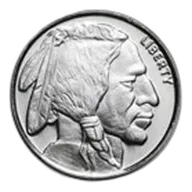
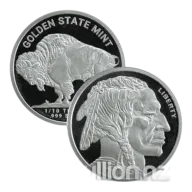
| Obverse | Native American profile (after Fraser's 1913 Buffalo Nickel) |
| Reverse | American bison standing on a mound |
| Manufacturer | CNT |
| Legal tender | No |
| Face value | None |
| Edge | Typically reeded (varies by manufacturer for random-mint) |
| Condition | Brilliant Uncirculated |
The Buffalo Nickel Design in Context
The Buffalo Nickel design was created by James Earle Fraser for the US Mint in 1913. Fraser was one of the most important American sculptors of the early 20th century, also known for his iconic sculpture "End of the Trail" (1915). The obverse is a composite portrait based on three Native American sitters: Iron Tail (Oglala Lakota), Two Moons (Northern Cheyenne), and Big Tree (Kiowa), though the exact attribution has been debated by historians since Fraser himself gave varying accounts. The reverse depicts an American bison, reportedly modelled after "Black Diamond" from the Central Park Zoo in New York City, though some sources also cite "Bronx" from the Bronx Zoo.
The design entered the public domain when its copyright protection expired, enabling unrestricted reproduction by private mints starting in the early 1980s. This timing coincided with the emergence of the silver bullion round market following the 1979-1980 silver price spike. The result was dozens of mints adopting the same recognisable design, creating a de facto commodity standard for generic silver rounds.
Weight and purity are stamped on the round. No advanced security features are standardised across manufacturers. Some newer variants from specific mints include radial line patterns or privy marks, but the CNT version uses the traditional plain field design. Authentication relies on physical testing methods: weight confirmation at 3.11g, dimension measurement, magnet slide test (silver's diamagnetic properties cause a rare earth magnet to slide slowly down a tilted round), and if needed, sigma or XRF analysis for definitive composition verification.
Tax Treatment of Generic Silver Rounds
Generic silver rounds, including Buffalo rounds from any manufacturer, receive the standard private-mint silver tax treatment in all jurisdictions. No special provisions apply regardless of the design's historical significance, the number of mints producing it, or how widely recognised the product is in the bullion market.
- United States: State sales tax varies. Approximately 35 states exempt bullion, roughly 10 impose full tax. Threshold states (California $2,000, Florida $500, New York $1,000, Massachusetts $1,000, Louisiana $1,000) will typically apply tax on fractional round purchases below the threshold unless bundled with other items in the same transaction. Some generic Buffalo rounds qualify for IRA inclusion depending on the specific manufacturer's accreditation status. CNT's IRA eligibility should be verified with the specific custodian. Capital gains at the 28% collectibles rate for holdings over one year.
- United Kingdom: 20% VAT on purchase. Subject to CGT on profits (18% basic rate, 24% higher rate, £3,000 annual allowance). Not CGT-exempt. UK buyers seeking silver with better tax efficiency should look at legal tender silver coins which receive CGT exemption despite still incurring VAT on purchase.
- Canada: Meets the .999 purity threshold for GST/HST exemption on precious metals in qualifying form (bar, ingot, coin, or wafer).
- Australia: Meets the 99.9% purity threshold for potential GST exemption on investment-grade precious metals from accredited sources.
- European Union: Standard VAT at local rates (17-27%). No investment silver exemption for rounds. The margin scheme (Differenzbesteuerung in Germany, margeregeling in Netherlands) applies only to pre-owned coins.
- South Africa: 15% VAT on all silver bullion regardless of form or manufacturer. Only gold receives zero-rating.
- Singapore: Potential IPM exemption if from a qualifying refiner at 99.9%+ purity. Non-qualifying rounds attract 9% GST.
- Hong Kong: No sales tax, no duties, no capital gains tax.
The "random mint" sales model for Buffalo rounds creates a practical complication for IRA buyers. If the specific manufacturer matters for custodian acceptance, buying random-mint rounds creates uncertainty about whether the received product will qualify. Buyers accumulating silver specifically for retirement accounts should purchase from named manufacturers whose products their custodian explicitly accepts, rather than generic random-mint Buffalo rounds where the source is uncontrolled.
1/10 oz Silver Buffalo Silver Round: frequently asked questions
-
The cheapest 1/10 oz Silver Buffalo round listed here is $10.53, based on the current silver spot price of $65.58. Fractional rounds carry a higher premium per ounce than full-ounce rounds because fixed minting and handling costs spread across less metal, so expect to pay proportionally more than a 1 oz equivalent.
-
A 1/10 oz Silver Buffalo round contains 1/10 oz of silver, which is 3.1104 grams of .999 fine silver. Troy ounces are the standard unit in the precious metals market and are slightly heavier than a standard (avoirdupois) ounce.
-
The Silver Buffalo round is a privately minted .999 fine silver round reproducing James Earle Fraser's Buffalo Nickel design, originally struck by the US Mint from 1913 to 1938. Multiple private mints produce it, including CNT, Golden State Mint, SilverTowne, and others. It carries no face value and no legal-tender status. Dealers typically sell it as "random mint," meaning the specific manufacturer may vary.
-
The current premium over the $65.58 spot price is 60.6%. Fractional rounds always carry a higher per-ounce premium than their 1 oz counterparts. If minimising the premium over spot is the priority, full-ounce rounds or bars offer better value per gram of silver.