 Golden Eagle Coins



Prices are fetched automatically and may not reflect current merchant prices. Currency conversions and tax treatment are approximate. Rankings are based solely on price. We are not a dealer and accept no responsibility for transactions with listed merchants. Past performance is not indicative of future results. This site does not provide investment advice. Full disclaimer
About the 1 oz Libertad Gold Coin
Mexico's No-Denomination Gold Bullion Coin
The 1 oz Gold Libertad stands alone among sovereign bullion coins for a reason no other major series can claim: it carries no face value. Every other coin on a bullion comparison table has a denomination stamped on it, from the 1oz Gold Britannia at £100 to the 1oz Gold Maple Leaf at C$50. The Libertad has none. Its legal tender status comes directly from Banco de Mexico, which guarantees the coin's value at the market price of its gold content. This is not a gimmick or oversight; it reflects a fundamentally different monetary philosophy, one where the metal itself is the denomination.
Struck by Casa de Moneda de Mexico, the oldest operating mint in the Americas (founded 1535), the 1 oz Gold Libertad contains 31.1 grams of .999 fine gold. The purity was upgraded from .900 to .999 in 1991, bringing it in line with the global standard set by coins like the 1oz Gold Philharmonic. That .999 purity sits below the .9999 standard of the Maple Leaf, Britannia, and Philharmonic, though the practical difference in gold content is negligible at this weight.
The Libertad's defining market characteristic is scarcity. Annual mintages are consistently among the lowest of any major sovereign bullion coin, and some year-size combinations number in the hundreds or low thousands. This scarcity drives premiums that are typically higher than those on comparable coins from larger-volume mints. Buyers who prioritise the lowest possible premium per ounce of gold will find better options in the Maple Leaf or 1oz Gold Krugerrand. Buyers who value low mintage numbers and the distinctive no-denomination status will pay more for the Libertad and accept that trade-off.
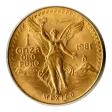
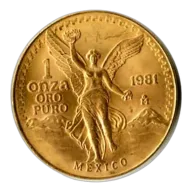
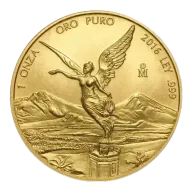
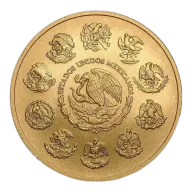
The reverse features the Angel of Independence (El Ángel), the winged figure atop the Monumento a la Independencia on Mexico City's Paseo de la Reforma, with the volcanoes Popocatépetl and Iztaccíhuatl visible in the background. The obverse carries the Mexican coat of arms: an eagle perched on a cactus devouring a serpent, a symbol drawn from Aztec founding mythology.
1 oz Gold Libertad Technical Details
| Attribute | Detail |
|---|---|
| Metal content | 1 troy oz (31.1 g) fine gold |
| Purity | .999 (1991-present); .900 (1981-1990) |
| Diameter | 34.5 mm |
| Face value | None |
| Edge | Reeded |
| Issuer | Casa de Moneda de Mexico |
| Legal tender authority | Banco de Mexico |
| First issued | 1981 |
Libertad Gold Denominations
| Size | Gold content | Diameter |
|---|---|---|
| 1 oz | 31.1 g | 34.5 mm |
| 1/2 oz | 15.55 g | 29.0 mm |
| 1/4 oz | 7.78 g | 23.0 mm |
| 1/10 oz | 3.11 g | 16.0 mm |
| 1/20 oz | 1.55 g | 13.0 mm |
The Libertad has no modern anti-counterfeiting technology comparable to the Maple Leaf's Bullion DNA system or the Britannia's latent image. Authentication relies on the high-relief Angel of Independence design detail, precise weight and dimensions, and reeded edge finish. The coin carries no mint marks beyond the standard design elements. Potential buyers should note that the absence of dedicated security features makes purchasing from reputable dealers particularly important for this series.
The first-year (1981) 1 oz gold mintage was 596,000 coins. Later years have generally been lower, with some recent issues produced in very small quantities. The Royal Canadian Mint struck roughly 1,000,000 Maple Leafs in its 1979 launch year by comparison, illustrating the consistently smaller production scale of the Libertad programme. Since 2018, an antiqued finish has been offered on certain silver denominations (1 oz, 2 oz, 5 oz) in limited numbers.
Libertad Tax Treatment by Country
The Libertad's unusual no-denomination status does not affect its investment gold classification for tax purposes in most jurisdictions. It is recognised as legal tender issued by a sovereign state, which is the relevant criterion.
- United Kingdom: Gold Libertads are VAT-free as investment gold (the coin meets the post-1800 legal tender threshold at .999 purity). They are not CGT-exempt because they are not UK legal tender. Capital gains are taxed at the individual's rate (18% basic, 24% higher), subject to the £3,000 annual allowance. UK buyers seeking CGT exemption should look at the 1oz Gold Britannia or 1oz Gold Royal Arms instead.
- United States: Gold Libertads are not specifically listed in IRS Section 408(m)(3)(A) as IRA-eligible coins. The .999 purity meets the generic bullion provision's 99.5% threshold, but eligibility depends on custodian interpretation. This contrasts with the 1oz Gold American Eagle, which has a specific statutory exemption. Capital gains are taxed at the collectibles rate of up to 28%. State sales tax varies; roughly 35 states exempt bullion purchases.
- Canada: GST/HST exempt at .999 purity (above the 99.5% threshold). Capital gains are taxed at a 50% inclusion rate.
- European Union: Gold Libertads typically appear on the EU's annual investment gold coin list, making them VAT-exempt across all member states. Germany offers complete capital gains exemption on bullion held for more than one year.
- Australia: GST-free as investment-grade gold (.999 exceeds the 99.5% threshold). Capital gains apply with a 50% CGT discount for holdings over 12 months.
- Singapore: GST-exempt as an Investment Precious Metal (gold at 99.5%+ purity). No capital gains tax.
- Hong Kong: No sales tax, no import duty, no capital gains tax.
- South Africa: Gold coins are zero-rated for VAT purposes. CGT applies at a 40% inclusion rate for individuals.
From Independence Monument to Bullion Standard
The Gold Libertad debuted in 1981, making it a contemporary of the Gold Maple Leaf (1979) and a predecessor of the Gold American Eagle (1986). Its issuing institution, Casa de Moneda de Mexico, was founded in 1535 by a decree of Spanish Viceroy Antonio de Mendoza, making it the oldest continuously operating mint in the Western Hemisphere. By the time the Libertad launched, the mint had been producing coinage for nearly 450 years.
The coin replaced the earlier Mexican Onza, a 1 oz silver coin produced from 1949 to 1979. The Libertad name references Mexico's independence from Spain, achieved in 1821. The word libertad means "liberty" in Spanish, and the design centres on the most recognisable symbol of that independence: the Angel of Independence statue in Mexico City, erected in 1910 to commemorate the centennial of the independence movement.
Early gold Libertads (1981-1990) were struck at .900 fineness, matching the traditional standard for Mexican gold coinage. In 1991, purity was upgraded to .999 to align with the international bullion market, where three-nines and four-nines purity had become the norm. The silver Libertad, introduced in 1982, has been .999 since its inception.
The silver version received a significant design update in 2000, when ten historical versions of the Mexican coat of arms were added in a ring around the central eagle on the obverse. The gold version has remained more consistent in design throughout its production run. In 2018, an antiqued finish was introduced for certain silver denominations (1 oz, 2 oz, 5 oz) in limited quantities, broadening the series' appeal to collectors alongside bullion investors.
A single platinum Libertad was produced in 1989: 3,500 quarter-ounce coins. This remains the only platinum issue in the Libertad programme's history and is now one of the rarest modern sovereign bullion coins in existence.
Mintage figures have trended downward in recent years. The 2025 BU silver 1 oz Libertad had an approximate mintage of just 300 coins, the lowest in the series' history. Gold Libertad mintages, though less extreme, remain consistently lower than competing sovereign bullion programmes, contributing to the premium differential that defines the series' market position.
Libertad vs Maple Leaf, Krugerrand, and Philharmonic
The 1 oz Gold Libertad occupies a distinct position among sovereign gold coins. Its combination of no face value, low mintages, and .999 purity creates a profile that differs meaningfully from the mainstream alternatives.
Against the 1oz Gold Maple Leaf, the most direct purity competitor among high-volume coins, the Libertad's .999 fineness falls just short of the Maple Leaf's .9999. The Maple Leaf also carries the Royal Canadian Mint's Bullion DNA micro-engraved security mark and radial lines, both of which the Libertad lacks. The Maple Leaf is produced in large quantities with no mintage cap, keeping premiums relatively low. The Libertad's controlled production drives premiums higher. For buyers focused purely on acquiring gold at the lowest cost above spot, the Maple Leaf wins. For buyers who value scarcity and the collector dimension that low mintages create, the Libertad is more appealing.
The 1oz Gold Krugerrand shares one notable trait with the Libertad: neither carries a conventional face value (the Krugerrand's legal tender status is defined separately from any denomination). The Krugerrand is 22-carat (.9167 fine) alloyed with copper, giving it the distinctive reddish tone and scratch resistance that pure gold coins lack. It was the world's first modern bullion coin (1967) and has the deepest secondary market of any gold coin globally. The Krugerrand is not IRA-eligible in the United States; the Libertad's IRA status is uncertain and custodian-dependent.
The 1oz Gold Philharmonic matches the Libertad's high gold purity at .9999 fine (actually exceeding it by one nine) and typically trades at lower premiums due to higher production volumes. The Philharmonic is denominated in euros and has strong distribution across continental Europe, making it the more accessible coin for European buyers. The Philharmonic's design has been unchanged since 1989; the Libertad's design has also remained largely stable, though the silver version received updates in 1996 and 2000.
The Libertad's premium disadvantage relative to all three competitors is the direct consequence of its low mintages. Buyers should treat this as a conscious choice: paying more per ounce for a coin with genuine scarcity and a unique monetary structure, versus paying less for coins that are produced in far greater numbers. The Libertad does not compete on cost; it competes on distinctiveness.
1 oz Libertad Gold Coin: frequently asked questions
-
The cheapest 1oz Gold Libertad available from dealers we track is $5,009.50, around 7.9% over spot, from Golden Eagle Coins. Premiums on the Libertad are typically higher than comparable coins such as the Maple Leaf or Britannia, reflecting the coin's low mintage and limited international distribution.
-
Libertad mintages are consistently among the lowest of any major sovereign bullion series. Supply from Casa de Moneda de Mexico is limited, and distribution outside Mexico relies on specialist dealers rather than the broad networks that serve Eagles or Maple Leafs. Low annual supply against persistent collector and investor demand pushes premiums above what you would pay for higher-mintage coins of the same weight.
-
Yes. The 1oz Gold Libertad struck from 1991 onward is 999.9 fine gold (99.9% purity), containing one full troy ounce of gold (31.1035g). Coins issued between 1981 and 1990 were struck at .900 fineness. If you are comparing with other coins, note that the Krugerrand and American Gold Eagle are 22-karat (.9167 fine), whereas the Libertad matches the purity of the Maple Leaf and Britannia.
-
The Gold Libertad is produced by Casa de Moneda de Mexico, Mexico's official sovereign mint established in 1535. The series launched in 1981 and features the Winged Victory (Angel of Independence) on the reverse and the Mexican coat of arms on the obverse. Unlike most bullion coins, the Libertad carries no face value denomination; its legal tender status is guaranteed by Banco de Mexico at the market value of its gold content.
-
Right now, 2 dealers list a total of 3 1oz Gold Libertad products on this comparison. Availability is narrower than for higher-volume coins like the Maple Leaf or Britannia, reflecting the Libertad's limited production and the smaller number of specialist dealers who carry it.