1 listing
Filters
| Product | /oz | Premium | Price | |
|---|---|---|---|---|

 The Gold Bullion Company
Out of Stock
The Gold Bullion Company
Out of Stock
|
$5,075.47 | +8.95% |
$16,317.55
£11,970
|
View Deal |
Prices are fetched automatically and may not reflect current merchant prices. Currency conversions and tax treatment are approximate. Rankings are based solely on price. We are not a dealer and accept no responsibility for transactions with listed merchants. Past performance is not indicative of future results. This site does not provide investment advice. Full disclaimer
About the 100g Baird Cast Bar Gold Bar
Baird & Co.'s Signature Gold Bar Series at 100g
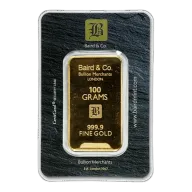
The 100g Baird Gold Bar is a named product line within Baird & Co.'s broader gold bar range, produced at the company's LBMA-accredited refinery in Beckton, East London. Each bar contains 3.2151 troy ounces of 999.9 fine gold. The Baird Gold Bar series represents the company's standard-issue minted gold bar, carrying the clean institutional design that has remained consistent for years: the Baird & Co. logo, weight, "FINE GOLD" designation, fineness, and a unique serial number.
Baird & Co. is the UK's only LBMA-accredited gold refinery, a distinction that separates it from every other British bullion producer. The company was founded by Tony Baird in 1967, initially as a numismatic dealer. The business expanded into refining in 1979, earned LBMA membership in 2000, and became an official Royal Mint Partner in 2016. The refinery was relocated to Beckton in 2008 from its previous Stratford location, which was earmarked for the London 2012 Olympic Park.
At the 100g weight, premiums of 2-4% over spot make this one of the most cost-efficient formats in Baird's range. The premium drop from 50g bars (typically 3-6%) to 100g bars is one of the sharpest efficiency gains available in the metric bar sizes. Only kilo bars offer meaningfully lower premiums, and at roughly $100,000+ for a gold kilo, the 100g bar provides most of the per-gram savings at a fraction of the total outlay.
Baird Gold Bar 100g Specifications
| Property | Detail |
|---|---|
| Weight | 100 grams (3.2151 troy oz) |
| Purity | .9999 fine gold (24 karat) |
| Manufacturer | Baird & Co., Beckton, East London |
| LBMA status | Member since 2000 |
| Type | Minted (precision-stamped from rolled gold sheet) |
| Serial number | Unique, engraved on bar face |
| Packaging | Tamper-evident assay card |
Minted Baird Gold Bars are produced by cutting a blank from a rolled sheet of refined gold, then pressing and stamping the design under high pressure. This produces a smooth, reflective surface with precisely defined markings. Each bar is sealed in a tamper-evident assay card that certifies the serial number, weight, and purity. Breaking the seal is visible and reduces resale convenience, as the bar may then need independent verification.
The Baird Gold Bar carries the company's refiner's hallmark (confirming LBMA-accredited origin), the weight in grams, the four-nines fineness, and an individually assigned serial number. The design is deliberately plain and institutional in character, reflecting the LBMA tradition of prioritising trust and standardisation over artistic embellishment.
Security and Authentication
Baird bars use traditional physical security: unique serial numbers, LBMA refiner's marks, and sealed assay packaging. The company does not employ digital verification systems such as PAMP's Veriscan laser-surface technology. For retail bars purchased from authorised dealers and kept in sealed assay cards, the physical security measures are sufficient. For secondary market transactions involving unsealed bars, authentication via weight measurement, dimensional checks, and XRF surface analysis (effective to roughly 10-50 microns depth) are standard dealer procedures. At 100g, the bar is small enough that the Sigma Metalytics Precious Metal Verifier provides effective electromagnetic conductivity testing as an additional non-destructive authentication method.
Tax Treatment for the Baird Gold Bar
UK Tax
Gold bars at 995+ purity are VAT-exempt in the UK. The 999.9 fineness of the Baird Gold Bar exceeds this threshold. Capital Gains Tax applies to gold bars at 18% (basic rate) or 24% (higher rate) on gains above the £3,000 annual exempt amount. Bars do not qualify for CGT exemption in the UK because they are not legal tender. Investors seeking tax-free gold gains in the UK need to look at legal tender coins, specifically the Gold Britannia or Gold Sovereign.
Baird Gold Bars qualify for SIPP and SSAS pension schemes. HMRC requires a minimum purity of 99.5% for gold held in pensions, and bars must be stored with an approved custodian. Baird & Co. operates vault storage at its Beckton refinery, insured by Lloyd's of London, making it a straightforward option for UK pension gold. Gold held within a SIPP or SSAS is not subject to CGT, and pension contributions receive income tax relief at the investor's marginal rate (up to 45%).
International
- European Union: VAT-exempt under the Investment Gold Directive.
- Germany: Gains on gold held for more than 12 months are CGT-free, making bars the most cost-efficient choice for German investors.
- United States: IRA-eligible (999.9 purity from an LBMA-accredited refiner). Taxed at the 28% collectibles rate for long-term holdings outside retirement accounts.
- Canada: GST/HST-exempt. Eligible for RRSP and TFSA through approved custodians.
- Australia: GST-free as investment-grade gold.
- Singapore: GST-exempt under the IPM scheme. Baird has a branch in Singapore.
- Hong Kong: No sales tax or capital gains tax.
Baird & Co.: From Krugerrand Dealer to Britain's Premier Gold Refinery
Tony Baird founded the company in 1967, the same year the Krugerrand was first minted in South Africa. He was reportedly the first person to trade Krugerrands in the UK, having started his interest in coins through schoolyard bartering. The business began as a numismatic coin dealership and grew steadily through the 1970s, a decade of surging gold prices and expanding retail bullion demand.
The expansion into refining came in 1979, a pivotal year when gold prices were spiking toward their January 1980 peak. By the late 1970s, Baird had also become the first private contributor of coin pricing to the Reuters Monitor System, maintaining the "BACO" page for over two decades. This made the company a de facto pricing reference for the UK coin trade, an unusual position for a private firm.
LBMA membership followed in 2000, formalising the company's status as a recognised refiner meeting international standards for gold purity and chain of custody. In 2008, the refinery relocated from Stratford to the current 30,000 sq ft high-security facility in Beckton, prompted by the area's redevelopment for the London 2012 Olympics. A Singapore branch was established in 2013, extending the company's reach into Asian markets. The Royal Mint Partnership came in 2016, and the Queen's Award for Enterprise (International Trade) in 2018.
Tony Baird died in 2015, and the company passed to his wife Lorena and sons Alex and Carlos. Under family ownership, Baird & Co. has continued to expand. The company pioneered several firsts: the world's first commercially available rhodium investment bar in 2012, and in 2018 a collaboration with the government of Tuvalu produced the world's first legal tender rhodium coin. The Hatton Garden flagship store was refurbished in 2017 and remains one of London's few locations for over-the-counter bullion trading.
Baird Gold Bar vs PAMP, Valcambi, and Royal Mint at 100g
The 100g gold bar market features several strong brands with different strengths. The 100g PAMP Suisse Fortuna bar is the premium choice, carrying the highest acquisition cost but also the strongest international brand recognition and Veriscan digital authentication. PAMP bars retain their brand premium better at resale, particularly in markets outside Europe. Valcambi bars offer the lowest premiums among major brands, since Valcambi's Balerna refinery is the world's largest by capacity and the company focuses on cost-efficient production rather than collectible design.
Within the UK market, the standard Baird & Co. 100g bar is the same product in a different packaging or product line context, and the main competitor is the Royal Mint gold bar. The Royal Mint has centuries of heritage and the cachet of Crown backing, which some investors value for provenance. Baird's counter-argument is that it actually refines the gold (the Royal Mint is primarily a coin producer that sources refined gold), and Baird's LBMA refinery accreditation provides a specific standard of assurance about the refining process itself. Premiums between the two UK brands are generally competitive.
The 100g Austrian Mint Gold Bar is another sovereign-backed option, produced by a subsidiary of Austria's central bank. For European buyers, particularly in the DACH region (Germany, Austria, Switzerland), the Austrian Mint may carry stronger local recognition than a British refinery. The choice often comes down to geography and planned resale market: Baird for UK-centric portfolios, Austrian or Swiss brands for continental European liquidity.
100g Baird Cast Bar Gold Bar: frequently asked questions
-
The 100g Baird Cast Bar is 999.9 fine gold, which is 24 carat. Although the common question refers to a "minted" bar, this product is a cast bar: produced by pouring molten gold into a mould. Purity is the same as Baird's minted bars at the same weight.
-
Cast bars are produced by pouring molten gold into a mould, giving them a rougher, organic surface with natural variation. Minted bars are cut from precision-rolled gold sheet and stamped under pressure, producing a uniform, reflective finish and typically sealed in an assay card. Both carry the same purity and are equally recognised by LBMA-accredited dealers. Cast bars generally attract a slightly lower fabrication premium.