1 listing
Filters
| Product | /oz | Premium | Price | |
|---|---|---|---|---|

 The Gold Bullion Company
Out of Stock
The Gold Bullion Company
Out of Stock
|
$5,094.44 | +17.24% |
$1,637.92
£1,227
|
View Deal |
Prices are fetched automatically and may not reflect current merchant prices. Currency conversions and tax treatment are approximate. Rankings are based solely on price. We are not a dealer and accept no responsibility for transactions with listed merchants. Past performance is not indicative of future results. This site does not provide investment advice. Full disclaimer
About the 10g Baird Cast Bar Gold Bar
The UK's Own LBMA Refinery at 10 Grams
The 10g Baird Gold Bar is produced by Baird and Co., the only LBMA-accredited gold refinery based in the United Kingdom. Founded in 1967 by Tony Baird as a numismatic coin dealer, the company expanded into refining in 1979 and achieved LBMA membership in 2000. The refinery operates from a 30,000 sq ft high-security facility in Beckton, East London, with the company's flagship retail store located in Hatton Garden, London's historic jewellery quarter.
For UK buyers, the Baird bar's domestic provenance is a genuine differentiator. The gold is refined on British soil, from raw material to finished bar, under one roof. Most other gold bars available in the UK market are manufactured by Swiss, German, or Australian refiners and imported. This distinction is largely sentimental rather than practical (an LBMA bar from Switzerland is functionally identical), but it resonates with buyers who prefer to keep their gold purchases within the UK supply chain.
At 10 grams, the bar contains 0.3215 troy ounces of 999.9 fine gold, placing it in the same price bracket as a 1/4 oz gold coin. The premium at this weight typically runs 8-12% over spot, which is elevated compared to larger bars but standard for the 10g format. The jump to a 50g gold bar represents the most significant premium improvement in the gram bar range, dropping from 8-12% down to 3-6%.
Baird also holds the distinction of being an Official Royal Mint Partner since 2016, which speaks to the company's standing within the UK precious metals industry. The company received the Queen's Award for Enterprise for International Trade in 2018, and its Singapore branch (established 2013) gives it an international footprint that most UK-based bullion companies lack.
Baird 10g Gold Bar Technical Details
| Attribute | Detail |
|---|---|
| Weight | 10 grams (0.3215 troy oz) |
| Purity | 999.9 fine gold (24 karat) |
| Manufacturer | Baird and Co., London, UK |
| Format | Minted bar |
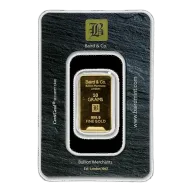
| Packaging | Tamper-evident assay card with serial number |
| Accreditation | LBMA member since 2000 |
| Face value | None (not legal tender) |
The bar's obverse carries the Baird and Co. logo, the weight in grams, fineness marking "999.9", the words "FINE GOLD", and a unique serial number. The design is consistent across all Baird bar sizes, scaling proportionally. The minted format produces a smooth, reflective finish, precision-cut from a single piece of gold and then pressed and stamped.
Baird also produces cast bars at larger sizes (100g, 500g, 1kg), which have a rougher, hand-poured texture and sometimes carry marginally lower premiums. At 10g, only the minted format is offered. The minted bar ships in a sealed assay card that includes a certificate of authenticity with the serial number, weight, and fineness. Keeping the assay card intact is important for resale, as breaking the seal may require the bar to be re-assayed at the buyer's expense. Baird bars do not include digital authentication technology such as VeriScan; authentication relies on the serial number, assay card integrity, and the LBMA-accredited hallmark stamped on the bar itself. The bar is manufactured at Baird's Beckton refinery in East London.
Tax Position for UK and International Buyers
The 10g Baird Gold Bar qualifies as investment gold in all major markets. It carries no face value and is not legal tender.
Purchase Tax
- United Kingdom: VAT-exempt under the Investment Gold Exemption. Gold bars at 995+ fineness are zero-rated for VAT purposes.
- European Union: VAT-exempt under the EU Investment Gold Directive (Directive 98/80/EC) for gold bars at 995+ fineness.
- United States: No federal sales tax. State-level exemptions apply in approximately 35 states.
- Canada: GST/HST exempt at 99.5%+ purity.
- Australia: GST-free as investment-grade gold.
- Singapore: GST-exempt under the IPM scheme. Baird and Co. has a physical branch in Singapore.
- Hong Kong: No sales tax or duties on gold.
Capital Gains Tax
- UK: Subject to CGT. This is the critical tax distinction for UK buyers: gold bars are VAT-efficient on purchase but carry CGT liability on sale. Only UK legal tender coins (Sovereigns, Britannias) enjoy CGT exemption. Gains on bars above the annual exempt amount (£3,000) are taxable at 18% (basic rate) or 24% (higher rate). For UK investors with significant gains, the CGT on bars can outweigh the initial premium savings versus CGT-free coins.
- UK SIPP/SSAS: Gold held within a pension wrapper is not subject to CGT. Baird bars qualify for SIPP and SSAS inclusion as their purity (999.9) exceeds HMRC's 995 minimum. Baird and Co. offers its own Lloyd's-insured vault storage at its Beckton facility, which can serve as an approved custodian arrangement.
- US: Taxed as collectibles at up to 28% for long-term gains.
- Germany: Tax-free if held for more than one year.
- Singapore and Hong Kong: No capital gains tax.
Baird vs Other 10g Gold Bars
The 10g Baird bar competes directly with bars from Swiss refiners and other LBMA-accredited producers. Its unique selling point is UK provenance; its weakness is narrower international recognition compared to the Swiss brands.
Against the 10g Argor-Heraeus Classic, the Baird bar offers British manufacturing versus Swiss. Argor-Heraeus has been LBMA-accredited since 1961 (four decades longer than Baird) and serves as one of seven LBMA referees. In terms of global resale liquidity, Argor-Heraeus bars are more widely recognised outside the UK. Within the UK market, Baird bars sell readily through all major dealers and the company's own Hatton Garden store. Both bars are 999.9 fine and sealed in assay cards. Premiums are typically similar.
The 10g Credit Suisse Liberty bar represents the Swiss branded-bar tradition. Manufactured by Valcambi, it carries the Credit Suisse name and a Statue of Liberty reverse design. The brand premium on Credit Suisse bars has historically placed them above plain refiner bars in price, though the UBS acquisition in 2023 has introduced uncertainty about future production. For UK buyers, the Baird bar is more straightforwardly sourced (domestic, still in continuous production) with a potentially lower premium.
Compared to the 10g Austrian Mint bar, Baird offers a private refiner's product versus a sovereign mint's. The Austrian Mint is government-owned and backed by the Austrian National Bank, which some buyers consider a stronger form of provenance than a private company's LBMA accreditation. For UK-focused buyers, Baird's domestic manufacturing and direct vault storage option (at Beckton, insured by Lloyd's) provide practical advantages that an imported Austrian bar does not.
The Baird bar's core audience is a UK investor who values knowing their gold was refined in London, wants a bar that is easy to buy and sell through UK dealers, and may use Baird's own storage for pension-scheme gold. Buyers with no attachment to UK provenance will find functionally identical bars from Argor-Heraeus, Valcambi, or Heraeus, often at comparable or lower premiums.
10g Baird Cast Bar Gold Bar: frequently asked questions
-
The 10g Baird Cast Bar is 999.9 fine gold, equivalent to 24 carat. Despite some questions referring to "minted" bars, this product is a cast bar: gold poured into a mould rather than stamped from rolled sheet. The purity is identical to Baird's minted range.
-
Cast bars are made by pouring molten gold into a mould, giving them a rougher, more organic surface texture. Minted bars are precision-cut from rolled gold sheet and then stamped, producing a smoother, sharper finish typically sealed in an assay card. Both carry identical purity and resale acceptance from an LBMA refinery; cast bars generally carry slightly lower fabrication premiums.
-
A 10g bar offers a lower initial outlay than larger sizes, making it accessible for new buyers. The trade-off is that smaller bars carry a higher premium per gram than 100g or 1oz bars, because fabrication costs are spread over less metal. The cast format partly offsets this: cast bars are cheaper to produce than minted bars, so the premium disadvantage of the small size is modestly reduced.