 APMEX
APMEX


Prices are fetched automatically and may not reflect current merchant prices. Currency conversions and tax treatment are approximate. Rankings are based solely on price. We are not a dealer and accept no responsibility for transactions with listed merchants. Past performance is not indicative of future results. This site does not provide investment advice. Full disclaimer
About the 1g Engelhard Gold Bar
A Discontinued Refiner's Gold at the Smallest Weight
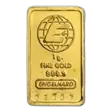
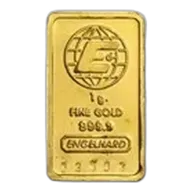
The 1g Engelhard gold bar carries the name of one of the most historically significant precious metals refiners in the world. Charles W. Engelhard Sr. founded the company in 1902 in Newark, New Jersey, and by the 1950s Engelhard was the world's largest precious metals smelter. The company produced gold and silver bars from the late 1960s through approximately 1986, exiting the retail bullion market in the late 1980s to focus on industrial catalysts and materials. BASF acquired Engelhard in 2006 for US$5 billion, and the Engelhard name was retired.
The bar is struck in 999.9 fine gold. Because Engelhard is no longer in production, every Engelhard gold bar on the market is secondary-market stock. This gives the bar an unusual position: it is simultaneously a standard investment gold bar and a collector item from a discontinued brand. Common Engelhard bars trade near standard bar premiums, but rarer varieties, particularly in the silver range where over 40 distinct 1oz types have been catalogued, can command significant premiums above metal value.
At 1g, this is the smallest standard gold bar format. Premiums on 1g bars are the highest of any weight relative to metal content, typically 8-15% over spot, driven by the fixed costs of manufacturing, assaying, and packaging. An Engelhard 1g bar may carry an additional premium for its discontinued status, depending on dealer and collector demand. The AllEngelhard.com community maintains comprehensive catalogues of Engelhard bar varieties and is the standard reference for collectors and authenticators.
Charles Engelhard Jr., who consolidated the family holdings into a publicly listed company in 1958, is widely cited as the inspiration for Ian Fleming's James Bond villain Auric Goldfinger, adding a layer of popular culture recognition to the brand. The company processed gold for the US Treasury and operated at the centre of the global precious metals trade for decades. That history follows the bars into the secondary market.
Engelhard 1g Gold Bar Details
| Attribute | Detail |
|---|---|
| Weight | 1 gram (0.03215 troy oz) |
| Purity | 999.9 fine gold |
| Manufacturer | Engelhard Industries (Newark, New Jersey) |
| Production period | Late 1960s to approximately 1986 |
| Current status | Discontinued; secondary market only |
| Serial number | Typically present (nearly all Engelhard bars are serial-numbered) |
| Company acquired by | BASF (2006, for US$5 billion) |
Engelhard produced bars in a wide range of sizes across gold and silver. The gold range included small minted bars in gram and troy ounce denominations, with individual serial numbers and the Engelhard hallmark. Specific dimensions for the 1g gold bar are not standardised in the collector literature to the same degree as the silver range, where AllEngelhard.com has catalogued over 40 distinct 1oz varieties with detailed die markings, font variations, and production era classifications.
Authentication of Engelhard bars relies on checking serial number formats against documented production runs, verifying font consistency, and examining edge finishing appropriate to the production era. Counterfeits exist, particularly in larger bar sizes. For 1g bars, the small size makes counterfeiting less economically attractive, but verification against known genuine examples is still advisable for secondary-market purchases.
Tax Treatment for the Engelhard 1g Gold Bar
The 999.9 gold purity qualifies this bar for investment gold treatment in all major jurisdictions. The bar's discontinued status has no bearing on its tax treatment; it is assessed on the same basis as any other 999.9 fine gold bar.
- US: Engelhard's home market. No federal sales tax; roughly 35 states exempt bullion. Capital gains taxed at the 28% collectibles rate. The .999+ purity meets IRS Section 408(m) requirements for precious metals IRAs. Some IRA custodians accept Engelhard bars, though the discontinued status and secondary-market sourcing may require additional verification.
- UK: VAT-exempt on purchase as investment gold (995+ fineness). Subject to CGT on disposal at 18% or 24%, with a £3,000 annual allowance. Not CGT-exempt.
- EU: VAT-exempt under Directive 98/80/EC for gold bars at 995+ fineness.
- Canada: GST/HST exempt at 99.5%+ purity.
- Australia: GST-free as investment-grade gold (99.5%+ purity).
- Singapore: GST-exempt under the Investment Precious Metals scheme.
- Hong Kong: No sales tax, no import duty, no capital gains tax.
If a collector premium above metal value is realised on sale, the full gain (including the collector element) is subject to the applicable capital gains tax, not just the metal value appreciation.
Engelhard 1g vs Current-Production Gold Bars
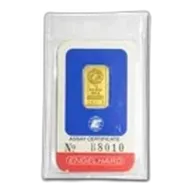
The Engelhard 1g gold bar occupies a unique position: it is a discontinued product competing with bars from refiners that are still in production. The 1g Argor-Heraeus Classic, PAMP Suisse Fortuna 1g, and 1g Valcambi CombiBar are all currently manufactured, readily available from dealers, and come with modern assay card packaging and anti-counterfeiting features. An Engelhard bar lacks these contemporary security measures and relies instead on serial number verification and the brand's established hallmark for authentication.
The comparison splits depending on the buyer's priorities. For a buyer focused on the lowest premium per gram of gold, a current-production bar from an LBMA refiner is typically cheaper, more readily available, and easier to verify. For a buyer who values the historical significance of the Engelhard name, the discontinued status itself creates the appeal. The same dynamic plays out more dramatically in the silver range, where Engelhard 1oz bars regularly sell at $5-20 or more above spot for common varieties, with rare types commanding far larger premiums.
Engelhard's gold bars are less extensively catalogued by collectors than the silver range, where the AllEngelhard.com community has documented over 40 distinct 1oz varieties. Gold bar collectors are a smaller and less organised group, which means fewer standardised references for authentication and valuation. For 1g bars specifically, the collector premium above standard bar pricing is modest compared to rarer Engelhard formats.
The closest market parallel is the Credit Suisse Liberty series, which may face a similar trajectory. Following UBS's acquisition of Credit Suisse in 2023, the long-term continuation of the Credit Suisse brand on new bars is uncertain. If production ceases, existing 1g Credit Suisse Liberty bars could develop the same discontinued-brand premium that Engelhard products carry today.
1g Engelhard Gold Bar: frequently asked questions
-
The cheapest 1g Engelhard bar we track is $434.36 from APMEX, about 224.1% over the $4,176.20 gold spot price. Small bars like this carry higher premiums per gram than larger sizes, and Engelhard's discontinued status can push that premium further above what a comparable modern 1g bar would cost.
-
Engelhard Corporation wound down its precious metals bar production years before its acquisition by BASF, which marked the end of the Engelhard bullion brand. No bars have entered production since. Buyers today are purchasing vintage secondary-market pieces, not newly minted stock.
-
Engelhard bars are stamped 999.9 fine gold, the same four-nines standard used by the London Bullion Market Association for good delivery. The fineness is independently verifiable by weight and XRF testing, and the bars are widely accepted by dealers. Quality is not in question; the main consideration for buyers is the collector premium that the vintage brand commands.
-
There is no public database for Engelhard serial number lookup. Serial numbers were assigned at production for internal tracking, not as a public authentication registry. To verify a bar, have it weighed (1g exactly), check the fineness and hallmark stamps for correct font and depth, and use XRF testing or an ultrasonic probe through a dealer or assay office for definitive confirmation of composition.