
 BullionMart
1 listing
Filters
| Product | /oz | Premium | Price | |
|---|---|---|---|---|
| $5,587.43 | +33.35% |
$449.10
CA$636
|
View Deal |

Prices are fetched automatically and may not reflect current merchant prices. Currency conversions and tax treatment are approximate. Rankings are based solely on price. We are not a dealer and accept no responsibility for transactions with listed merchants. Past performance is not indicative of future results. This site does not provide investment advice. Full disclaimer
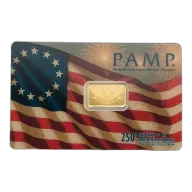
About the 2.5g America the Free Gold Bar
The 2.5g Gold Bar Weight Class
A 2.5 gram gold bar contains 0.0803 troy ounces of fine gold, roughly one-twelfth of a troy ounce. It is the most common fractional gold bar denomination, sitting at the point where a bar is small enough to be affordable yet large enough to be worth trading. At 2026 gold prices of around $3,300 per ounce, a 2.5g bar represents approximately $265 of metal, which makes it one of the most accessible entry points into gold bar ownership.
Bars at this weight are produced exclusively in gold. No refiner makes 2.5g silver bars, because silver's value density is too low for such a small piece to be practical. Standard purity across the weight class is .9999 fine, and the major Swiss refiners all seal their 2.5g bars in tamper-evident assay cards. The card is typically credit-card sized and carries the refiner's mark, a serial number, and the weight and purity certification. Keeping the card sealed matters at resale: dealers worldwide readily buy assay-carded fractional bars from major refiners, whereas a broken seal can mean the bar needs re-assaying.
The trade-off at this size is premium. Buyers pay meaningfully more per gram than they would on a 1 oz bar in exchange for the smaller denomination. The weight class is popular all the same, particularly in German-speaking Europe where 2.5g is the dominant fractional bar size, and across the Middle East, India, and Asia where gram-denominated gold is the standard. The sealed packaging, recognisable refiner branding, and accessible price point also make 2.5g gold bars one of the most frequently gifted bullion products, a common choice for festivals and weddings in gram-based markets.
2.5g Gold Bar Specifications
Specifications below describe the 2.5g gold bar weight class as produced by the major refiners. Individual products vary in design and packaging detail, so check the listing for the exact bar offered.
| Specification | Detail |
|---|---|
| Gold content | 2.5 grams (0.0803 troy oz) |
| Standard purity | .9999 fine gold |
| Format | Minted bar, sealed in a tamper-evident assay card |
| Assay card | Credit-card sized; carries refiner's mark, serial number, weight, and purity certification |
| Metal | Gold only; no 2.5g silver bars are produced |
| IRA status | Meets IRS purity requirements when from an LBMA-accredited refiner |
Minted bars like these are cut from rolled gold sheet and polished, which gives a cleaner finish than cast bars but adds to production cost. The flat, thin assay card stacks efficiently and protects the bar from contact damage, though the card itself is fragile and should be stored flat rather than standing on edge. A dozen 2.5g bars in their cards take up less space than a deck of cards, which makes the weight class easy to keep in a home safe or safe deposit box.
Tax Treatment of 2.5g Gold Bars by Country
Gold bars at .9999 purity qualify as investment gold in every major jurisdiction, so a 2.5g bar buys free of sales tax almost everywhere. Capital gains treatment on sale varies more widely.
- UK: VAT-exempt as investment gold (bars of 995+ fineness qualify). Bars are not CGT-exempt, however; only UK legal tender coins carry that exemption. Gains above the GBP 3,000 annual allowance are taxable at 18-24% depending on income.
- EU: 0% VAT under the Investment Gold Directive, which covers gold bars and wafers of 995+ fineness. Capital gains rules vary by member state: Germany taxes nothing after a 12-month holding period, France applies a flat 36.2% on gains or 11.5% on proceeds depending on the regime chosen.
- US: Sales tax is state-dependent, though most states exempt bullion bars. Long-term capital gains are taxed at the 28% collectibles rate. Bars from LBMA-accredited refiners at 99.5%+ purity are IRA-eligible when held at an IRS-approved depository.
- Canada: GST/HST exempt at 99.5%+ purity.
- Australia and New Zealand: GST-free as investment-grade gold at 99.5%+ purity.
- Singapore: GST-exempt under the Investment Precious Metals scheme for bars from LBMA-accredited refiners, and no capital gains tax.
- Hong Kong: No sales tax, no import duty, no capital gains tax.
For UK buyers the CGT position deserves attention: the lower purchase premium on bars can be outweighed at sale by the CGT that exempt coins avoid, though at 2.5g bar values most buyers stay well within the annual allowance.
2.5g Bars vs 1/10 oz Coins and Other Fractional Sizes
The closest alternative to a 2.5g bar is the 1/10 oz gold coin. A 1/10 oz coin contains 3.11 grams, which is 24% more gold than the 2.5g bar, so it costs correspondingly more. The 2.5g size is cheaper per piece and more common in European, metric-system markets, whereas 1/10 oz is the standard fractional size in troy-ounce markets like the US and Canada. North American buyers seeking 2.5g bars are typically targeting Swiss-brand products specifically.
Against other fractional bars, 2.5g occupies a premium sweet spot. Premiums at this weight run roughly 8-15% over spot depending on brand and dealer. That is a significant penalty against a 1 oz bar, costing perhaps 10% more per gram for the smaller denomination, but it compares well to going smaller still: 1g bars run 15-30% over spot and 0.5g bars 30-50%. Buyback for sealed assay-carded bars from major refiners is typically at or slightly below spot.
Within the weight class, brand drives premium. The PAMP Fortuna 2.5g bar is the single most recognisable small gold bar and commands the highest premiums, with the strongest secondary market of any fractional bar. Valcambi and generic bars sit at the low end of the premium range, and Argor-Heraeus offers classic and holographic Kinebar versions. Valcambi's CombiBar takes a different approach: a 50g or 100g bar perforated into 2.5g segments, combining bulk pricing with small-denomination divisibility. For pure accumulation, larger bars remain more cost-efficient; the 2.5g size earns its premium for gifting, for splitting a holding into small units, or for buyers not yet ready for a full ounce.