 BGASC
BGASC
1 listing
Filters
| Product | /oz | Premium | Price | |
|---|---|---|---|---|
| $4,587.77 | +10.10% | $2,949.93 | View Deal |

Prices are fetched automatically and may not reflect current merchant prices. Currency conversions and tax treatment are approximate. Rankings are based solely on price. We are not a dealer and accept no responsibility for transactions with listed merchants. Past performance is not indicative of future results. This site does not provide investment advice. Full disclaimer
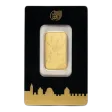
About the 20g Holy Land Mint Gold Bar
The 20g Holy Land Mint Gold Bar
A 20 gram gold bar contains 0.6430 troy ounces of gold, placing it slightly under two thirds of a troy ounce. The weight belongs to the metric bar series (1g, 2.5g, 5g, 10g, 20g, 50g, 100g, 250g, 500g, 1kg) that dominates European and Asian gold markets, where gram-denominated bars are the standard rather than fractional troy ounces. For buyers in those markets, 20g is a familiar mid-range size; in India and Southeast Asia it is also a common gifting and investment weight.
The practical appeal of the 20g size is its position on the premium curve. Premiums at this weight fall between those of 1 oz bars and the 50g and 100g sizes, and are far lower per gram than the 1g to 5g bars, which can carry premiums of 10-40% over spot. That makes 20g a workable compromise for stackers who want smaller, more divisible units than a full ounce without paying small-bar prices. At 2026 gold prices a 20g bar represents roughly $2,100 of metal, a meaningful but accessible purchase.
The bar is also extremely compact. In its assay card a 20g gold bar is roughly credit-card sized, so a stack of them fits easily in a home safe or safe deposit box. Buyers comparing across the weight class can view all 20g gold bars side by side, and the broader category of gold bars for other sizes.
20g Gold Bar Specifications
This is a minted gold bar in the standard 20 gram metric weight. Key figures for the weight class:
| Attribute | Detail |
|---|---|
| Gold weight | 20 grams (0.6430 troy oz) |
| Purity | 999.9 fine gold (24 carat), the retail standard for minted bars |
| Form | Minted bar, typically sealed in an assay card |
| Packaging | Tamper-evident card with serial number, weight and purity certification, and the refiner's mark |
| Size in card | Approximately credit-card sized |
The assay card matters for resale. Minted bars are normally bought and sold sealed, and a bar removed from its card may need re-assaying before a dealer will pay full buyback value, which adds cost and friction. Keep the seal intact and store the card flat rather than standing on edge, since the cards themselves are fragile even though they protect the bar from contact damage.
Minted bars like this one are cut from rolled gold sheet and polished, which gives a cleaner finish than cast bars but a slightly higher production cost. Gold bars carry no face value and are not legal tender; their value is purely the metal content plus the premium the market assigns to the brand and packaging.
Tax Treatment of 20g Gold Bars by Country
Gold bars at 999.9 fineness qualify as investment gold in every major English-speaking market, so purchase taxes are rarely an issue at this purity.
- UK: Investment gold bars (995+ fineness) are VAT exempt. Bars are not CGT exempt, however; only UK legal tender coins carry that exemption. Gains above the £3,000 annual allowance are taxable at 18-24%.
- US: No federal sales tax; most states exempt bullion bars, with some applying thresholds (California over $2,000, New York over $1,000). Long-term capital gains are taxed at the 28% collectibles rate. IRA eligibility requires 99.5%+ purity from an LBMA, COMEX or NYMEX accredited refiner, held at an approved depository.
- Canada: 0% GST/HST at 99.5%+ purity, a federal exemption with no provincial variation.
- Australia: 0% GST for investment-grade gold at 99.5%+ purity in a form commonly traded on commodity markets.
- New Zealand: GST exempt at 99.5%+ gold purity.
- EU: 0% VAT on investment gold bars at 995+ fineness under the Investment Gold Directive.
- Singapore and Hong Kong: No GST on qualifying investment gold in Singapore (IPM scheme) and no sales tax of any kind in Hong Kong; neither charges capital gains tax.
The UK position is the one worth weighing carefully: a bar is VAT-efficient on purchase but CGT-liable on sale, so UK buyers with large expected gains sometimes prefer CGT-exempt legal tender coins despite their higher premiums.
20g Bars vs Half-Ounce Coins and Other Refiners
The closest troy-denominated rival to a 20g bar is the 1/2 oz coin or bar. The gold content is not identical: 20 grams is 0.643 troy ounces, about 29% more gold than a half ounce. Choosing between them is largely a question of regional convention, since metric markets in Europe, the Middle East and Asia favour grams while North America and Australia trade mainly in fractional troy ounces. Metric bars from the big Swiss refiners typically carry lower premiums than sovereign mint half-ounce coins competing for the same budget.
Within the 20g weight class itself the established names are the Swiss refiners. The 20g PAMP Suisse Fortuna is one of the most recognised small gold bars in the world and commands a slight brand premium for its Lady Fortuna design. Valcambi 20g bars are often the lowest-premium Swiss option at this weight, and Valcambi also offers a 20g CombiBar perforated into segments that can be broken off individually, trading a higher premium for divisibility. Argor-Heraeus produces both classic minted 20g bars and its kinebar line with a holographic security feature.
Liquidity is the other axis to weigh. Assay-carded 20g bars from the major LBMA-accredited refiners are accepted by dealers across Europe, Asia and the Middle East, though the weight is less mainstream in the US, Canada and Australia, where 1 oz products dominate retail trade. Buyers who expect to resell in a troy-ounce market may prefer a 1 oz bar; buyers in metric markets give up nothing by holding 20g.