17 products · 100 deals
Filters
| Product | /oz | Premium | Price | |
|---|---|---|---|---|

4 deals
|
$4,509.32 | +2.30% | $2,899.56 | Compare |

3 deals
|
$4,463.80 | +2.47% |
$2,870.29
S$3,669
|
Compare |
| $4,503.78 | +3.38% |
$2,895.99
S$3,702
|
View Deal | |
| $4,503.78 | +3.38% |
$2,895.99
S$3,702
|
View Deal | |

7 deals
|
$4,514.77 | +3.88% |
$2,903.06
€2,533
|
Compare |

6 deals
|
$4,515.65 | +3.92% |
$2,903.63
£2,176
|
Compare |

10 deals
|
$4,521.46 | +4.06% |
$2,907.36
£2,179
|
Compare |

14 deals
|
$4,563.42 | +5.02% |
$2,934.35
£2,199
|
Compare |

6 deals
|
$4,572.37 | +5.23% |
$2,940.10
£2,203
|
Compare |

13 deals
|
$4,588.47 | +5.60% |
$2,950.45
£2,211
|
Compare |

19 deals
|
$4,601.52 | +5.90% |
$2,958.85
£2,217
|
Compare |
| $4,605.57 | +5.99% |
$2,961.45
£2,219
|
View Deal | |

4 deals
|
$4,613.93 | +6.18% |
$2,966.83
£2,223
|
Compare |

4 deals
|
$4,618.38 | +6.29% |
$2,969.68
£2,225
|
Compare |

3 deals
|
$4,660.71 | +7.15% |
$2,996.90
A$4,209
|
Compare |
| $4,702.58 | +8.11% |
$3,023.83
A$4,247
|
View Deal | |

3 deals
|
$4,727.05 | +8.77% |
$3,039.56
€2,652
|
Compare |






Prices are fetched automatically and may not reflect current merchant prices. Currency conversions and tax treatment are approximate. Rankings are based solely on price. We are not a dealer and accept no responsibility for transactions with listed merchants. Past performance is not indicative of future results. This site does not provide investment advice. Full disclaimer
About 20g Gold Bars
20g Gold Bars: The Mid-Range Metric Denomination
The 20 gram gold bar contains 0.6430 troy ounces of gold, positioning it squarely between the small fractional bars (1g to 10g) and the standard 1oz weight. At current prices (roughly $2,100 per bar), it represents a meaningful gold holding without requiring the $3,300+ commitment of a full troy ounce. This middle-ground position is the 20g bar's defining characteristic: it costs enough to make the premium penalty tolerable, yet remains accessible to buyers building a position incrementally.
Twenty grams is a metric denomination, native to European and Asian markets where gold has always been traded in grams rather than troy ounces. The major Swiss refiners (PAMP, Valcambi, Argor-Heraeus) and German refiners (Heraeus, Umicore) all produce 20g bars as part of their standard range. In the US, Canada, and Australia, where troy ounces dominate, 20g bars are available but less commonly stocked than the 1/2oz equivalent.
The 20g weight is close to half a troy ounce (0.5 oz = 15.55g), which creates an interesting comparison. A buyer choosing between a 20g bar and a 1/2oz product gets 29% more gold with the 20g bar at roughly similar premiums. This makes 20g bars slightly more cost-efficient than half-ounce products on a per-gram basis, assuming the buyer is indifferent to the troy-ounce vs metric distinction.
Who Buys 20g Gold Bars
Three buyer profiles dominate this weight. Regular accumulators use 20g as a stepping stone: they may not be able to commit to a full ounce every month, but a 20g bar every two months builds a position steadily. Gift buyers find the price point substantial enough to feel significant without being extravagant. Portfolio diversifiers use 20g bars for divisibility, holding ten 20g bars (200g total) rather than a single 200g bar, which allows partial liquidation without selling an oversized single holding.
The premium economics at 20g are reasonable. Expect roughly 4-8% over spot depending on brand, compared to 2-4% on 1oz gold bars and 8-15% on 2.5g bars. The 20g denomination sits at the point in the size curve where premiums begin to flatten: the jump from 10g to 20g produces a noticeable premium improvement, but the jump from 20g to 50g produces less marginal gain.
20g Gold Bar Premium Dynamics
Premium percentages on 20g gold bars typically range from 4-8% over spot, varying by brand and dealer. This places them in the middle of the bar premium spectrum, well below small fractional bars but above the 1oz and larger sizes where institutional-scale efficiency compresses margins.
Brand premium stratification at 20g follows the same pattern seen across the weight range. The 20g PAMP Fortuna commands the highest premiums (typically 6-8%) due to design recognition and VeriScan authentication. Valcambi and Argor-Heraeus 20g bars trade in the 4-6% range. Generic or less-recognised brands can be found closer to 3-5%.
The comparison to adjacent sizes is instructive. Moving down to 10g roughly doubles the premium percentage. Moving up to 50g might save 1-2 percentage points. The practical question for a buyer with $2,100 to invest is whether the fractional premium of the 20g bar is justified by the benefit of having a more portable and divisible holding compared to saving up for a larger bar. For most retail buyers, the answer depends on how frequently they plan to buy: monthly buyers benefit from buying what they can afford each period, while those making a one-time allocation should consider whether stretching to a 1oz bar or waiting for a 50g bar would give better overall value.
Resale spreads on 20g bars from LBMA-accredited refiners are tight: dealers typically buy back at or near spot for sealed assay-carded bars from major brands. Non-LBMA and unbranded 20g bars may face wider spreads, though the 20g weight is universally standardised enough that even less-recognised bars are readily tradeable.
Major 20g Gold Bar Products
The 20g gold bar market is dominated by Swiss and German refiners, with one sovereign mint product (the Britannia bar from the Royal Mint) adding a distinctive option for UK buyers.
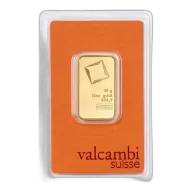
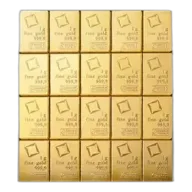
The 20g Valcambi bar leads on dealer count (58 dealers) and typically offers the tightest premiums among Swiss refiners. Valcambi's position as the world's largest refinery by volume means consistent supply and competitive pricing. The bar is a clean minted design sealed in a tamper-evident assay card. Valcambi also produces a 20g CombiBar variant, pre-scored into 20 individual 1g segments for buyers who want divisibility within a single purchase.
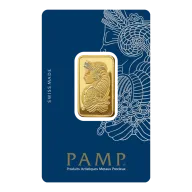
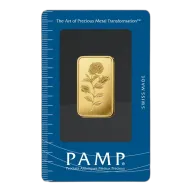
The 20g PAMP Fortuna (49 dealers) adds the iconic Lady Fortuna design and VeriScan digital authentication. Dimensions are 31.0 x 18.0 x 1.88mm. The Fortuna commands a premium above Valcambi, but its stronger secondary-market recognition often means a higher buyback price, partially offsetting the extra purchase cost.
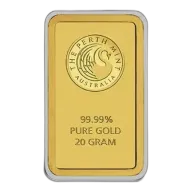
The 20g Perth Mint bar (43 dealers) brings government backing from the Western Australian Government. Perth Mint bars use CertiCard packaging with a kangaroo security hologram. They are especially competitive in Australia and Asia-Pacific markets where Perth Mint's brand is strongest.
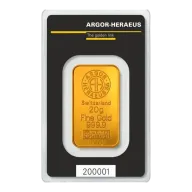
The 20g Argor-Heraeus bar (26 dealers) and its 20g Kinebar variant (22 dealers, featuring a holographic security element) represent the Heraeus Group's Swiss refining arm. LBMA-accredited since 1961, Argor-Heraeus bars are priced competitively with Valcambi.
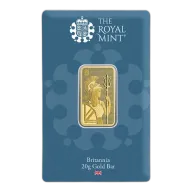
The 20g Britannia gold bar (23 dealers) from the Royal Mint is the only sovereign mint bar at this weight with a named series. It carries 999.9 fineness and is VAT-exempt in the UK, but unlike Britannia coins, the bar does not carry CGT exemption (it is not legal tender). Its appeal is to UK buyers who want a familiar brand from a domestic mint.
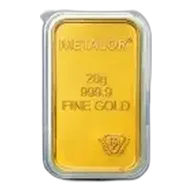
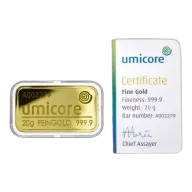
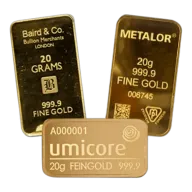
The 20g Metalor bar (24 dealers) and 20g Umicore bar (21 dealers) round out the LBMA-accredited options, offering competitive pricing from established European refiners.
Resale and Storage at 20g
The 20g bar sits in a comfortable liquidity position. It is large enough to be worth trading through any established dealer and small enough to attract a broad buyer pool. Assay-carded bars from PAMP, Valcambi, Argor-Heraeus, and Perth Mint are accepted globally without question. Non-LBMA bars may face slightly wider spreads but are still readily tradeable at this universally recognised weight.
Regional liquidity varies. In Europe, the Middle East, and Asia, where gram-denominated gold is native, 20g bars are a standard denomination with deep secondary markets. In the US, Canada, and Australia, 20g bars are available but compete with the more familiar 1/2oz and 1oz troy weights. A US buyer reselling a 20g Valcambi bar will find ready buyers at major online dealers, but a local coin shop may be more familiar with and offer tighter spreads on 1oz products.
Storage is one of the 20g bar's strengths. Each bar in its assay card is roughly credit-card sized, making it one of the most space-efficient ways to store gold. A dozen 20g bars (240g, worth roughly $25,000) fit in a small safe deposit box alongside other documents. Bars should be stored flat in their assay cards rather than stacked, to avoid pressure damage to the sealed packaging.
For buyers building a larger gold position, the 20g denomination offers a practical middle path between the divisibility of 10g bars and the premium efficiency of 50g bars. Holding gold in 20g increments allows partial liquidation in roughly $2,100 steps, which is granular enough for most personal finance scenarios without the excessive premium penalty of smaller bars.
20g Gold Bars: frequently asked questions
-
Divide the bar's weight in grams by 31.1035 to convert to troy ounces (20g = 0.6430 troy oz), then multiply by $4,408.10 per troy oz. That gives the raw melt value. The retail price of a 20g bar will be higher, as it includes the dealer's premium over spot.
-
Investment-grade 20g gold bars are almost universally 999.9 fine (24 carat), with some older or branded bars at 999. Purity matters because it determines the actual gold content used in premium calculations: a 999.9 fine 20g bar contains fractionally more gold than a 999 fine bar of the same weight.
-
For resale and liquidity, buying from an LBMA-accredited refiner is broadly advisable. These bars are universally recognised by dealers and banks worldwide. Bars from less-known producers may be harder to sell quickly or attract verification costs, even if the gold content is identical.
-
45 dealers in our comparison stock 20g gold bars, covering 110 individual listings. Comparing prices across multiple dealers for the same weight and brand can make a meaningful difference to the premium you pay.
-
Reporting rules vary by country. In the UK, HMRC requires a CGT return only when a gain is realised on disposal, not on purchase. In Canada, 50% of any gain on disposal is included in taxable income. In the US, dealers may be required to report certain cash transactions above set thresholds. Always check the rules in your jurisdiction.
- 20g ABC Cast Bar Gold Bar
- 20g ABC Refinery Gold Bar
- 20g Ainslie Gold Bar
- 20g Argor-Heraeus Gold Bar
- 20g Austrian Mint Gold Bar
- 20g Britannia Gold Bar
- 20g BulMint Gold Bar
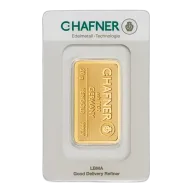
- 20g C.Hafner Gold Bar
- 20g CombiBar Gold Bar
- 20g Credit Suisse Gold Bar
- 20g Credit Suisse Liberty Gold Bar
- 20g Engelhard Gold Bar
- 20g Fortuna Gold Bar
- 20g Geiger Original Gold Bar
- 20g Gold Bar
- 20g Heraeus Gold Bar
- 20g Istanbul Gold Refinery Gold Bar
- 20g Johnson Matthey Gold Bar
- 20g Ka `Bah. Mecca Gold Bar
- 20g Kinebar Gold Bar
- 20g Metalor Gold Bar
- 20g Minted Bars Gold Bar
- 20g MMTC-PAMP Lakshmi Ganesh Gold Bar
- 20g PAMP Suisse Gold Bar
- 20g Perth Mint Gold Bar
- 20g Perth Mint Kangaroo Gold Bar
- 20g Rosa Gold Bar
- 20g Royal Canadian Mint Gold Bar
- 20g Sunshine Minting Gold Bar
- 20g Swiss Kantonalbank Gold Bar
- 20g Themis Gold Bar
- 20g The Royal Mint Gold Bar
- 20g UBS Gold Bar
- 20g Umicore Gold Bar
- 20g Valcambi Gold Bar
- 20g World's Wildlife Gold Bar
- Pre-Owned 20g Britannia Gold Bar
- Pre-Owned 20g Credit Suisse Gold Bar
- Pre-Owned 20g Fortuna Gold Bar
- Pre-Owned 20g Gold Bar
- Pre-Owned 20g Istanbul Gold Refinery Gold Bar
- Pre-Owned 20g Kinebar Gold Bar
- Pre-Owned 20g Metalor Gold Bar
- Pre-Owned 20g MMTC-PAMP Lakshmi Ganesh Gold Bar
- Pre-Owned 20g PAMP Suisse Gold Bar
- Pre-Owned 20g The Royal Mint Gold Bar
- Pre-Owned 20g UBS Gold Bar