1 listing
Filters
| Product | /oz | Premium | Price | |
|---|---|---|---|---|

 Chards
Out of Stock
Chards
Out of Stock
|
$4,619.49 | +6.31% |
$2,970.48
£2,226
|
View Deal |
Prices are fetched automatically and may not reflect current merchant prices. Currency conversions and tax treatment are approximate. Rankings are based solely on price. We are not a dealer and accept no responsibility for transactions with listed merchants. Past performance is not indicative of future results. This site does not provide investment advice. Full disclaimer
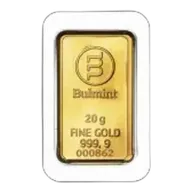
About the 20g BulMint Gold Bar
The 20g BulMint Gold Bar
Twenty grams is the in-between weight of the gold bar world: 0.643 troy ounces, slightly under two-thirds of an ounce, sitting in the gram-denominated series that runs 1g through 1kg. This BulMint bar is struck to .9999 fine gold, the standard four-nines purity at this weight. At current gold prices a 20g bar represents roughly $2,100 of metal, a meaningful but accessible single purchase, and the format is a core size in the markets where metric gold is the norm: Germany, Switzerland, Austria, the Middle East, and across Asia, where gold souks and bullion dealers stock 20g prominently.
The premium economics are the middle of the curve. Expect roughly 4 to 8% over spot depending on brand and dealer, significantly cheaper per gram than 1g to 5g bars, which can carry 10 to 40% premiums, but more expensive per gram than 1 oz and larger bars. The weight is close enough to half a troy ounce that it competes directly with 1/2 oz gold coins for the same budget, and metric bars typically undercut sovereign half-ounce coins on premium while containing 29% more gold.
The practical advice for any 20g bar applies here: keep it sealed in its assay card. Bars removed from their original packaging may need re-assaying before resale, which adds cost and friction, and a sealed card in its credit-card-sized format stores anywhere. In troy-ounce markets like the US and UK, expect the metric weight to be a slightly less mainstream sell than 1 oz bars.
Tax Treatment of a 20g Gold Bar
At .9999 fineness, this bar comfortably exceeds the investment-gold thresholds everywhere, so it takes gold's favourable purchase-tax treatment across all major markets.
- UK: VAT-exempt as investment gold, which covers bars of 995+ fineness. Bars are not CGT-exempt regardless of who refines them; the CGT exemption applies only to UK legal tender coins such as the Britannia and Sovereign, so gains above the £3,000 annual allowance are taxable at 10 to 20%.
- US: most states exempt bullion from sales tax, others tax it, and several apply thresholds. A 20g bar at roughly $2,100 clears the $1,000 thresholds in Louisiana, Massachusetts, and New York and the $2,000 threshold in California on a single-bar order. IRA eligibility requires 99.5%+ purity from an accredited refiner held at an approved depository.
- EU: VAT-exempt under the Investment Gold Directive for bars of 995+ fineness, which makes the 20g format especially clean in its core German-speaking markets. Germany additionally makes gains tax-free after a one-year holding period.
- Canada: GST/HST exempt at 99.5%+ purity in bar form.
- Australia and New Zealand: GST-free as investment-grade gold at 99.5%+ purity.
- Singapore: GST-exempt as an Investment Precious Metal when from a qualifying refiner; no capital gains tax.
- Hong Kong: no sales tax, no import duty, no capital gains tax.
BulMint 20g vs Swiss Brands and Half-Ounce Coins
The 20g weight is dominated by the big LBMA-accredited names: the PAMP Suisse Fortuna, one of the most recognised small gold bars globally, Valcambi, often the lowest-premium Swiss option at this weight, Argor-Heraeus with its holographic kinebar security, Perth Mint in CertiCard packaging, plus Heraeus and Umicore. Against that field, a bar from a less prominent mint competes on price. The metal is identical at .9999 fine; the difference shows up at resale, where assay-carded bars from PAMP, Valcambi, Argor-Heraeus, and Perth Mint are accepted by virtually every gold dealer worldwide and typically buy back at or near spot, while lesser-known brands can face more scrutiny. A buyer choosing on price alone should weigh the discount at purchase against potentially wider spreads at exit.
One Swiss option worth knowing about at this weight is the Valcambi CombiBar, a 20g bar perforated into twenty 1g segments that can be snapped off individually. It carries a higher premium for the divisibility, the opposite trade to a plain bar.
The cross-format comparison is the 1/2 oz sovereign coin. The 20g bar contains 29% more gold (0.643 oz against 0.5 oz) and metric bars generally carry lower premiums, while the coin brings sovereign branding, legal tender status, and in the Britannia's case UK CGT exemption. Metric markets reach for the bar; troy-ounce markets and tax-sensitive UK buyers tend toward the coin.