
1 listing
Filters
| Product | /oz | Premium | Price | |
|---|---|---|---|---|

 Ainslie Bullion
|
$4,515.61 | +3.81% |
$2,903.63
A$4,078
|
View Deal |
Prices are fetched automatically and may not reflect current merchant prices. Currency conversions and tax treatment are approximate. Rankings are based solely on price. We are not a dealer and accept no responsibility for transactions with listed merchants. Past performance is not indicative of future results. This site does not provide investment advice. Full disclaimer
About the 20g Ainslie Gold Bar
The 20g Ainslie Gold Bar
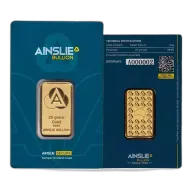
This Ainslie bar contains 20 grams of .9999 fine gold, which works out to 0.6430 troy ounces, slightly under two-thirds of a troy ounce. The 20g weight belongs to the metric, gram-denominated bar ladder (1g, 2.5g, 5g, 10g, 20g, 50g, 100g and up) that is native to European and Asian markets, where gram-denominated gold is the standard rather than the troy-ounce fractions that dominate North American retail trade.
The appeal of the 20g size is its position on the premium curve. Gold bar premiums scale inversely with size: tiny 1g to 5g bars can carry steep per-gram premiums, while 20g bars typically land in the region of 4-8% over spot depending on brand and dealer. That makes 20g significantly cheaper per gram than the small gift sizes while keeping the outlay well below a full ounce. It also competes directly with 1/2 oz sovereign coins for the same budget bracket, and metric bars generally undercut half-ounce gold coins on premium because bars are simpler to produce than legal tender coinage.
Practical points apply to any minted bar at this weight. Bars in this size class are normally supplied in sealed assay cards carrying the refiner mark, serial number and weight and purity certification, and the card matters: a bar removed from its assay packaging may need re-assaying before resale, which adds cost and friction. A 20g bar in its card is roughly credit-card sized, so storage is trivial. As a bar rather than a coin, it carries no face value and no legal tender status; what you are buying is refined gold weight in a compact, certifiable format.
How 20g Gold Bars Are Taxed
Gold bars at .9999 fineness comfortably clear the investment-gold purity thresholds in every major jurisdiction, so the purchase-tax picture is friendly almost everywhere.
- United Kingdom: Investment gold bars of 995 fineness or better are 0% VAT. Bars are not CGT-exempt, however; only UK legal tender coins escape capital gains tax, so gains on a bar above the annual CGT allowance (currently £3,000) are taxable at 18-24%.
- EU: VAT-exempt as investment gold under the EU directive (bars at 995+ fineness). Capital gains rules vary by country; Germany, for example, taxes no gain on bullion held over a year.
- United States: No federal sales tax; most states exempt bullion, others tax it or apply purchase thresholds. Long-term gains are taxed at the collectibles rate of up to 28%. IRA eligibility for gold bars requires 99.5%+ purity from an accredited refiner with approved depository storage.
- Australia: GST-free as investment-grade gold at 99.5%+ purity in a commonly traded form.
- Canada: GST/HST exempt at 99.5%+ purity. New Zealand exempts gold at the same threshold, and Singapore and Hong Kong charge no tax on investment gold at all.
For UK buyers specifically, the bar-versus-coin decision is a lifecycle calculation: bars are cheaper going in, but a CGT-exempt coin can be cheaper coming out if the gain is large.
20g Bar vs Half-Ounce Coins and Ounce Bars
The closest decision most buyers face at this budget level is 20g bar versus 1/2 oz gold coin. The gold content is not identical: 20g is 0.643 troy ounces, about 29% more metal than a half-ounce coin. Metric bars also typically carry lower premiums than sovereign mint half-ounce coins, so the bar usually wins on gold-per-dollar. The coin wins on liquidity in troy-ounce markets and, for UK buyers, on the CGT exemption that legal tender coins like the 1/2 oz gold Britannia carry and bars do not.
Moving up the ladder, 1 oz gold bars and larger sizes offer lower percentage premiums still; 1 oz minted bars typically run 1-4% over spot against the rough 4-8% at 20g. The 20g size is the compromise for buyers who want a meaningful but sub-ounce position, or who are accumulating in smaller steps.
Within the 20g format itself, the established names are the Swiss and European refiners: PAMP Suisse's Fortuna, Valcambi (often the lowest-premium Swiss option at this weight), Argor-Heraeus with its holographic kinebar security, plus Perth Mint, Heraeus and Umicore. Those LBMA-accredited brands set the benchmark for resale: their assay-carded 20g bars are accepted by virtually every gold dealer worldwide, typically bought back at or near spot. When weighing an Ainslie bar against those alternatives, the practical questions are the premium being asked, the packaging and certification supplied, and how readily your likely buyers recognise the brand, since recognition is what converts a bar back to cash at the best price.
20g Ainslie Gold Bar: frequently asked questions
-
The cheapest Ainslie 20g gold bar we track is $2,903.63, at 3.8% over the gold spot price of $4,408.10 per troy ounce. The bar contains 20 grams of 999.9 fine gold (about 0.6430 troy oz), so its metal value changes throughout the trading day as spot moves.
-
The Ainslie 20g gold bar weighs 20g and is 999.9 fine gold (24-carat), produced by Ainslie. The bar meets the standard specifications for investment-grade gold. Exact dimensions vary slightly between production runs; check the dealer listing for precise measurements.
-
Small gold bars are best kept in their original sealed packaging to preserve condition and resale value. For home storage, a quality safe bolted to the structure is the practical minimum. Many buyers prefer insured specialist vault storage, which removes the security burden and often satisfies insurance requirements. Keep purchase receipts alongside any stored bars.