1 listing
Filters
| Product | /oz | Premium | Price | |
|---|---|---|---|---|

 Suisse Gold
Out of Stock
Suisse Gold
Out of Stock
|
$4,805.18 | +10.57% |
$3,089.81
€2,696
|
View Deal |
Prices are fetched automatically and may not reflect current merchant prices. Currency conversions and tax treatment are approximate. Rankings are based solely on price. We are not a dealer and accept no responsibility for transactions with listed merchants. Past performance is not indicative of future results. This site does not provide investment advice. Full disclaimer
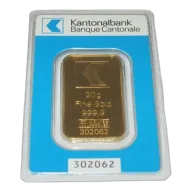
About the 20g Swiss Kantonalbank Gold Bar
The 20g Swiss Kantonalbank Gold Bar
The 20g Swiss Kantonalbank gold bar holds 20 grams of 999.9 fine gold, just under two-thirds of a troy ounce (0.643 oz). The 20 gram size belongs to the metric bar series native to European and Asian markets, where gram-denominated gold is the standard rather than troy-ounce fractions. At roughly $2,100 at 2026 gold prices, it is a meaningful but accessible purchase: a serious step up from gift-sized gram bars without the outlay of a full ounce.
The economics of the weight class are favourable for a mid-size buyer. Premiums at 20g run roughly 4-8% over spot depending on brand and dealer, significantly cheaper per gram than the 1g-5g bars that can carry 10-40%, though above what 1 oz gold bars and larger formats achieve. Because 20 grams is close to half a troy ounce, the bar competes directly with 1/2 oz sovereign coins for the same budget bracket, and metric bars typically undercut those coins on premium while containing 29% more gold than an actual half ounce.
The practical caveat with any 20g bar is packaging. Bars at this size are typically supplied in sealed assay cards carrying the serial number, refiner mark, and weight and purity certification, and buyback runs at or near spot for sealed cards from recognised refiners. A bar removed from its card may need re-assaying before a dealer pays full value, so the card is part of the asset. For a bank-branded bar outside the best-known refinery names, intact certification matters even more at resale.
20g Gold Bar Specifications
| Attribute | Detail |
|---|---|
| Weight | 20 grams (0.6430 troy oz) |
| Metal | Gold |
| Purity | 999.9 fine (24 carat) |
| Form | Minted bar |
The 999.9 fineness is the four-nines standard shared by all major refiners at this weight. A 20g bar in its assay card is roughly credit-card sized, storing easily in a home safe or safe deposit box; minted bars in cards stack flat and efficiently, though the cards themselves are fragile and should be stored flat rather than on edge.
Counterfeiting risk at 20g is modest compared with large bars. The tungsten-core threat that dogs 100g+ gold bars is less practical at small sizes, and the tamper-evident assay card provides the primary chain-of-custody assurance. Standard verification still applies for loose or secondary-market bars: weight and dimension checks first, then electromagnetic testing with a Sigma-type verifier, which works well on bars up to about 100g. Keeping the seal intact sidesteps all of it, which is the strongest argument for never opening the card.
Tax Treatment of 20g Gold Bars by Country
At 999.9 fineness this bar qualifies as investment gold in every major jurisdiction, with the usual bar-versus-coin caveats on capital gains.
- UK: 0% VAT (investment gold at 995+ fineness). Bars are CGT-liable on disposal; the legal tender exemption covers coins like Britannias and Sovereigns only. Gains above the £3,000 annual allowance are taxed at 18-24%, and qualifying gold can be held in a SIPP.
- EU: 0% VAT under the Investment Gold Directive. Capital gains rules vary by country; Germany charges nothing after a 12-month hold, which suits its strong metric-bar market.
- Switzerland: 0% VAT on investment gold.
- US: No federal sales tax; most states exempt bullion. A single bar at roughly $2,100 clears the $1,000 thresholds in New York and Massachusetts but sits close to California's $2,000 line. Long-term gains taxed at up to 28% as collectibles. IRA inclusion requires accredited-refiner bars meeting the purity floor.
- Canada: 0% GST/HST at 99.5%+ purity.
- Australia: 0% GST for investment-grade gold (99.5%+).
- New Zealand: GST-exempt at 99.5%+ purity; no formal CGT.
- Singapore and Hong Kong: No GST (IPM scheme) or sales tax respectively, and no capital gains tax in either; both are core markets for gram-denominated gold.
Swiss Kantonalbank 20g vs the Established 20g Bars
The 20g weight is crowded with recognised names, which frames the decision for any less common brand. The PAMP Suisse Fortuna 20g is one of the most recognised small gold bars in the world and carries a brand premium for the Lady Fortuna design; Valcambi and Argor-Heraeus are typically the lowest-premium Swiss options, the latter offering kinebar holographic security; Heraeus and Umicore serve the European market and the Perth Mint covers Australia and Asia in CertiCard packaging. Assay-carded bars from those refiners are accepted by virtually every gold dealer worldwide. A bank-branded Swiss bar contains identical gold at identical purity, so it needs a price advantage at purchase to offset narrower recognition at sale.
One structural alternative at this weight is the Valcambi CombiBar 20g, perforated into twenty 1g break-off segments. It costs more per gram but converts a single bar into divisible units, solving the all-or-nothing problem that every solid bar shares.
The cross-format comparison is with 1/2 oz sovereign coins, which occupy the same budget bracket. The 20g bar carries 29% more gold than a half-ounce coin and metric bars generally undercut sovereign mint coins on premium, but coins answer back with legal tender status, which in the UK means CGT exemption that no bar of any brand can offer. In metric-native markets like Germany, Switzerland, the Middle East, and Asia, the bar is the default choice; in troy-ounce markets like the US and Canada, 20g remains a niche weight for buyers specifically seeking metric gold.