1 listing
Filters

 APMEX
APMEX
Prices are fetched automatically and may not reflect current merchant prices. Currency conversions and tax treatment are approximate. Rankings are based solely on price. We are not a dealer and accept no responsibility for transactions with listed merchants. Past performance is not indicative of future results. This site does not provide investment advice. Full disclaimer
About the 500g Johnson Matthey Gold Bar
A Half-Kilo Bar from Britain's Historic Precious Metals Refiner
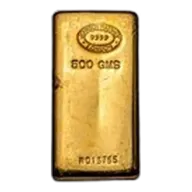
The 500g Johnson Matthey gold bar comes from one of the most important names in precious metals refining history. Johnson Matthey was founded in London in 1817, and its precious metals division operated for nearly 200 years before being sold to Asahi Refining in 2015. During its operational period, JM was one of the five members of the London Gold Fix, the institution that set the benchmark gold price twice daily from 1919 until 2015. The company held LBMA Good Delivery accreditation throughout its refining years.
No new Johnson Matthey bars are being produced. Every 500g JM gold bar on the market is a secondary market piece, and the brand's combination of LBMA heritage and discontinuation gives it a profile similar to Engelhard bars on the American side of the Atlantic. The bar is refined to 9999 fine gold (four nines) and weighs 500 grams (16.075 troy ounces), a substantial investment at the half-kilo weight class.
JM's reputation was built on industrial precision. The company was (and its successor Asahi remains) a major refiner of platinum group metals, and its gold refining carried the same exacting standards. JM bars from the production era are well-documented, serialised, and widely recognised by dealers globally. The LBMA heritage means the bar is accepted at full buyback value by any dealer familiar with the JM hallmark, though as with any secondary-market bar, verification of authenticity may be required.
For buyers seeking a 500g gold bar at the lowest possible premium over spot, current-production alternatives from Valcambi, Heraeus, or Metalor will generally cost less. The Johnson Matthey bar carries its historical provenance as an additional attribute beyond the gold content itself.
500g Johnson Matthey Gold Bar Specifications
| Property | Detail |
|---|---|
| Weight | 500 grams (16.075 troy oz) |
| Purity | 9999 fine gold (four nines, 24 carat) |
| Manufacturer | Johnson Matthey |
| Country of origin | United Kingdom |
| LBMA accredited | Yes (during operational period; bullion operations sold to Asahi in 2015) |
| Production status | Discontinued (secondary market only) |
| Serial number | Yes |
| Face value | None (not legal tender) |
Johnson Matthey produced bars in both cast and minted forms. The 500g size was typically produced as a cast bar. Each bar carries the JM hallmark, serial number, weight and purity markings. JM bars are noted for the quality and consistency of their stamping, reflecting the company's industrial precision standards developed over nearly 200 years of precious metals refining.
Because production has ceased, most 500g JM gold bars on the market are unpackaged or in third-party holders rather than in original sealed assay cards. Authentication relies on verifying the JM hallmark, serial number format, and physical characteristics against documented specifications for the production era. Dealers experienced with JM products can authenticate by visual inspection in most cases. The bar's 9999 purity notation is equivalent to 999.9 fineness, meeting the highest standard for investment gold. JM's London heritage and its role as a founding member of the London Gold Fix give these bars a documented provenance chain that few other discontinued brands can match.
Tax Treatment of the 500g Johnson Matthey Gold Bar
The bar's discontinued production status does not affect its tax classification. At 9999 fineness (equivalent to 999.9), it qualifies as investment gold in all major markets.
United Kingdom
VAT-exempt as investment gold at 995+ fineness. Subject to CGT on disposal, as gold bars are not UK legal tender. Any premium above the bullion value (including collector premium) forms part of the taxable gain. The bar meets the 99.5% purity threshold for SIPP and SSAS pension eligibility. JM's British heritage makes these bars familiar to UK pension custodians.
United States
State sales tax varies. The 9999 purity comfortably exceeds the 99.5% IRA threshold under Section 408(m). JM bars from the production era are generally accepted by IRA custodians, though buyers should confirm with their specific provider. Federal capital gains tax on gold is at the collectibles rate (up to 28% long-term).
European Union
VAT-exempt under the Investment Gold Directive for bars at 995+ fineness. In Germany, gains are tax-free after one year of holding. Capital gains treatment varies across other EU member states.
Canada, Australia, and Asia-Pacific
GST/HST-exempt in Canada (gold at 99.5%+). GST-exempt in Australia and New Zealand as investment-grade gold. Exempt under Singapore's IPM scheme for gold at 99.5%+ from recognised refiners. Hong Kong applies no sales tax or CGT.
Johnson Matthey vs Other 500g Gold Bars
The Johnson Matthey 500g bar shares the secondary-market profile with the 500g Engelhard bar. Both are from discontinued LBMA-accredited refiners, both are no longer in production, and both carry a degree of historical provenance that current-production bars do not. Engelhard bars have a stronger collector following in the United States, while JM bars are more recognised in the UK and European markets, reflecting each company's geographic origins.
Against current-production bars, the comparison is straightforward. The 500g Valcambi, 500g Heraeus, and 500g PAMP Suisse all offer the same purity of gold in sealed assay card packaging from active LBMA refiners. They are easier to authenticate, more widely available, and typically trade at lower total premiums because there is no discontinued-brand markup. For a buyer focused purely on gold content at the best price, these are the more efficient choices.
The JM bar's distinction is its provenance. Johnson Matthey was a founding member of the London Gold Fix, participated in setting the global gold price for nearly a century, and was one of the most respected names in precious metals refining. The company's bullion operations were sold to Asahi Refining, which now produces bars under its own name. A JM bar is a piece of that history in physical form, and for some buyers that provenance has value beyond the gold content alone.
The 500g Royal Mint bar is the closest current-production British equivalent. The Royal Mint offers government-backed provenance and modern sealed packaging, though its bars also carry no CGT exemption (only Royal Mint legal tender coins are CGT-exempt in the UK).
500g Johnson Matthey Gold Bar: frequently asked questions
-
Johnson Matthey exited the retail bullion bar business after its precious metals division ran into serious financial difficulties. The company later sold its gold and silver refining operations to Asahi Holdings, with LBMA Good Delivery status transferring to the new owner. All Johnson Matthey-branded bars available today come from the secondary market.
-
Yes. The 500g Johnson Matthey gold bar is 999.9 fine gold, meaning it meets the four-nines standard of 99.99% pure gold. At 500g it is a mid-range bar size, sitting between the popular 1 oz and 1 kg formats often held by investors seeking larger physical gold positions.