 Summit Bullion
34 listings




Prices are fetched automatically and may not reflect current merchant prices. Currency conversions and tax treatment are approximate. Rankings are based solely on price. We are not a dealer and accept no responsibility for transactions with listed merchants. Past performance is not indicative of future results. This site does not provide investment advice. Full disclaimer
About the 1/4 oz American Gold Eagle Gold Coin
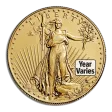
The 1/4 oz American Gold Eagle (Type II)
The 1/4 oz American Gold Eagle contains 7.777 grams of fine gold in a 22 karat alloy (.9167 fine), with a total coin weight of 8.483 grams. This listing covers the Type II version of the American Gold Eagle, produced from 2021 onwards, featuring Jennie Norris' close-up bald eagle portrait on the reverse. The coin carries a $10 face value and is legal tender of the United States.
The 2021 redesign marked the first reverse change in the Gold Eagle program's 35-year history. The original Type I reverse (1986-2021) showed a family of eagles by sculptor Miley Busiek Frost. The Type II replaced this with an intimate portrait of a single bald eagle, sculpted by Renata Gordon, along with a new anti-counterfeiting edge feature: a specifically positioned missing reed that changes position annually. Both Type I and Type II were produced during 2021, making it the only year with two reverse designs in circulation.
The same 22 karat "crown gold" composition has been used since 1986. The alloy (91.67% gold, 3% silver, 5.33% copper) delivers greater scratch resistance than .9999 fine coins while containing exactly the stated weight of pure gold. The total coin weight exceeds the gold content because the alloy metals add mass. This is the same approach used by the Gold Krugerrand, the only other major sovereign coin still struck in 22 karat gold.
US law mandates that the gold used in American Eagles must come from domestic sources. The coin's IRA eligibility is secured by a specific statutory exemption in IRC Section 408(m)(3), which names the American Eagle regardless of its purity. This bypasses the general .995 minimum that other gold coins must meet for IRA inclusion, giving the Gold Eagle a retirement account advantage that most foreign coins achieve only through higher purity.
American Gold Eagle Type II Specifications
| Specification | Value |
|---|---|
| Fine gold content | 7.777 g (1/4 troy oz) |
| Total coin weight | 8.483 g |
| Purity | .9167 (22 karat) |
| Alloy composition | 91.67% gold, 3% silver, 5.33% copper |
| Diameter | 22.00 mm |
| Thickness | 1.83 mm |
| Face value | $10 USD |
| Edge | Reeded with anti-counterfeiting notch (position varies annually) |
| Obverse | Augustus Saint-Gaudens' Lady Liberty (enhanced 2021) |
| Reverse | Close-up bald eagle portrait by Jennie Norris, sculpted by Renata Gordon |
| Mint | United States Mint |
| Production varieties | Bullion, Proof (W mint mark), Uncirculated/Burnished |
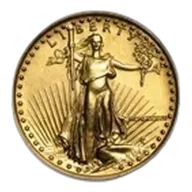
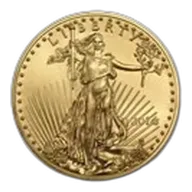
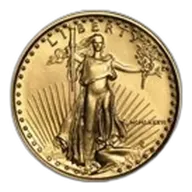
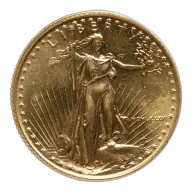
The obverse design is adapted from Augustus Saint-Gaudens' 1907 $20 Double Eagle, depicting Lady Liberty striding forward with a torch and olive branch. This design is widely regarded as one of the finest in American numismatic history. The Type II enhancement refined certain details while preserving the fundamental composition. The reverse shows a close-up portrait of a bald eagle, emphasising feather detail and the bird's intensity. Jennie Norris' first-ever coin design submission won this commission, a remarkable debut for one of the most prestigious design slots in the minting world.
Production facilities include West Point (proofs, marked with "W"), Philadelphia, and San Francisco. Mintage is demand-driven rather than capped, leading to significant year-to-year variation. The 2019 1 oz mintage of 108,000 was among the lowest in the series, while 2009 saw 1,493,000 produced during the financial crisis demand surge. This volatility means secondary market availability varies considerably by vintage.
The anti-counterfeiting edge notch, introduced with Type II, is a missing-reed position that changes annually, allowing authentication through simple edge inspection. Combined with the 22 karat alloy (which is more difficult to counterfeit than pure gold due to the specific colour and hardness of the three-metal formulation), the Type II represents an improvement in security over the Type I without adding the digital verification systems used by the Royal Canadian Mint or the visual security features of the Royal Mint.
American Gold Eagle Tax and Retirement Account Status
The 1/4 oz American Gold Eagle's tax treatment is largely identical to the 1/4 oz American Eagle (Type I). The 2021 redesign did not change the coin's legal status, purity, or eligibility for retirement accounts.
- United States: IRA-eligible by explicit statutory exemption under IRC Section 408(m)(3). The American Eagle is named directly in the tax code, bypassing the normal .995 purity requirement. This makes it one of the few 22 karat coins eligible for precious metals IRAs. Outside retirement accounts, gains are taxed at the collectibles rate of up to 28%. State sales tax varies; most states exempt bullion purchases.
- United Kingdom: VAT-exempt as investment gold. Not CGT-exempt because it is not UK legal tender. The annual CGT allowance is £3,000.
- Canada: GST/HST-exempt on investment gold. Capital gains taxed at the 50% inclusion rate. Not RRSP-eligible.
- European Union: Listed on the EU's annual investment gold coin list and VAT-exempt in all member states.
- Australia: The .9167 purity falls below Australia's .995 GST-exemption threshold for investment gold. This may result in 10% GST on purchases, unlike .9999 coins from the Perth Mint. Buyers should verify the current ATO position.
- Singapore: GST-exempt under the IPM scheme for qualifying gold coins from recognised mints. No capital gains tax.
- Hong Kong: No sales tax, import duty, or capital gains tax on gold.
Type II vs Type I, and How Both Compare
The distinction between the American Gold Eagle Type I and Type II is primarily aesthetic and anti-counterfeiting, not compositional. Both contain exactly 1/4 troy oz of .9167 fine gold, weigh 8.483 g total, and share the same diameter, thickness, and face value. The Saint-Gaudens obverse appears on both, with minor refinements for Type II. The practical differences are the reverse design (Frost's eagle family versus Norris' single eagle portrait) and the Type II's anti-counterfeiting reed variation on the edge.
For resale purposes, both types are treated identically by dealers pricing at metal value. Collectors may assign a modest premium to specific years, particularly the 2021 Type I as the final year of the original design, but this is a numismatic rather than bullion consideration.
Against other 1/4 oz gold coins, the Gold Eagle's competitive position remains unchanged between types. The 1/4 oz Gold Maple Leaf offers .9999 purity and Bullion DNA authentication at typically lower premiums. The 1/4 oz Gold Britannia matches .9999 purity with four visual security features and UK CGT exemption. The 1/4 oz Gold Krugerrand shares the 22 karat composition with typically lower premiums outside the US. The Gold Eagle's core advantage remains its statutory IRA exemption and its unmatched brand recognition among American investors and dealers.
1/4 oz American Gold Eagle Gold Coin: frequently asked questions
-
The cheapest 1/4 oz American Gold Eagle we track is $1,098.55 at Summit Bullion, about 4.7% over the $4,195.70 gold spot price. The coin contains exactly 1/4 troy oz of pure gold despite its 22-karat alloy, so its melt value tracks gold directly. Buy price will always sit above melt value by the dealer's premium.
-
The lowest premium across 17 dealers we track is 4.7% at Summit Bullion. Fractional coins like the 1/4 oz typically carry higher percentage premiums than the 1 oz size because fixed production and distribution costs are spread over less gold. Comparing $4,195.70 spot against the ask price will tell you the current cost of entry.
-
The 1/4 oz American Gold Eagle is 22 karat, or 916.7 fine gold (91.67% gold, alloyed with silver and copper). This is the traditional "crown gold" standard used in historic coinage. The coin still contains exactly 1/4 troy oz of pure gold; the alloy simply adds durability and gives the coin its distinctive warm colour. The 24-karat American Gold Buffalo is a different product.
-
The 1/4 oz American Gold Eagle contains exactly 1/4 troy oz of pure gold, which is 1/4 oz of fine gold. The total coin weight is higher than this figure because the 22-karat alloy adds silver and copper on top of the gold content. Every coin guarantees the stated pure gold content regardless of the alloy's additional mass.
-
Yes. The 1/4 oz American Gold Eagle carries a $10 USD face value and is legal tender for all debts public and private under US law, as authorised by the Gold Bullion Coin Act of 1985. Its market value as bullion far exceeds this nominal face value. It is also explicitly named in the US tax code (IRC Section 408(m)(3)), making it eligible for inclusion in a self-directed IRA.