 Global Bullion Suppliers


Prices are fetched automatically and may not reflect current merchant prices. Currency conversions and tax treatment are approximate. Rankings are based solely on price. We are not a dealer and accept no responsibility for transactions with listed merchants. Past performance is not indicative of future results. This site does not provide investment advice. Full disclaimer
About the 2 oz $20 for $20 Silver Coin
A 2 oz Coin From the Royal Canadian Mint's Face-Value Era
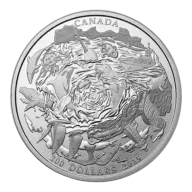
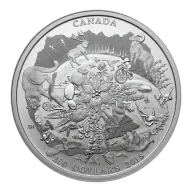
This page covers a 2 oz fine silver coin from the Royal Canadian Mint, grouped under the mint's face-value coin family. The dealer listings tracked here are 2015 issues sold under the name $200 for $200 Fine Silver Coin, with themes including Coastal Waters and Canada's Rugged Mountains. Each coin contains 62.207 grams of .9999 fine silver, which is the RCM's standard bullion purity.
The face-value concept behind these coins came from the RCM's $20 for $20 programme, which ran from 2011 to 2016 and sold $20 CAD legal tender coins containing roughly 1/4 oz of silver for exactly $20 CAD. The mint extended the same concept to other denominations, issuing related face-value coins at $25 for $25, $50 for $50, $100 for $100, and $200 for $200. The defining feature across the family was that the sale price equalled the coin's legal tender face value, which the RCM marketed as a low-risk way to buy silver collector coins: the buyer held legal tender worth the purchase price regardless of where the silver price went.
That structure is also why the programme family no longer exists. Silver prices fell roughly 67 percent from 2011 levels, holders returned coins for face-value redemption in large numbers, and the RCM discontinued the programme in early 2017. For a buyer today, that history matters in two ways. First, these coins trade on the secondary market rather than as ongoing mint issues. Second, the silver content is the floor on value, while the original face-value redemption promise applies within Canada through the RCM, which stated no expiration date on redemptions.
As a 2 oz silver coin, this product sits in a weight class the RCM does not otherwise serve with a standard bullion coin. Neither the US Mint nor the Royal Canadian Mint produces a regular 2 oz silver bullion coin, so buyers in this weight class usually look to the Royal Mint or Perth Mint. That makes this coin an unusual route to RCM-struck silver at the 2 oz weight, though as a specimen-era collector product rather than a bullion series with annual issues.
2 oz Face-Value Silver Coin Specifications
The specifications below combine the listing data for this product group with the documented standards of the RCM's face-value coin family.
| Attribute | Value |
|---|---|
| Weight | 2 troy oz (62.207 g) |
| Purity | .9999 fine silver |
| Form | Coin |
| Manufacturer | Royal Canadian Mint |
| Issue names tracked | $200 for $200 Fine Silver Coin: Coastal Waters (2015), Canada's Rugged Mountains (2015) |
| Pricing currency of listings | CAD |
Across the RCM's face-value coin family, the documented presentation standard was a specimen finish with a certificate of authenticity, and the coins carry full Royal Canadian Mint production standards and legal tender status in Canada. The .9999 purity matches the RCM's standard for its silver bullion output. Dimensions for the 2 oz issues are not published in our reference material, so they are not listed here. For comparison, the original programme coin was a much smaller piece: the 1/4 oz for coin weighed 7.96 g, roughly an eighth of the silver in this 2 oz issue.
Tax Treatment of RCM Face-Value Silver Coins
Tax treatment for this coin follows the rules for fine silver coins in each country, with one Canadian wrinkle from its legal tender status.
- Canada: Silver refined to 99.9 percent purity or better in coin form is exempt from GST/HST, and this coin's .9999 purity clears that threshold, though coins with numismatic value above their metal content may not qualify. On disposal, capital gains are taxed at the 50 percent inclusion rate. The Listed Personal Property rule means a coin both bought and sold for under $1,000 CAD generates no reportable gain or loss. The RCM's face-value redemption promise had no stated expiration date, and redeeming at face value would not generate a capital gain.
- United States: Sales tax depends on the buyer's state; roughly 35 states exempt bullion, around 10 tax it, and several apply threshold-based exemptions. Long-term gains on bullion are taxed at the collectibles rate of up to 28 percent. The $200 CAD denomination has no US legal tender status; in the US market these are simply Canadian silver coins.
- United Kingdom: New silver carries 20 percent VAT. Canadian coins are not UK legal tender, so there is no CGT exemption; gains are taxed at 10 or 20 percent above the annual allowance.
- European Union: Silver coins attract the full standard VAT rate of the member state, ranging from 17 to 27 percent. European distribution of these coins was limited.
The Face-Value Programme Behind This Coin
This coin's lineage runs through one of the most significant financial missteps in modern sovereign mint history. The Royal Canadian Mint's $20 for $20 programme, launched in 2011, sold $20 CAD legal tender coins containing about 1/4 oz of .9999 silver for exactly $20 CAD. Roughly 4.2 million of those coins were minted across the programme. The concept proved popular enough that the mint extended it into related face-value denominations, including the $200 for $200 line that the 2015 issues in this group belong to. Themes ranged from Canadian wildlife and landscapes to licensed pop culture designs such as Superman, Bugs Bunny, and the Starship Enterprise in 2015 and 2016.
The structural flaw was that selling silver at a fixed price handed buyers a free put option. If silver rose, holders kept the coins and captured the gain. If silver fell, they could return them to the mint for face value, transferring the loss to the RCM. Silver fell roughly 67 percent from its 2011 levels, leaving the metal in a $20 coin worth under $6 CAD, and Canadians returned coins by the truckload. At 4.2 million coins minted, the $20 for $20 programme alone carried a total potential redemption liability of $84 million CAD.
The reckoning came in the RCM's 2016 financial report, which reversed all past revenues from the $20 for $20 programme, cutting reported profits from $41.3 million to $24.5 million CAD, a $17 million hit. As a consequence, 1,200 RCM employees lost their annual bonuses. The programme was discontinued in early 2017, and no other major mint has replicated the face-value-equals-sale-price model since. A CoinWeek article from 2016 described the situation as armageddon for the programme. The episode is now studied as a cautionary tale in sovereign mint risk management, which gives the surviving coins, including the 2 oz issues here, a documented place in Canadian numismatic history beyond their silver content.
How This Coin Compares at 2 oz and Within Its Family
The most direct family comparison is the original 1/4 oz $20 for $20 silver coin. Both share .9999 purity, RCM production standards, and the face-value sale concept, but the 1/4 oz coin contains just 7.96 g of silver against 62.207 g here. For a buyer pricing these on metal content, the 2 oz coin is the more substantial holding by a factor of about eight, while the 1/4 oz coin is the piece with the larger documented mintage at roughly 4.2 million across its programme.
Against the RCM's own bullion flagship, the Silver Maple Leaf, the positioning is completely different. The Maple Leaf is a 1 oz .9999 bullion coin that trades above spot and is struck continuously for the investment market. The face-value coins were collector products whose price was anchored to their legal tender denomination rather than to silver. A stacker buying purely for metal exposure will usually find the Maple Leaf the more liquid and conventional choice; the face-value coins appeal where the programme's history or the specific designs matter.
Within the 2 oz weight class itself, the benchmark products come from other mints, since neither the RCM nor the US Mint produces a standard 2 oz bullion coin. The Royal Mint made 2 oz a mainstream silver weight with the Queen's Beasts series (2016 to 2021, .9999 silver, 38.61 mm diameter), continued by the Tudor Beasts from 2023, and the Perth Mint covers the weight with its Lunar and Koala ranges. Those series are actively bought by dealers and have good liquidity. The appeal of the 2 oz format in all cases is the larger canvas for detailed designs rather than premium savings, since the weight does not offer the per-ounce discount seen with 10 oz bars.
2 oz $20 for $20 Silver Coin: frequently asked questions
-
The cheapest listing we track is $207.20, currently 57.7% over the $65.58 silver spot price. Note that the $20 for $20 program originally issued coins weighing approximately 1/4 oz each, not 2 oz; the listing you are viewing may represent a multi-coin lot or a later variant, so check the product description carefully before buying.
-
The Royal Canadian Mint sold CA$20 legal-tender silver coins at face value from 2011 to 2016, one coin for CA$20. Each coin contained approximately 1/4 oz of .9999 fine silver. When silver prices fell sharply after 2011, holders redeemed coins in large numbers, and the program generated a significant financial loss for the mint. Production ended and no new $20 for $20 coins have been issued since early 2017.
-
Yes. These are genuine Canadian legal-tender coins with a CA$20 face value, produced by the Royal Canadian Mint to the same standards as its other collector issues. The RCM offered face-value redemption with no stated expiry date. Note that legal tender in Canada means creditors must accept the coins for debt settlement; individual retailers have no obligation to accept them for everyday purchases.