36 listings
Filters
| Product | /oz | Premium | Price | |
|---|---|---|---|---|

 US Precious Metals
|
$4,610.93 | +10.36% | $461.10 | View Deal |
|
20
BullionStar US
|
$4,654.13 | +11.42% | $465.42 | View Deal |
 GLT Direct
|
$4,667.43 | +11.85% | $466.75 | View Deal |
 Summit Metals
|
$4,695.93 | +12.39% | $469.60 | View Deal |
|
1/
Austin Rare Coins & Bullion
|
$4,805.22 | +15.16% | $480.53 | View Deal |
|
20
Blanchard
|
$4,842.42 | +15.93% | $484.25 | View Deal |
 AU Capital Management
|
$4,855.32 | +16.20% | $485.54 | View Deal |
 Coins Online
|
$4,909.92 | +17.51% | $491.00 | View Deal |
|
1/
|
$4,925.62 | +17.54% | $492.57 | View Deal |
 Grand Rapids Coins
|
$4,966.82 | +18.87% | $496.69 | View Deal |
 Bullion Express
|
$4,968.12 | +18.91% | $496.82 | View Deal |
| $4,986.78 | +19.35% | $498.67 | View Deal | |
 Alabama Gold Refinery
|
$5,055.22 | +21.02% | $505.53 | View Deal |
| $5,146.68 | +23.22% | $514.66 | View Deal | |
 Coins Online
|
$5,172.62 | +23.80% | $517.27 | View Deal |
| $5,186.78 | +24.14% | $518.67 | View Deal | |
| $5,196.78 | +24.38% | $519.67 | View Deal | |
| $5,236.78 | +25.34% | $523.67 | View Deal | |
| $5,286.79 | +26.53% | $528.67 | View Deal | |
| $5,296.79 | +26.77% | $529.67 | View Deal | |
| $5,296.79 | +26.77% | $529.67 | View Deal | |
| $5,291.88 | +26.81% | $529.18 | View Deal | |
| $5,322.91 | +27.56% | $532.30 | View Deal | |
 Texas Precious Metals
$529.08 for 500+
Texas Precious Metals
$529.08 for 500+
|
$5,353.29 | +28.12% | $535.32 | View Deal |
| $5,349.19 | +28.19% | $534.91 | View Deal | |
| $5,386.79 | +28.93% | $538.67 | View Deal | |
| $5,386.79 | +28.93% | $538.67 | View Deal | |
 SD Bullion
|
$5,403.29 | +29.32% | $540.32 | View Deal |
| $5,406.79 | +29.41% | $540.67 | View Deal | |
| $5,486.79 | +31.32% | $548.67 | View Deal |















Prices are fetched automatically and may not reflect current merchant prices. Currency conversions and tax treatment are approximate. Rankings are based solely on price. We are not a dealer and accept no responsibility for transactions with listed merchants. Past performance is not indicative of future results. This site does not provide investment advice. Full disclaimer
About the 1/10 oz American Gold Eagle Gold Coin
The 1/10 oz American Gold Eagle
The 1/10 oz American Gold Eagle is the entry-level denomination of the US Mint's gold bullion program, authorised by the Gold Bullion Coin Act of 1985 and first struck in 1986. Carrying a $5 face value, it contains exactly one-tenth of a troy ounce (3.111 g) of pure gold in a 22-karat alloy with silver and copper. The total coin weight is 3.393 grams, with the difference accounted for by the alloy metals rather than additional gold.
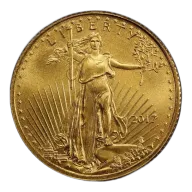
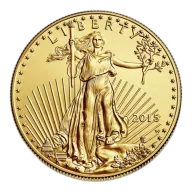
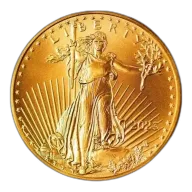
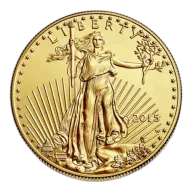
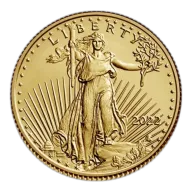
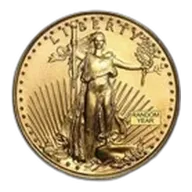
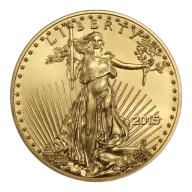
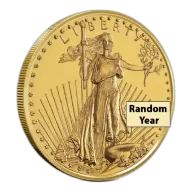
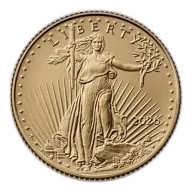
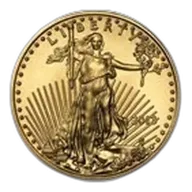
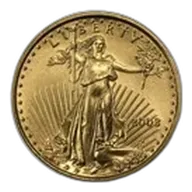
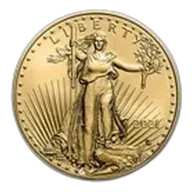
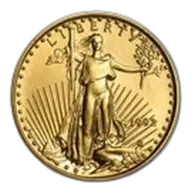
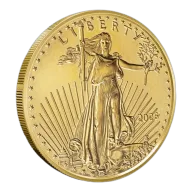
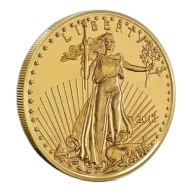
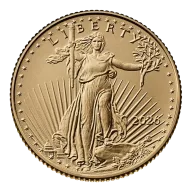
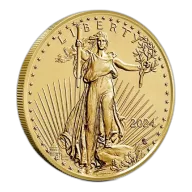
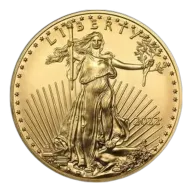
The coin's obverse features Augustus Saint-Gaudens' Lady Liberty design, adapted from his celebrated 1907 $20 Double Eagle, which is routinely described as the most beautiful American coin design ever created. The reverse underwent its first change in 35 years in 2021: the original "Family of Eagles" design by Miley Busiek Frost (a male eagle carrying an olive branch above a nest with a female eagle and hatchlings) was replaced by Jennie Norris' close-up portrait of a bald eagle. The Type II reverse (2021 onwards) also introduced an anti-counterfeiting reeded edge variation, where an intentionally omitted reed creates a notch whose position changes annually.
The 22-karat alloy is deliberate. Crown gold (91.67% gold, 3% silver, 5.33% copper) was an English coinage standard dating to 1526 and produces a harder coin than 24-karat alternatives. The copper content makes the Gold Eagle more resistant to scratches and handling marks, a practical consideration for a coin that may be frequently examined. The alloy gives the coin a distinctive warm yellow tone with a faint reddish undertone, visually distinct from the pure yellow of 24-karat coins like the 1/10 oz Maple Leaf.
At current gold prices, the 1/10 oz Gold Eagle costs approximately $400-500, making it the most accessible US-minted gold coin. This price point has made it popular as a gift item and a starting point for new gold buyers. The US Mint packages these coins in sealed tubes of 50.
American Gold Eagle 1/10 oz Dimensions and Weight
| Property | Value |
|---|---|
| Pure gold content | 1/10 troy oz (3.111 g) |
| Total weight | 3.393 g (0.1091 troy oz) |
| Purity | 916.7 (22 karat) |
| Alloy | 91.67% gold, 3% silver, 5.33% copper |
| Diameter | 16.50 mm |
| Thickness | 1.19 mm |
| Face value | $5 USD |
| Edge | Reeded (Type II adds anti-counterfeiting notch) |
| Obverse | Saint-Gaudens' Lady Liberty |
| Reverse (Type I, 1986-2021) | Family of Eagles by Miley Busiek Frost |
| Reverse (Type II, 2021-present) | Eagle portrait by Jennie Norris |
The coin's 16.50 mm diameter is roughly the size of a small button. The total weight of 3.393 g exceeds the 3.111 g of pure gold because the copper and silver alloy adds mass. This is an important distinction that sometimes confuses buyers: the coin is heavier than a 1/10 oz 24-karat coin (such as the Maple Leaf at 3.11 g total weight), but both contain identical amounts of pure gold.
Full American Gold Eagle Range
| Denomination | Face value | Pure gold | Total weight | Diameter |
|---|---|---|---|---|
| 1/10 oz | $5 | 3.111 g | 3.393 g | 16.50 mm |
| 1/4 oz | $10 | 7.777 g | 8.483 g | 22.00 mm |
| 1/2 oz | $25 | 15.554 g | 16.965 g | 27.00 mm |
| 1 oz | $50 | 31.108 g | 33.931 g | 32.70 mm |
American Gold Eagle Tax and IRA Status
The American Gold Eagle has a unique position in US tax law. It is one of only two coins explicitly named in the Internal Revenue Code as eligible for precious metals IRAs, bypassing the standard 99.5% purity requirement that would otherwise disqualify its 91.67% gold content.
United States
The 1/10 oz Gold Eagle is IRA-eligible by specific statutory provision (IRC Section 408(m)(3)). This exemption exists because the coin was created partly as a retirement savings vehicle. Within an IRA, gains are tax-deferred (Traditional) or tax-free (Roth). Outside an IRA, gains are taxed at the collectibles rate of up to 28% for holdings over one year, plus a potential 3.8% Net Investment Income Tax. Most states exempt bullion from sales tax; threshold-based exemptions apply in California ($2,000), Florida ($500), Louisiana ($1,000), Massachusetts ($1,000), and New York ($1,000).
United Kingdom
The Gold Eagle is VAT-exempt as investment gold. Not CGT-exempt, as it lacks a sterling face value. UK buyers seeking CGT efficiency at this weight class should consider the 1/10 oz gold Britannia, which offers both VAT exemption and CGT exemption.
Australia and New Zealand
The 22-karat purity (91.67%) falls below Australia's 99.5% GST exemption threshold, potentially subjecting the coin to 10% GST. In New Zealand, the same issue results in 15% GST. Buyers in both countries can avoid this by choosing 24-karat fractional coins such as the 1/10 oz Kangaroo or the 1/10 oz Philharmonic.
Canada
GST/HST-exempt as investment gold. Not eligible for RRSPs or TFSAs. Capital gains are taxed at a 50% inclusion rate.
European Union
Listed on the EU's annual investment gold coin list and VAT-exempt across all member states. In Germany, gains on gold held longer than one year are completely tax-free.
Singapore and Hong Kong
Both exempt investment gold from sales tax. No capital gains tax in either jurisdiction.
The Gold Eagle Since 1986
The American Gold Eagle program launched in 1986, authorised by the Gold Bullion Coin Act of 1985. The US had not produced a gold bullion coin before, though it had a long history of gold coinage that ended when President Roosevelt took the country off the gold standard in 1933. The Gold Eagle revived that tradition, with the obverse drawing directly from Saint-Gaudens' 1907 design.
The 1/10 oz denomination was part of the original launch alongside the 1/4 oz, 1/2 oz, and 1 oz sizes. By law, the gold must come from sources within the United States, a provision intended to support domestic mining. The alloy composition (91.67% gold, 3% silver, 5.33% copper) was chosen for durability, following the crown gold standard that had not been used in US coinage since 1834.
Production volumes have been volatile, driven entirely by demand rather than predetermined targets. The 1 oz Gold Eagle's mintage peaked at 1,505,026 in 1999 and dropped as low as 108,000 in 2019. The 2009 financial crisis produced a surge in demand so intense that the US Mint suspended proof and uncirculated versions to divert capacity to bullion production.
The most significant change in the program's history came in 2021, when both the gold and silver Eagle series received new reverse designs for the first time. The transition year saw both Type I (original design) and Type II (new design) coins produced, creating a deliberate supply pinch that drove secondary market premiums higher for both types. The Type II reverse also introduced a new anti-counterfeiting feature: a specifically placed missing reed on the coin's edge, with the position varying by year to enable authentication.
Jennie Norris' Type II reverse design, a close-up portrait of a bald eagle's head emphasising feather detail, was her first-ever coin design submission to the US Mint Artistic Infusion Program. Winning the most prestigious coin design commission in the country as a debut submission is a notable achievement in numismatic design history.
1/10 oz American Gold Eagle vs Competitors
The fractional gold market at 1/10 oz is crowded, with every major sovereign mint producing a coin at this weight. The Gold Eagle's distinctive 22-karat alloy sets it apart technically, while its IRA status and US market dominance set it apart commercially.
vs 1/10 oz Maple Leaf
The 1/10 oz Maple Leaf is 999.9 fine versus the Eagle's 916.7. The Maple Leaf's Bullion DNA system provides digital authentication that the Eagle lacks. Maple Leafs tend to carry slightly lower premiums. The Eagle's advantages are its IRA exemption by name and deeper US market liquidity. In Australia and New Zealand, the Maple Leaf's higher purity avoids GST charges that the 22-karat Eagle may incur.
vs 1/10 oz Britannia
The 1/10 oz Britannia offers CGT exemption for UK buyers, four security features integrated into the design, and 999.9 purity. For UK-based investors, the Britannia is the clear choice at this weight. Post-2013 Britannias are also IRA-eligible, meeting the 99.5% purity requirement through standard rules rather than a special exemption. The Eagle's advantage is confined to US market recognition.
vs 1/10 oz Kangaroo
The 1/10 oz Kangaroo is 999.9 fine with annually changing reverse designs that add mild collector appeal. Both are IRA-eligible. The Kangaroo has stronger market presence in the Asia-Pacific region, while the Eagle dominates in the Americas. The Kangaroo's AUD $15 face value is closer to a proportional face value than the Eagle's symbolic $5.
vs 1/10 oz Philharmonic
The 1/10 oz Philharmonic is 999.9 fine and typically one of the lowest-premium 1/10 oz coins available. IRA-eligible. Its cultural design (Musikverein organ and orchestra instruments) sets it apart aesthetically. For buyers focused on minimising the premium cost of fractional gold, the Philharmonic is a strong alternative to the Eagle.
1/10 oz American Gold Eagle Gold Coin: frequently asked questions
-
The cheapest 1/10 oz American Gold Eagle we track is $461.10 at US Precious Metals, sitting around 10.4% over the $4,178.20 gold spot price. The coin contains exactly 1/10 troy oz of pure gold, so its intrinsic (melt) value tracks one tenth of the gold price, with the dealer premium on top reflecting the smaller size's higher per-ounce production cost.
-
The 1/10 oz American Gold Eagle contains exactly 1/10 troy oz of pure gold, which is 1/10 oz of fine gold. At 916.7 fine (22 karat), the total coin weight is heavier than the pure gold figure because silver and copper are added to the alloy. Every coin guarantees the stated 1/10 troy oz of pure gold content.
-
The 1/10 oz American Gold Eagle is 22 karat, or 916.7 fine (91.67% gold). It is alloyed with silver and copper by US law, which makes the coin more scratch-resistant and harder-wearing than pure 24-karat coins. The coin still contains the guaranteed 1/10 troy oz of pure gold. If you want 24-karat from the US Mint, that is the American Gold Buffalo, a separate product.
-
For most bullion stackers, the year makes little practical difference. All years contain the same 1/10 troy oz of pure gold and trade at broadly similar premiums. The 2021 transition to the Type 2 reverse design is a minor marker that some collectors note, but it does not significantly move bullion-market prices. Specific proof or low-mintage years can attract numismatic interest, but that is outside the scope of generic stacking.