69 listings
Filters
| Product | /oz | Premium | Price | |
|---|---|---|---|---|
| $5,170.70 | +23.91% | $1,292.68 | View Deal | |

 Golden Eagle Coins
|
$5,237.26 | +25.35% | $1,309.32 | View Deal |
| $5,245.98 | +25.71% | $1,311.50 | View Deal | |
| $5,245.98 | +25.71% | $1,311.50 | View Deal | |
| $5,287.94 | +26.72% | $1,321.99 | View Deal | |
| $5,455.82 | +30.74% | $1,363.96 | View Deal | |
| $5,455.82 | +30.74% | $1,363.96 | View Deal | |
| $5,455.82 | +30.74% | $1,363.96 | View Deal | |
| $5,455.82 | +30.74% | $1,363.96 | View Deal |








Prices are fetched automatically and may not reflect current merchant prices. Currency conversions and tax treatment are approximate. Rankings are based solely on price. We are not a dealer and accept no responsibility for transactions with listed merchants. Past performance is not indicative of future results. This site does not provide investment advice. Full disclaimer
About the 1/4 oz Maple Leaf Gold Coin
The 1/4 oz Gold Maple Leaf
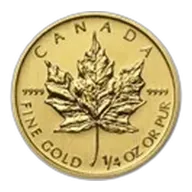
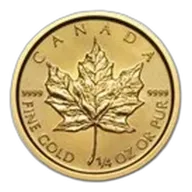
The 1/4 oz Gold Maple Leaf from the Royal Canadian Mint contains 7.78 grams of .9999 fine gold and carries a face value of C$10 as legal tender of Canada. The series was introduced in 1979 (with fractional sizes added later) and has established itself as one of the world's most traded gold bullion coins. The RCM, a Crown corporation with facilities in Ottawa and Winnipeg, was among the first mints to offer .9999 purity as standard, upgrading from .999 in November 1982.
The Maple Leaf's market position among 1/4 oz gold coins rests on three pillars: purity, security, and premium efficiency. At .9999 fine, it matches the 1/4 oz Gold Britannia, 1/4 oz Gold Philharmonic, and 1/4 oz Gold Kangaroo on purity, and exceeds the 1/4 oz Gold Eagle (.9167) and 1/4 oz Gold Krugerrand (.9167). It typically trades at the lowest premiums among these .9999 competitors.
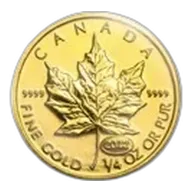
The coin's security technology is the most sophisticated in the bullion market. Each Gold Maple Leaf dated 2014 or later carries a micro-engraved laser mark on the die, capturing a textured maple leaf privy mark and the last two digits of the production year, visible only under magnification. This mark is recorded in the Bullion DNA (Digital Non-Destructive Activation) database, developed in partnership with Signoptic. Dealers with a dedicated Bullion DNA reader can photograph a coin's mark and match it against the encrypted database for instant authentication. No other bullion coin offers individual coin-level digital verification at this standard.
The .9999 purity does create a trade-off. The gold is softer than alloyed coins like the Eagle or Krugerrand, making the Maple Leaf more susceptible to contact marks and bag marks during handling. This affects visual appearance but not metal content or bullion value. The fixed sugar maple leaf reverse design, unchanged in its fundamental form since 1979, means no year-specific collector premiums. Every year's coin trades at the same premium to spot, keeping pricing simple and predictable.
1/4 oz Gold Maple Leaf Dimensions and Details
| Specification | Value |
|---|---|
| Fine gold content | 7.78 g (1/4 troy oz) |
| Purity | .9999 (24 karat) |
| Diameter | 20.0 mm |
| Thickness | 1.78 mm |
| Face value | C$10 |
| Edge | Reeded |
| Obverse (2024+) | King Charles III portrait by Steven Rosati |
| Obverse (2004-2023) | Queen Elizabeth II, Susanna Blunt portrait |
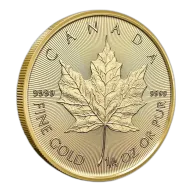
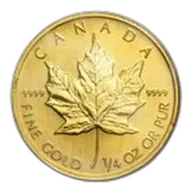
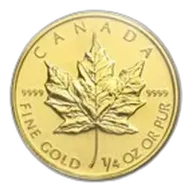
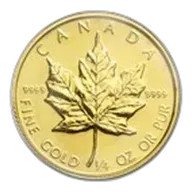
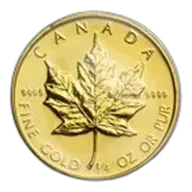
| Reverse | Sugar maple leaf (unchanged since 1979, radial lines added 2015) |
| Security (2014+) | Micro-engraved laser mark, radial lines, Bullion DNA verification |
| Mint | Royal Canadian Mint (Ottawa and Winnipeg) |
The radial lines added in 2015 stretch across both sides of the coin, creating a light-diffracting pattern that is extremely difficult to replicate. This visual anti-counterfeiting layer works alongside the micro-engraved laser mark, which captures a textured maple leaf privy mark and the last two digits of the production year. Each mark is photographed and encrypted in the Bullion DNA database for dealer verification.
The 20.0 mm diameter makes this a compact coin, roughly the same size as the 1/4 oz Kangaroo (20.1 mm) and slightly smaller than the Britannia and Eagle (both 22 mm). At 7.78 g, it is lighter than the 22 karat alternatives (the Eagle weighs 8.483 g, the Krugerrand 8.482 g) because .9999 gold has no alloying metals adding mass beyond the gold content itself.
The RCM is one of the few mints in the world that refines its own gold from raw ore to finished coin, maintaining complete chain-of-custody control over the entire production process. This vertical integration is unique among the major bullion mints and supports the .9999 purity standard that the RCM pioneered in 1982.
Gold Maple Leaf Tax Treatment by Country
- Canada: GST/HST-exempt on investment gold at 99.5%+ purity. Physical gold bullion, including Maple Leafs, is not eligible for RRSP or TFSA accounts (only mining stocks and precious metal ETFs qualify for these registered accounts). Capital gains on physical bullion are taxed at the standard 50% inclusion rate: half the gain is added to taxable income and taxed at the individual's marginal rate.
- United Kingdom: VAT-exempt as investment gold. Not CGT-exempt because it is not UK legal tender. Gains above the £3,000 annual CGT allowance are taxable at the individual's rate. The 1/4 oz Gold Britannia is the CGT-exempt alternative at the same weight and purity.
- United States: IRA-eligible across all metals (gold .9999 exceeds the .995 minimum, silver .9999 exceeds .999, platinum .9995 meets the threshold). Must be held by an approved custodian. Capital gains taxed at the collectibles rate of up to 28% outside retirement accounts. State sales tax varies; roughly 35 states exempt bullion.
- Australia: GST-free as investment-grade gold at .9999 purity. Capital gains tax applies on disposal with a 50% discount for holdings over 12 months.
- European Union: VAT-exempt as investment gold under Directive 98/80/EC. The Maple Leaf appears on the EU's annual list of qualifying investment gold coins.
- Singapore: GST-exempt under the Investment Precious Metals scheme. No capital gains tax.
- Hong Kong: No sales tax, import duty, or capital gains tax.
- New Zealand: GST-exempt for gold at 99.5%+ purity. No formal capital gains tax, but gains may be taxable as income if the IRD determines the gold was acquired for the purpose of resale.
1/4 oz Gold Maple Leaf vs Eagle, Britannia, and Krugerrand
The 1/4 oz Maple Leaf competes at the intersection of purity, security, and cost efficiency. It typically wins on the first two and is competitive on the third.
Against the 1/4 oz Gold Britannia, both coins share .9999 purity and compete directly. The Britannia's four visual security features (latent image, surface animation, micro-text, tincture lines) are impressive but verifiable only by eye. The Maple Leaf's Bullion DNA system provides digital verification against an encrypted database, a higher standard of authentication. The deciding factor is often geographic: UK buyers benefit from the Britannia's CGT exemption; non-UK buyers have no reason to pay any premium differential for a tax benefit they cannot use.
The 1/4 oz Gold Eagle at .9167 purity contains the same 1/4 troy oz of fine gold but in a heavier, more durable alloy. The Eagle's statutory IRA exemption means US retirement investors can use either coin, but the Eagle's stronger US brand recognition and higher buyback prices from American dealers give it a domestic advantage. Internationally, the Maple Leaf typically trades at lower premiums. Over the 2009-2023 period, the premium gap between the two series was documented at roughly 2% versus 3.3% for their 1 oz equivalents.
The 1/4 oz Gold Krugerrand usually carries the lowest premiums of any major quarter-ounce sovereign coin. Its 22 karat alloy provides greater durability but lower purity. The Krugerrand has no modern anti-counterfeiting features. For buyers who prioritise cost per gram of gold above all else, the Krugerrand is typically the most efficient choice. For buyers who value purity, security, and authentication capability, the Maple Leaf is the stronger option.
The 1/4 oz Gold Kangaroo matches .9999 purity and adds annual design changes. It typically trades at slightly higher premiums than the Maple Leaf, reflecting both the design variation and lower production volumes. The Maple Leaf's Bullion DNA authentication substantially exceeds the Kangaroo's micro-laser engraving. For straightforward bullion accumulation without collector considerations, the Maple Leaf's combination of low premiums and high security makes it the benchmark at this weight.
1/4 oz Maple Leaf Gold Coin: frequently asked questions
-
The cheapest 1/4 oz Gold Maple Leaf tracked across dealers is $1,057.04, based on $4,173.00 gold spot. As a 7.7759 g coin of .9999 fine gold, its value moves directly with the gold price, with a dealer premium added on top.
-
The current dealer premium on the 1/4 oz Gold Maple Leaf is around 1.3% over spot, with the lowest price available from Summit Bullion (last checked recently). Fractional coins typically carry a higher premium than full-ounce coins because manufacturing costs are spread over less metal.
-
The 1/4 oz Gold Maple Leaf weighs 7.7759 grams (a quarter troy ounce of .9999 fine gold). The coin is struck by the Royal Canadian Mint and contains exactly 7.7759 g of pure gold, making grams-to-spot conversion straightforward.
-
Yes. The Gold Maple Leaf is struck at .9999 fineness, which is effectively 24-carat gold. This four-nines purity has been the standard for the series since 1982 and means the coin contains no alloying metals beyond trace amounts.
-
The 1/4 oz Gold Maple Leaf has a diameter of 20 mm and a thickness of 1.78 mm. It weighs 7.7759 g and carries a face value of C$10. These dimensions are consistent across all years of issue.