 APMEX
APMEX






Prices are fetched automatically and may not reflect current merchant prices. Currency conversions and tax treatment are approximate. Rankings are based solely on price. We are not a dealer and accept no responsibility for transactions with listed merchants. Past performance is not indicative of future results. This site does not provide investment advice. Full disclaimer
About the 1 oz Taku Silver Coin
The 1 oz Fiji Taku Silver Coin
The Fiji Taku is a discontinued legal tender bullion coin featuring the hawksbill turtle, known as taku in Fijian. It was issued from 2010 to 2013 under the authority of the Reserve Bank of Fiji and contract-minted by the New Zealand Mint, which has a long pattern of producing bullion coins for Pacific Island nations. Each 1 oz coin contains .999 fine silver and carries a 2 Fiji Dollar face value.
The case for buying one today rests on scarcity rather than stacking economics. The Fiji-branded series ended after four years when the Fijian government ended its licensing arrangement with the mint, and from 2014 the design continued as the Niue Hawksbill Turtle under a different issuing authority. That makes the 2010-2013 Fiji coins the original, finite series, with the 2010 first-year issue carrying particular scarcity appeal. These were not ultra-low-mintage coins, the 2013 issue was capped at 350,000 pieces, so secondary market supply still exists, but the pool can only shrink.
The subject matter adds genuine interest: the hawksbill turtle (Eretmochelys imbricata) is listed as critically endangered by the IUCN, and the coin brought attention to Pacific marine conservation. Stackers buying purely for silver weight will find better premiums and liquidity among mainstream 1 oz silver coins; the Taku is for buyers who want a short-lived, story-rich sovereign series at the same metal content.
Fiji Taku 1 oz Silver Specifications
| Attribute | Value |
|---|---|
| Metal | Silver, .999 fine |
| Weight | 1 troy oz (31.1 g) |
| Diameter | 40.50 mm |
| Thickness | 2.30 mm |
| Face value | $2 FJD (Fiji Dollar) |
| Edge | Milled (reeded) |
| Issued | 2010-2013 |
| Mint | New Zealand Mint (for the Reserve Bank of Fiji) |
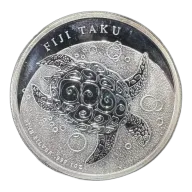
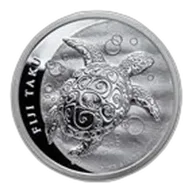
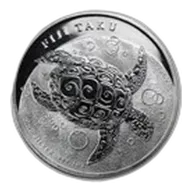
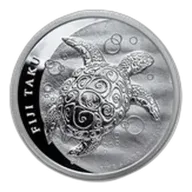
The turtle side shows a stylised hawksbill swimming along the ocean floor amid bubbles. From 2010 to 2012 the other face carried the Ian Rank-Broadley portrait of Queen Elizabeth II; in 2013 it was redesigned to show the Coat of Arms of Fiji instead. The series also appeared as a 1 oz gold coin in .9999 fine gold with a $200 FJD face value, plus documented 1/2 oz and 5 oz silver sizes and limited fractional gold issues. New Zealand Mint quality control and packaging apply across the series, with capsules or certicards for gold versions.
Fiji Taku Tax Treatment by Country
As a .999 fine legal tender silver coin, the Taku clears the silver purity thresholds in the main exempting jurisdictions, though as a discontinued series most stock now trades on the secondary market, which itself changes the tax picture in some countries.
- UK: New silver attracts 20% VAT, and some dealers trade pre-owned Fiji Taku coins under the margin scheme, where VAT applies only to the dealer's margin. The coin is not UK legal tender, so gains are not CGT-exempt.
- US: No federal sales tax; most states exempt bullion. Capital gains tax applies on disposal. The .999 purity meets general IRA criteria for silver, though acceptance depends on the specific custodian.
- Canada: GST/HST exempt as silver refined to at least 99.9% purity in coin form.
- Australia and New Zealand: GST-free as investment-grade silver at 99.9% purity or finer; the coin's Australasian distribution makes it a familiar product in both markets.
- Singapore: GST-exempt for qualifying Investment Precious Metals; no capital gains tax.
- EU: Silver coins attract full local VAT on new stock, with margin schemes available for second-hand coins in some member states.
- Hong Kong: No sales tax, no import duty, no capital gains tax.
Four Years of Fiji, Then a Change of Flag
The series launched in 2010 with the hawksbill turtle obverse paired with the Ian Rank-Broadley portrait of Queen Elizabeth II, a format retained through 2011 and 2012. The 2013 issue made a significant break: the Queen's portrait was replaced by the Coat of Arms of Fiji. The change reflected Fiji's political trajectory after the 2006 military coup and the constitutional reforms that followed, which moved the country away from British monarchy symbols. Fiji formally became a republic in 2013, removing the Queen as head of state, and the coin redesign was one of the earliest visible signals of that shift.
The same year proved to be the programme's last under the Fiji name. The Fijian government ended the licensing arrangement with the New Zealand Mint, and from 2014 the design was reissued for Niue, a self-governing island in free association with New Zealand that recognises the British Crown. The Niue version restored a portrait of Queen Elizabeth II and changed the turtle-side inscription from Fiji Taku to simply Turtle, with denominations switching from Fiji Dollars to New Zealand Dollars.
One linguistic note the bullion trade often gets wrong: taku is the Fijian word for the hawksbill turtle, not a Maori borrowing. Fijian is a Melanesian language and Maori is Polynesian; some dealer listings conflate the two. The four-year Fiji run, the mid-series design change, and the rebranding give this coin an unusually eventful history for a bullion product.
Fiji Taku vs Niue Hawksbill, Maple Leaf, and Perth Mint Coins
The most direct comparison is the Niue Hawksbill Turtle, the post-2014 continuation of the same basic design from the same mint under a different legal tender authority. Niue versions are more readily available; the Fiji originals (2010-2013) are the finite first series and carry a scarcity premium, especially the 2010 first-year coin. Collectors who want the original buy Fiji; buyers who just like the turtle design will find Niue stock easier and usually cheaper to source.
Against the Canadian Maple Leaf, the global benchmark for silver purity at .9999 fine, the Taku's .999 is slightly lower, though the difference has no practical investment significance. Where the Maple Leaf clearly wins is liquidity: it is recognised by every dealer worldwide, while the Taku trades as a niche product.
The Perth Mint Kookaburra and Koala series are the closest Southern Hemisphere competitors, annual-design wildlife coins with greater liquidity, wider dealer networks, and Australian legal tender status. The Taku's appeal is narrower and more collectible. The New Zealand Mint's own Fiji Great Wave series shows the same issuer-mint relationship with a different theme.
The practical split: for silver accumulation with the easiest exit, choose a major sovereign coin; for a discontinued Pacific series with conservation subject matter and genuine historical quirks, the Fiji Taku occupies ground few silver coins can match.
1 oz Taku Silver Coin: frequently asked questions
-
The cheapest 1 oz Fiji Taku silver coin listed on BullionFerret right now is $78.41 from APMEX, around 19.2% over the $65.90 silver spot price. The series ended in 2013, so availability depends on secondary market supply.
-
"Taku" is the Fijian word for the hawksbill turtle, the critically endangered species depicted on the coin's obverse swimming along the ocean floor. The series ran from 2010 to 2013, contract-minted by the New Zealand Mint as legal tender of Fiji with a $2 FJD face value. From 2014 the design continued as the Niue Hawksbill Turtle under a different issuing authority.
-
Avoid cleaning silver bullion coins. Cleaning removes the natural toning that develops over time, can leave fine scratches on the surface, and reduces both numismatic value and resale appeal to many buyers. Store coins in airtight capsules or inert holders away from humidity and direct contact with other metals to keep them in the condition they arrived.
-
Tax on silver coin sales varies by country. In the UK, gains above the £3,000 annual exemption are subject to CGT at 18% or 24% depending on your income tax band. In Canada, 50% of any capital gain is included in taxable income. In the US, silver coins are treated as collectibles and long-term gains are taxed at up to 28%. Always verify with a tax adviser for your specific situation.