 Defy The Grid


Prices are fetched automatically and may not reflect current merchant prices. Currency conversions and tax treatment are approximate. Rankings are based solely on price. We are not a dealer and accept no responsibility for transactions with listed merchants. Past performance is not indicative of future results. This site does not provide investment advice. Full disclaimer
About the 1/4 oz Incuse Indian Silver Round
The Smallest Standard Incuse Indian Silver Round
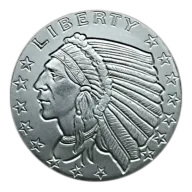
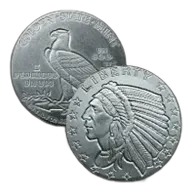
The 1/4 oz Incuse Indian silver round from Golden State Mint is the smallest commonly available size in a series that spans from 1/10 oz to 5 oz. The incuse format, where the design sits sunken below the flat surface rather than raised in relief, makes these rounds immediately identifiable among generic silver products. The technique traces back to the US $2.50 Quarter Eagle and $5 Half Eagle gold coins minted between 1908 and 1929, designed by Bela Lyon Pratt under a commission from President Theodore Roosevelt. Those federal coins were the only incuse-format coins the US Mint ever produced, and they were controversial from the start. The American Numismatic Association's official journal called them "a triumph of mediocrity" at launch. They are now among the most prized collectible US coins.
At 1/4 oz (7.78 g), this round sits at a price point that is accessible for regular, small-increment silver purchases. The fractional size serves buyers who prefer to add silver in smaller amounts over time rather than making fewer, larger purchases. In the silver market, where the per-ounce price is low enough that a 1/4 oz round costs only a few dollars of metal content, the fractional format is less about affordability and more about divisibility and flexibility.
Golden State Mint, established in 1974, operates from facilities in Southern California and Central Florida (headquarters in Sanford, Florida). The Incuse Indian is one of their flagship series, alongside the Aztec Calendar and several other themed designs. All silver Incuse Indians are struck in .999 fine with a reeded edge, carrying the Golden State Mint name on the reverse. The design adapts the original federal coin's Native American chief portrait on the obverse and standing eagle on the reverse, replacing government inscriptions with the mint's own markings.
1/4 oz Incuse Indian Silver Round Specifications
| Attribute | Value |
|---|---|
| Weight | 1/4 troy oz (7.78 g) |
| Purity | .999 fine silver |
| Manufacturer | Golden State Mint |
| Edge | Reeded |
| Face value | None (private mint round) |
| Design format | Incuse (sunken relief) |
Full Incuse Indian Size Range
| Size | Metal | Purity | Diameter |
|---|---|---|---|
| 1/10 oz | Silver | .999 | ~19 mm |
| 1/4 oz | Silver | .999 | Not published |
| 1/2 oz | Silver | .999 | Not published |
| 1 oz | Silver | .999 | 39.3 mm |
| 2 oz | Silver | .999 | Not published |
| 5 oz | Silver | .999 | Not published |
The 1 oz round, the most popular size in the series, measures 39.3 mm in diameter and 2.8 mm thick. Gold Incuse Indians are available in 1/10 oz and 1 oz at .9999 fine (four nines), with the 1 oz gold measuring 32.09 mm diameter and 2.19 mm thick. Copper versions span the same size range at .999 fine.
Security and Authentication
The Golden State Mint hallmark is stamped on each round along with exact weight and purity markings. The incuse design itself provides a modest counterfeit deterrent, as the sunken impression requires different tooling than standard raised-relief products. There are no serial numbers, micro-engraving, or optical verification features. Authentication relies on weight, dimensions, and metal-content testing via specific gravity, XRF, or the magnet slide test (silver's diamagnetic properties cause a rare earth magnet to slide slowly down a tilted surface).
Tax Treatment for the 1/4 oz Incuse Indian Silver Round
This round has no legal tender status and carries no face value. Tax treatment is determined by jurisdiction and silver purity.
United States
Sales tax exemptions cover approximately 35 states for investment bullion. At the 1/4 oz price point, threshold-based exemptions in states like California ($2,000), Florida ($500), and New York ($1,000) may not apply to individual purchases but would typically apply when buying in sufficient quantity. Golden State Mint states that the Incuse Indian is IRA-approved. The .999 purity meets IRS minimum requirements, though individual custodians set their own acceptance policies. Capital gains are taxed at the collectibles rate, up to 28% for holdings exceeding one year.
United Kingdom
Silver rounds carry 20% VAT on purchase. There is no CGT exemption for any private-mint silver product. The VAT burden makes fractional silver particularly expensive for UK buyers, as the tax applies to the full purchase price including the premium above spot. The margin scheme may reduce VAT on pre-owned rounds from registered dealers.
Canada
The .999 purity exceeds the 99.9% threshold for GST/HST exemption on investment-grade precious metals. Capital gains are subject to a 50% inclusion rate.
Australia, New Zealand, and Asia-Pacific
Australia exempts silver from GST at 99.9% purity. New Zealand exempts fine silver at 99.9% purity from its 15% GST, with no formal capital gains tax. Singapore exempts IPM-qualifying silver (99.9% purity) from its 9% GST. Hong Kong has no sales tax, import duty, or capital gains tax on bullion.
Incuse Indian vs Other 1/4 oz Silver Rounds
At the 1/4 oz weight, the main competitors are fellow Golden State Mint products: the 1/4 oz Aztec Calendar and the 1/4 oz Walking Liberty. All three share the same manufacturer, purity, and weight, so the comparison is purely about design and the functional characteristics of each format.
The Incuse Indian's defining advantage is physical durability during storage. Because the design elements sit below the flat rim surface, stacked rounds do not make design-to-design contact. The flat fields touch instead, leaving the images protected. This matters for silver, which tarnishes from hydrogen sulphide exposure and shows contact marks more readily than gold. The Walking Liberty and Aztec Calendar use conventional raised relief, meaning the highest points of the design contact adjacent rounds in a stack.
The Aztec Calendar round is the most visually complex of the three, with concentric rings of Mesoamerican symbols surrounding a central solar deity. The Incuse Indian is simpler in subject matter but more distinctive in execution, thanks to the sunken relief. The Walking Liberty is the most widely recognised design in the American bullion market, sharing its imagery with the American Silver Eagle.
Premiums at the 1/4 oz weight are proportionally higher than at 1 oz for all silver rounds, because the fixed costs of production, packaging, and shipping are spread across less metal value. A buyer purely focused on accumulating the most silver for the least money would be better served by 1 oz Incuse Indian rounds. The 1/4 oz exists for buyers who specifically want smaller units for divisibility, gradual accumulation, or collection building across the full size range.
Against sovereign-mint silver at the 1/4 oz weight, few options exist. Fractional silver coins from government mints are uncommon as standard bullion products. This makes the private-mint 1/4 oz round one of the only options for buyers who specifically need silver in this denomination.
1/4 oz Incuse Indian Silver Round: frequently asked questions
-
The cheapest 1/4 oz Incuse Indian silver round we track is $18.12, about 10.5% over the $65.79 silver spot price, from Defy The Grid. A quarter troy ounce of .999 silver has a metal value equal to one quarter of the silver spot price, with the dealer's premium added above that.
-
An incuse design is recessed into the surface rather than raised in relief. Where a conventional coin has images projecting above the flat field, an incuse piece has them sunken below it. The style was inspired by the 1908 US Indian Head gold coins designed by Bela Lyon Pratt. A practical benefit: the recessed design is shielded by the rim, reducing contact wear when rounds are handled or stacked.
-
Silver rounds are produced by private mints without government authorisation, so they carry no face value and no legal-tender status. Sovereign coins (Eagles, Britannias, Maple Leafs) cost more because buyers pay for the government guarantee, stricter quality standards, and often greater global resale liquidity. Rounds trade closer to silver spot because the premium is simpler: metal plus basic production, with no sovereign-mint mark-up.
-
Fractional silver rounds are typically sold in protective tubes that hold multiple pieces. Buying a full tube rather than singles often reduces the per-round premium slightly and keeps the rounds protected during storage and shipping. Check the listing or contact the dealer for the exact tube count, as quantities can vary.
-
It depends on where you buy. In the UK, silver bullion rounds carry 20% VAT. In Canada, investment-grade silver bullion meeting purity thresholds is exempt from GST/HST at 0%. In the US, sales tax on silver varies by state, with no federal rule. Australia exempts investment silver from GST at 0%. Check the rules for your country before buying.