1 listing
Filters
| Product | /oz | Premium | Price | |
|---|---|---|---|---|

 Golden State Mint
|
$72.20 | +6.76% | $72.20 | View Deal |
Prices are fetched automatically and may not reflect current merchant prices. Currency conversions and tax treatment are approximate. Rankings are based solely on price. We are not a dealer and accept no responsibility for transactions with listed merchants. Past performance is not indicative of future results. This site does not provide investment advice. Full disclaimer
About the 1 oz Incuse Indian Silver Round
The Golden State Mint Incuse Indian Round
The 1 oz Incuse Indian silver round from Golden State Mint is one of the few bullion products that can claim a genuinely distinctive physical characteristic. The design is incuse: sunken below the flat surface of the round rather than raised in relief. This means the flat field sits above the design elements, the reverse of how virtually every other coin and round in the bullion market is struck. The technique is borrowed from the original US $2.50 Quarter Eagle and $5 Half Eagle gold coins minted between 1908 and 1929, which remain the only incuse federal coins ever produced in the United States.
The original coins were designed by sculptor Bela Lyon Pratt at the instigation of William Sturgis Bigelow, and commissioned during Theodore Roosevelt's presidency as part of a broader effort to improve the artistic quality of American coinage. The design was controversial from the start: the American Numismatic Association's journal called it "a triumph of mediocrity," and the Mint's chief engraver, Charles Barber, openly opposed the concept. Critics worried that dirt would accumulate in the recessed design and spread disease, a concern that proved entirely unfounded. The coins ran for 21 years regardless, and they are now highly prized by numismatic collectors.
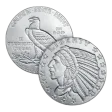
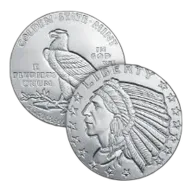
GSM's interpretation adapts the incuse concept for a modern bullion round. The obverse shows a Native American chief in a feathered headdress with "LIBERTY" above and stars, while the reverse features a standing eagle with "IN GOD WE TRUST," "E PLURIBUS UNUM," and "GOLDEN STATE MINT" inscriptions. The incuse format provides a practical benefit beyond aesthetics: because the design sits below the rim, stacked rounds do not press their design surfaces against each other, reducing contact marks and wear during storage. For stackers who store silver in tubes, this is a genuine functional advantage.
Incuse Indian Round Specifications
| Attribute | Value |
|---|---|
| Weight | 1 troy ounce (31.10 g) |
| Purity | .999 fine silver |
| Diameter | 39.3 mm |
| Thickness | 2.8 mm |
| Edge | Reeded |
| Face value | None (not legal tender) |
| Finish | Brilliant Uncirculated |
| Packaging | Individual flip, tube of 20, or monster box of 500 (25 tubes) |
Available Sizes and Metals
The Incuse Indian is available across an extensive range of sizes and metals:
- Silver (.999): 1/10 oz, 1/4 oz, 1/2 oz, 1 oz, 2 oz, 5 oz
- Gold (.9999): 1/10 oz, 1 oz
- Copper (.999): 1/4 oz, 1/2 oz, 1 oz, 2 oz, 5 oz
The gold version is notably struck at .9999 purity (four nines), matching the standard of sovereign coins like the Canadian Gold Maple Leaf. The incuse design is particularly effective at the larger 2 oz and 5 oz sizes, where the sunken detail has more visual impact. The copper versions are inexpensive novelty items under $5 retail, often used as starter pieces for new collectors or as gifts.
The incuse striking technique itself adds a subtle anti-counterfeiting dimension: reproducing a sunken impression requires different tooling than standard raised-relief designs, making casual counterfeiting marginally more difficult. GSM does not include serial numbers, micro-engraving, or other high-tech security features.
Tax Treatment of the Incuse Indian Silver Round
The Incuse Indian is a privately minted silver round with no legal tender status, no face value, and no sovereign backing. Standard silver bullion tax treatment applies worldwide.
United States
GSM lists the round as IRA-approved, and the .999 purity meets the IRS Section 408(m) requirement for silver in a precious metals IRA. Custodian acceptance varies for private-mint products. State sales tax varies widely: most states exempt bullion purchases. Capital gains are taxed at the collectibles rate of up to 28%.
United Kingdom
Silver rounds attract 20% VAT on purchase. CGT applies on disposal at 18% or 24%, with a £3,000 annual allowance. No CGT exemption applies to rounds, since they are not legal tender. The combination of VAT on entry and CGT on exit makes silver rounds a tax-inefficient choice for UK buyers compared to CGT-exempt silver Britannias.
Canada
GST/HST exempt at .999 purity. No provincial variation on this federal exemption for qualifying precious metals. Capital gains follow the standard 50% inclusion rate.
Australia and New Zealand
GST-free in both countries. Australia requires 99.9% purity for investment-grade silver exemption; New Zealand applies the same threshold. The .999 purity of the Incuse Indian round meets both.
Singapore and Hong Kong
Singapore's Investment Precious Metals scheme exempts qualifying silver from the 9% GST. Hong Kong levies no sales tax, import duty, or capital gains tax on bullion.
South Africa
Silver bullion attracts 15% VAT regardless of form or manufacturer. No exemption exists for silver in South Africa, unlike gold Krugerrands which are zero-rated.
From Roosevelt's Controversial Coins to a Modern Bullion Round
The incuse concept has an unexpectedly dramatic origin. In the early 1900s, President Theodore Roosevelt was dissatisfied with the artistic quality of American coinage and personally championed a series of redesigns. The $2.50 and $5 gold coins received the most radical treatment: sculptor Bela Lyon Pratt created designs that were struck into the coin's surface rather than raised above it, a technique that had no precedent in US federal coinage. The idea was conceived by William Sturgis Bigelow, a physician and art collector who had studied Japanese metalwork, where incuse techniques were more common.
The reaction was fierce. Charles Barber, the US Mint's chief engraver, opposed the design and reportedly attempted to sabotage it during production. Numismatists were divided; some praised the artistic departure, others called it a step backward. The hygiene argument, that recessed surfaces would harbour germs, gained surprising traction despite having no scientific basis. The coins entered circulation in 1908 regardless and were minted continuously until 1929, producing a total of approximately 15 million Quarter Eagles and 7 million Half Eagles across all years.
Today, the 1908-1929 incuse Indian Head gold coins are among the most collected US coins of their era. Their value on the numismatic market far exceeds their gold content. The GSM Incuse Indian round captures the aesthetic of these coins in a modern bullion format at a fraction of the cost, making the design accessible to silver stackers who might never own a $2,000+ numismatic original.
Incuse Indian vs Other 1 oz Silver Rounds
The incuse striking technique is the defining feature that separates this round from everything else in its price category. Every other major private-mint round, from the Buffalo to the Aztec Calendar to the GSM Silver Eagle, uses conventional raised-relief striking. The sunken design gives the Incuse Indian a visual distinction that is immediately apparent and a tactile quality that feels different in the hand.
The practical advantage of incuse striking is real: when rounds are stacked in a tube, the raised rim protects the recessed design from contact with adjacent pieces. Standard rounds press their raised designs against each other, creating the contact marks that accumulate over time. This matters most for long-term storage in tubes, which is how the majority of silver rounds are held.
Against the 1 oz Asahi Buffalo, the Incuse Indian trades LBMA institutional credibility for design distinctiveness. Both are .999 fine and sit in the same premium tier. The Asahi round is the stronger choice for IRA inclusion and institutional contexts; the Incuse Indian is the stronger choice for buyers who value visual and physical uniqueness in their stack.
The 1 oz Scottsdale Cowboy represents a different kind of premium private-mint round. Its .9999 purity, buffalo privy mark, and radial security lines make it a more technically sophisticated product. The Cowboy round costs slightly more per ounce, and whether that premium is justified depends on how much the buyer values the higher purity and security features versus the Incuse Indian's unique striking method.
For buyers considering a step up to sovereign coins, the 1 oz Silver Philharmonic provides the lowest-premium entry into government-backed silver. The premium gap between the Philharmonic and the Incuse Indian round is modest, and the coin's legal tender status, sovereign mint backing, and deeper international liquidity make it the more defensible choice for buyers who prioritise resale certainty over purchase cost.
1 oz Incuse Indian Silver Round: frequently asked questions
-
The metal value of a 1oz Incuse Indian silver round tracks the silver spot price closely. Dealers on this page are currently offering it from $72.20, about 6.8% over the $67.63 silver spot price. Check the table above for live pricing across multiple dealers.
-
Incuse means the design is recessed into the surface of the round rather than raised in relief. The Incuse Indian design takes its cue from the original 1908-1929 US Indian Head gold coins, which were the only incuse federal coins the US Mint ever produced. The sunken format also shields the design from contact wear during handling and stacking.
-
Yes. The 1oz Incuse Indian round is struck in 999 fine silver, containing one full troy ounce (31.10 g) of silver. Golden State Mint stamps the weight and purity on the round alongside its maker's mark.
-
Start with a weight check: a genuine 1oz round should weigh 31.1 g on a precise scale. Silver is not magnetic, so a strong magnet should produce no stick or slide. A ring or ping test can indicate a hollow counterfeit. For certainty, buy from an established bullion dealer and consider XRF or Sigma Metalytics testing for high-value purchases.