 Ainslie Bullion
4 listings
Filters

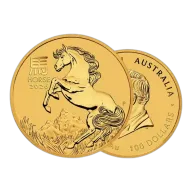

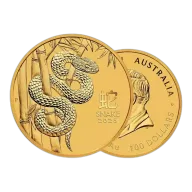

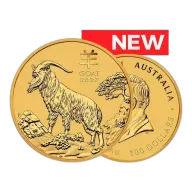

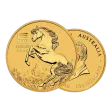
Prices are fetched automatically and may not reflect current merchant prices. Currency conversions and tax treatment are approximate. Rankings are based solely on price. We are not a dealer and accept no responsibility for transactions with listed merchants. Past performance is not indicative of future results. This site does not provide investment advice. Full disclaimer
About the 1 oz Perth Mint Lunar Gold Coin
The 1oz Gold Lunar: Bullion With a Sellout Habit
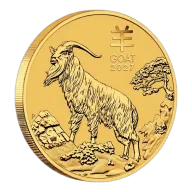
The 1 oz gold Lunar is the flagship of the Perth Mint's Lunar program, the first bullion series from a major mint built around the Chinese zodiac. Launched in 1996 with the Year of the Mouse, it has run through complete 12-year cycles ever since: Series I (1996-2007), Series II (2008-2019) and the current Series III (2020-2031). Each year carries a new reverse design for that year's zodiac animal, struck in 99.99% fine gold with a $100 AUD face value.
What separates the gold Lunar from fixed-design bullion is controlled supply meeting cyclical demand. Unlike the unlimited-mintage 1oz gold Kangaroo, Lunar mintages are managed, and 1 oz gold coins sell out in many years. Dragon years (2000, 2012, 2024) are the perennial fast sellers, reflecting the dragon's status in Chinese culture, and early Series I coins from 1996-1999 trade at substantial premiums over spot. That gives the coin a dual character: it works as a straight gold purchase at the metal's value, with the possibility that the right year appreciates above it.
Series III coins add the program's first meaningful security package: a micro-laser engraved letter detectable under magnification, a "P" mintmark worked into the reverse, and a precision-machined radial line background. The series was designed for Asia-Pacific demand, particularly China, Hong Kong, Singapore and Malaysia, where the zodiac connection sustains a structurally deeper market than most western collector themes. The trade-off is price: the Lunar commands higher premiums than fixed-design coins of identical purity, so it suits buyers who value the design cycle and collectibility, not those chasing the cheapest ounce.
Gold Lunar Specifications and Denominations
All gold Lunar coins are 99.99% fine across all three series, with the 1 oz coin the core denomination of a ladder that has grown to nine sizes.
| Denomination | Face value (AUD) | Weight | Diameter |
|---|---|---|---|
| 1/20 oz | $5 | 1.556 g | 14.1 mm |
| 1/10 oz | $15 | 3.111 g | 16.1 mm |
| 1/4 oz | $25 | 7.777 g | 20.1 mm |
| 1/2 oz | $50 | 15.554 g | 25.1 mm |
| 1 oz | $100 | 31.112 g | 32.1 mm |
| 2 oz | $200 | 62.215 g | 40.6 mm |
| 10 oz | $1,000 | 311.067 g | 60.3 mm |
| 1 kg | $3,000 | 1,001.1 g | 75.3 mm |
| 10 kg | $30,000 | 10,001 g | 180 mm |
The 2 oz, 10 oz and 1 kg sizes were added from 2000, the 1/2 oz in 2004 and the 10 kg in 2006, and not all sizes are produced every year. All denominations have a reeded edge. The coins are Australian legal tender under the Currency Act 1965, with symbolic face values far below metal value. Series III adds the micro-laser engraved letter, "P" mintmark and radial line background; Series I and II coins have no advanced security features, so older coins are authenticated on weight, dimensions and strike quality. A matching 1oz silver Lunar carries the same annual designs.
Gold Lunar Tax Treatment by Country
At 99.99% fine, the gold Lunar qualifies as investment gold in every major jurisdiction.
- Australia: GST-free as investment-grade gold (99.5%+ purity). Bullion is subject to CGT on disposal, with a 50% discount for individuals and trusts holding 12 months or more; there is no Australian CGT exemption for legal tender bullion. Goods exported by the Perth Mint are GST-free regardless.
- UK: VAT-free as investment gold, but not CGT-exempt, since only coins with a sterling face value qualify; the Royal Mint's UK lunar coins are the CGT-exempt zodiac alternative for UK sellers. The Perth Lunar remains popular with UK collectors seeking variety beyond Britannias.
- USA: IRA-eligible at 99.99% fine, held by an approved custodian. Gains are taxed as collectibles at a maximum 28% federal rate. Most states exempt bullion from sales tax.
- Canada: GST/HST-exempt as qualifying 99.5%+ bullion, and can be held in RRSPs through qualifying dealers.
- EU: Gold coins on the EU's annual gold coins list are VAT-exempt, and Perth Lunar gold coins typically appear on it.
- New Zealand: GST-exempt as gold of at least 99.5% purity in coin form.
- Singapore and Hong Kong: Singapore exempts qualifying investment-grade gold from GST and Hong Kong levies no sales tax; neither taxes capital gains. These are core Lunar markets, and the most tax-efficient places to buy and hold the coin.
The First Western Zodiac Bullion Series
The Perth Mint launched the gold Lunar in 1996, becoming the first major western mint to build a precious metal program around the Chinese lunar calendar. The logic was geographic: the zodiac's cultural weight in China, Hong Kong, Singapore and Malaysia gave Australia's bullion mint a product tailored to its nearest export markets, years before other mints copied the formula. Silver joined in 1999 and platinum has been added in limited runs, with the gold coin the constant across all three series.
Each 12-year cycle has its own character. Series I (1996-2007) used simpler, traditional designs with a distinctive pimpled border, stylised clouds and the Chinese character for each animal. Series II (2008-2019) brought more complex compositions, some years showing multiple animals on the reverse. Series III (2020-2031) carries the most intricate designs yet, setting each animal among landscape elements, and introduced the program's security features: micro-laser engraving, the "P" mintmark and radial line backgrounds. Obverse portraits have tracked the monarchy through Maklouf, Rank-Broadley and Clark effigies of Queen Elizabeth II to King Charles III from 2024.
The program's scarcity stories are concentrated early and at the extremes. Series I coins from 1996-1999 are significantly scarcer than later years and command substantial premiums, and the 2007 Year of the Pig 10 kg gold coin was struck in a mintage of just six pieces, among the rarest modern bullion coins ever made. Dragon years sell out fastest in every cycle. The result is a bullion series with a genuine secondary-market history, where year and animal matter to price in a way they simply do not for fixed-design coins.
Gold Lunar vs Panda, Kangaroo, Britannia and Maple Leaf
The Chinese Gold Panda (1982) is the closest thematic rival: annually changing designs with Chinese cultural pull. The differences are concrete. The Lunar is 99.99% fine against the Panda's 99.9%; the Lunar stays in troy ounces while the Panda moved to metric sizing in 2016 (30 g replacing 1 oz); and Panda mintages run higher in most years, against the Lunar's more controlled production. Both have strong collector demand, but the Lunar's supply discipline supports its premiums more consistently.
In-house, the gold Kangaroo is the value alternative: identical .9999 purity from the same mint, unlimited mintage, lower premium, with its own annual design change. The Lunar's tighter mintages and zodiac demand are what buyers pay extra for; many years of the 1 oz gold Lunar sell out, which the demand-produced Kangaroo never needs to.
Against the Britannia, both are 99.99% gold, and the Britannia's four security features from 2021 outclass the Lunar's 2020-era package. The Britannia is CGT-exempt for UK sellers, which the Lunar is not, and has unlimited mintage. The Lunar's case is collector upside; the Britannia's is UK tax efficiency.
The Canadian Maple Leaf offers the same purity with Bullion DNA anti-counterfeiting and unlimited mintage at lower premiums; the Lunar commands more because of collectibility. The American Gold Eagle is the liquidity king in the US but is 22-karat with a fixed design, leaving the Lunar as a niche product there. Buyers who want the zodiac cycle at a smaller outlay can start with the 1/4 oz gold Lunar before committing to the full ounce.
1 oz Perth Mint Lunar Gold Coin: frequently asked questions
-
The cheapest 1 oz Perth Lunar gold coin tracked on this page is A$6,433.35 from Ainslie Bullion, across 2 dealers compared. The annual design change means each year's coin is a distinct product, so prices can vary between issues depending on year and availability.
-
Dealers currently charge around 5.3% over the A$6,109.19 gold spot price for the 1 oz Perth Lunar. The Lunar series commands a higher premium than plain bullion coins because of its annual design changes and controlled mintages, which give it collector appeal alongside its gold content.
-
The Perth Mint Lunar series follows the 12-year Chinese zodiac cycle across three consecutive series: Series I (1996-2007), Series II (2008-2019), and Series III (2020-2031). The twelve animals are the Rat, Ox, Tiger, Rabbit, Dragon, Snake, Horse, Goat, Monkey, Rooster, Dog, and Pig. Each year's coin carries a new reverse design featuring that year's animal.
-
Yes. The 1 oz Perth Lunar is struck in 999.9 fine gold (1 oz), the four-nines standard equivalent to 24 carat. All three series of Perth Lunar gold coins have maintained 99.99% purity since the program began in 1996.