 Ainslie Bullion



Prices are fetched automatically and may not reflect current merchant prices. Currency conversions and tax treatment are approximate. Rankings are based solely on price. We are not a dealer and accept no responsibility for transactions with listed merchants. Past performance is not indicative of future results. This site does not provide investment advice. Full disclaimer
About the 1 oz South African Mint Krugerrand Silver Coin
The Silver Krugerrand: A Modern Extension of a Historic Brand
The 1 oz Silver Krugerrand was introduced in 2017 to mark the 50th anniversary of the original gold Krugerrand, the coin that created the modern bullion market in 1967. Struck by the South African Mint in .999 fine silver with a face value of R1, it extended the world's most recognised bullion coin brand into a new metal for the first time.
The gold Krugerrand had been the dominant force in global gold bullion for decades. By 2017, over 53 million troy ounces of gold Krugerrands had been sold, comprising more than 60 million individual coins. The silver version arrived into a crowded field of established competitors, including the 1 oz Silver Maple Leaf, the 1 oz Silver Britannia, and the 1 oz Silver Philharmonic, but the Krugerrand name carried enough global recognition to secure immediate market acceptance.
Unlike the 22-karat gold Krugerrand (which weighs 33.93g to contain exactly 1 troy oz of fine gold within its copper alloy), the Silver Krugerrand is .999 pure silver weighing exactly 31.1g. It was also the first Krugerrand to carry a face value denomination. Gold Krugerrands have never had a face value; their legal tender status in South Africa is based on gold content value.
The debut production run in 2017 consisted of 1,000,000 Premium Uncirculated coins and 15,000 proof editions. Annual production has continued since, establishing the Silver Krugerrand as a regular part of the South African Mint's bullion lineup alongside a platinum Krugerrand (also introduced in 2017, struck in .999 platinum with a R10 face value).
Silver Krugerrand Dimensions and Details
| Attribute | Value |
|---|---|
| Weight | 31.1 g (1 troy oz) |
| Purity | .999 fine silver |
| Diameter | 38.7 mm |
| Thickness | 2.84 mm |
| Face Value | R1 (South African Rand) |
| Edge | Reeded (180 serrations) |
| Obverse | Paul Kruger portrait (designed by Otto Schultz) |
| Reverse | Springbok antelope (designed by Coert Steynberg) |
| First Year | 2017 |
| 2017 Mintage | 1,000,000 (Premium Uncirculated) + 15,000 (Proof) |
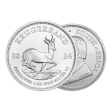
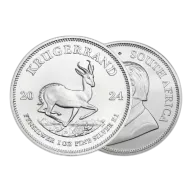
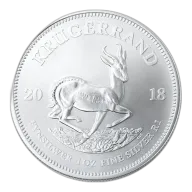
The design is essentially identical to the gold Krugerrand that has remained unchanged since 1967. The obverse shows the portrait of Paul Kruger, President of the South African Republic, with "SUID-AFRIKA" and "SOUTH AFRICA" in the two official languages used at the time. The reverse depicts a springbok antelope in mid-leap, South Africa's national animal, with "KRUGERRAND" above and the silver weight below.
The 180-serration reeded edge on bullion coins is distinct from the 220 serrations on proof editions, providing a tactile and visual method to distinguish the two grades. This detail is specific to the Krugerrand; most other bullion coins do not differentiate edge serration counts between grades.
The gold Krugerrand's 22-karat composition was originally chosen to match the historic British Sovereign, providing durability for a coin that was expected to circulate and be handled frequently. The silver version adopted the modern .999 standard instead, aligning with contemporary silver bullion norms rather than replicating the alloy approach. This means the silver coin weighs exactly 31.1g (its entire mass is silver content), unlike the gold version where the 1 oz coin weighs 33.93g to accommodate the copper alloy while containing exactly 1 oz of fine gold.
Silver Krugerrand Tax Treatment by Country
The Silver Krugerrand's tax treatment differs significantly from the gold version in several key markets.
- South Africa: Gold Krugerrands are zero-rated for VAT under the Value-Added Tax Act. This exemption does not extend to the Silver Krugerrand, which is subject to 15% VAT. Platinum Krugerrands also attract 15% VAT. Capital gains tax applies at a 40% inclusion rate for individuals.
- United Kingdom: Subject to 20% VAT on purchase. Not CGT-exempt (not UK legal tender). This is the critical distinction for UK buyers: the Silver Britannia provides CGT exemption that the Krugerrand cannot. The margin scheme applies to pre-owned Silver Krugerrands.
- United States: IRA-eligible. The Silver Krugerrand is specifically approved under IRS regulations, matching the gold version's status. Sales tax varies by state, with approximately 35 states exempting bullion. Capital gains taxed at the 28% collectibles rate.
- Canada: Silver Krugerrands are subject to GST/HST (the .999 purity meets the threshold, but provincial rules vary). Capital gains taxed at a 50% inclusion rate.
- European Union: Silver subject to local VAT rates. Gold Krugerrands are listed on the EU investment gold coin list and are VAT-exempt; the silver version is not covered by this exemption. Margin scheme available in Germany and the Netherlands for pre-owned coins.
- Australia: .999 silver meets the 99.9% purity threshold for GST-free treatment. Capital gains tax applies with a 50% discount for holdings over 12 months.
- Singapore: GST-exempt as an Investment Precious Metal at .999+ purity. No capital gains tax.
- Hong Kong: No sales tax, no import duty, no capital gains tax.
From 1967 Gold Pioneer to 2017 Silver Expansion
The Krugerrand's history begins on 3 July 1967, when the South African Mint struck the first modern gold bullion coin designed specifically for individual investment. The initial run was 40,000 bullion coins and 10,000 proof editions. By 1980, the Krugerrand accounted for more than 90% of the global gold coin market, a dominance that has never been matched by any other bullion product.
The apartheid-era sanctions that began in the 1970s disrupted the Krugerrand's supremacy. The United States enacted an import ban in 1985, and wider international restrictions followed. These sanctions created the opening that allowed the Canadian Maple Leaf (launched 1979), the American Eagle (1986), and the Silver Britannia (1997) to establish themselves as alternatives. After sanctions were lifted in 1991, the Krugerrand never regained its overwhelming market share, but it remained the most widely distributed gold bullion coin in history.
The silver version's 2017 launch marked the 50th anniversary of the original gold coin. It was joined by a platinum Krugerrand, making 2017 the year the Krugerrand brand expanded from a single-metal coin to a three-metal range. The 2017 silver debut production of over 1 million Premium Uncirculated coins was a confident statement of the brand's market power, and annual production has continued since.
The Krugerrand lacks modern anti-counterfeiting features (no micro-engraving, latent images, or digital authentication). Its security relies on the high-relief design detail, precise specifications, and the 180-serration reeded edge (versus 220 on proof editions, providing a way to distinguish the two grades). This absence of technology-based security is a notable contrast to the Britannia and Maple Leaf.
Silver Krugerrand vs Britannia, Maple Leaf, and Philharmonic
The Silver Krugerrand trades on brand recognition more than any technical advantage. At .999 purity, it matches the Silver Britannia and Silver Philharmonic but falls behind the Silver Maple Leaf (.9999) and the Perth Kangaroo (.9999) on purity.
Against the Silver Britannia, the Krugerrand lacks CGT exemption for UK buyers and the Britannia's security features. In the UK market, the Britannia is the clear choice for tax-conscious investors. Internationally, the Krugerrand name is arguably more widely recognised, particularly in the US and South African markets.
Against the Silver Maple Leaf, the Krugerrand gives up higher purity (.9999 vs .999), the Bullion DNA verification system, and MintShield anti-tarnish coating. The Maple Leaf is the more technically advanced coin. The Krugerrand's advantage is brand heritage and, in many markets, comparable or lower premiums.
Against the Silver Philharmonic, the two coins are closely matched: same .999 purity, similar absence of advanced security features, and competitive premiums. The Philharmonic often has a slight price advantage in European markets, while the Krugerrand has stronger distribution in Africa and parts of North America.
The Krugerrand's unique characteristic among major silver coins is the design continuity with the 1967 gold original. The Paul Kruger portrait and springbok design are unchanged across nearly six decades, giving the silver coin an inherited visual identity that no other recently launched silver bullion series can claim. For buyers who already hold gold Krugerrands, adding the silver version maintains a consistent aesthetic across their collection.
1 oz South African Mint Krugerrand Silver Coin: frequently asked questions
-
The cheapest 1oz silver Krugerrand tracked across dealers is A$107.56 from Ainslie Bullion, around 14.8% over the A$93.73 silver spot price. Prices move with silver daily, so the live figures above reflect current market conditions.
-
Yes. The 1oz silver Krugerrand is 999 fine silver, weighing 31.1035 g. This is distinct from the gold Krugerrand, which is 22-carat (91.67% gold) alloyed with copper for durability. The silver version, first issued in 2017, uses .999 fine silver with no added alloy.
-
Silver Krugerrands were first issued in 2017 to mark the 50th anniversary of the original gold Krugerrand, which launched in 1967. The 2017 issue had a mintage of one million premium uncirculated coins plus 15,000 proof editions. Annual production has continued since, with the same Paul Kruger and Springbok design as the gold version.
-
Yes, it is a separate coin. The silver Krugerrand was introduced in 2017 and is struck in .999 fine silver, unlike the gold version which has been produced since 1967 in 22-carat alloy. Both share the same obverse portrait of Paul Kruger and the Springbok reverse. The silver version carries a R1 face value; gold Krugerrands carry no face value denomination.
-
In the UK, silver Krugerrands are subject to Capital Gains Tax; they are South African legal tender, not UK legal tender, so the UK CGT exemption that applies to Britannias and Sovereigns does not extend to them. UK gains above the annual allowance of £3,000 are taxed at 18% (basic rate) or 24% (higher rate). In the US, gains are taxed at up to 28% as collectibles; in Canada, 50% of any gain is included in taxable income.